Skip to content
Epomedicine

Mnemonics, Simplified Concepts & Thoughts

Epomedicine

Mnemonics, Simplified Concepts & Thoughts

depression

Depression Criteria Mnemonic

Dr. Sulabh Kumar Shrestha, MS Orthopedics, Nov 3, 2016Apr 1, 2026

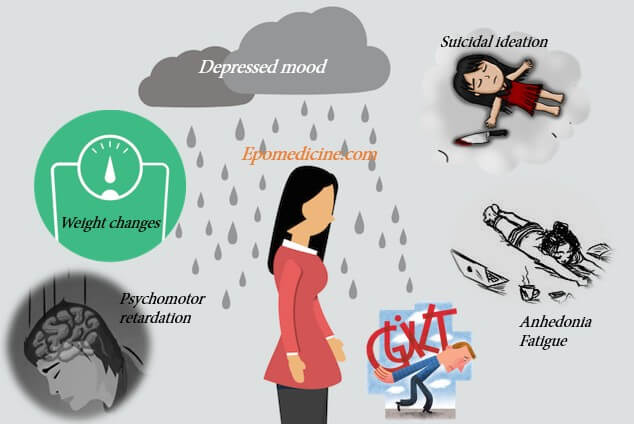
Mnemonic: DEPRESSION

Major symptoms

  1. Depressed mood
  2. Energy loss or fatigue
  3. Pleasure loss or anhedonia

Minor symptoms

  1. Retardation or agitation (psychomotor)
  2. Eating and weight change (at least 5% in the last month)
  3. Sleep changed – insomnia or hypersomnia
  4. Suicidial ideation or behavior
  5. I‘m a failure (Loss of confidence or self-esteem)
  6. Only me to blame (guilt)
  7. No concentration, Indecisiveness or inability to think
depression

Alternative mnemonic: SIGECAPS

  1. Sad/depressed mood
  2. Interest reduced/anhedonia
  3. Guilt/worthlessness
  4. Energy reduced/easy fatiguability
  5. Concentration reduced (pseudodementia)
  6. Appetite (weight change >5% in a month)
  7. Psychomotor retardation/agitation
  8. Suicidal thoughts or acts
  9. Sleeping disturbances

Criteria for Major Depressive Disorder

  1. Duration: ≥2 weeks, most of the day, nearly every day
  2. Organic causes must be excluded: not attributable to the abuse of psychoactive substances or to an organic mental disorder.
  3. ICD-11 criteria vs DSM-V criteria: While ICD-10 criteria recognizes loss of energy or fatigue as a major or key symptoms, DSM-V and ICD-11 doesn’t recognize it as a key symptom. Hence, DSM-V has only 2 key symptoms.
    • “Loss of confidence or reduced self-esteem” is there in ICD-10/11 criteria (total 10 symptoms) but not there in DSM-V criteria (total 9 symptoms).
    • Diagnosis by DSM-V and ICD-11: ≥5 symptoms with ≥1 of the 2 key symptoms – “S” or “I” symptoms from SIGECAPS or “D” or “P” symptoms from DEPRESSION mnemonic
    • Diagnosis by ICD-10: ≥2 of the 3 key symptoms – “S”, “I” or “E” symptoms from SIGECAPS or “D”, “E” or “P” symptoms from DEPRESSION mnemonic + ≥2 of other symptoms

Grading of Depression

Unlike in the ICD-10, grading of depression into mild, moderate and severe is not based on the sum of the symptoms, but also takes into account their intensity and the degree of functional impairment in addition to the number of symptoms.

dr. sulabh kumar shrestha
Dr. Sulabh Kumar Shrestha, MS Orthopedics

He is the section editor of Orthopedics in Epomedicine. He searches for and share simpler ways to make complicated medical topics simple. He also loves writing poetry, listening and playing music. He is currently pursuing Fellowship in Hip, Pelvi-acetabulum and Arthroplasty at B&B Hospital.
5 shares
  • Facebook5
  • Twitter
PGMEE, MRCS, USMLE, MBBS, MD/MS Nervous systemPsychiatry

Post navigation

Previous post
Next post

Related Posts

PGMEE, MRCS, USMLE, MBBS, MD/MS

Fasciae of the Neck

Apr 29, 2024Apr 29, 2024

Superficial cervical fascia Contents: Deep cervical fascia or Fascia colli 1. Investing layer 2. Pretracheal layer 3. Carotid sheath: Formed anteriorly by pretracheal fascia and posteriorly by prevertebral fascia Encloses: Relations: 4. Pharyngobasilar fascia (deep to pharynx): lines the inner surface of pharyngeal muscles 5. Prevertebral layer Spread of Infections…

Read More
PGMEE, MRCS, USMLE, MBBS, MD/MS cephalosporins

Cephalosporin Pharmacology – Mnemonics

May 16, 2014Jan 3, 2023

Cephalosporins are one of the most widely prescribed antimicrobial drugs. They can be classified into 5 to generations and the medical students often have hard time remembering the names of drugs falling into different generations as the names appear and sound similar. This is a collection of mnemonics from different…

Read More
PGMEE, MRCS, USMLE, MBBS, MD/MS medial brainstem syndrome

Medial Medullary (Dejerine’s) Syndrome : Anatomical basis mnemonic

Jan 22, 2016Oct 26, 2022

As already discussed in the previous section about Lateral Medullary (Wallenberg) Syndrome: 6 “S” pass/lie on the Side (latetral) of Medulla Except the anteromedian part supplied by vertebral artery, rest of the medulla is supplied by PICA Let us now review the relevant anatomy and physiology of the medial portion…

Read More

Leave a Reply Cancel reply

Your email address will not be published. Required fields are marked *

This site uses Akismet to reduce spam. Learn how your comment data is processed.

Shrestha SK. Depression Criteria Mnemonic [Internet]. Epomedicine; 2016 Nov 3 [cited 2026 Jun 5]. Available from: https://epomedicine.com/medical-students/depression-criteria-mnemonic/.

Pre-clinical (Basic Sciences)

Anatomy

Biochemistry

Community medicine (PSM)

Embryology

Microbiology

Pathology

Pharmacology

Physiology

Clinical Sciences

Anesthesia

Dermatology

Emergency medicine

Forensic

Internal medicine

Gynecology & Obstetrics

Oncology

Ophthalmology

Orthopedics

Otorhinolaryngology (ENT)

Pediatrics

Psychiatry

Radiology

Surgery

RSS Ask Epomedicine

  • What to study for Clinical examination in Orthopedics?
  • What is the mechanism of AVNRT?

Epomedicine weekly

  • About Epomedicine
  • Contact Us
  • Author Guidelines
  • Submit Article
  • Editorial Board
  • USMLE
  • MRCS
  • Thesis
©2026 Epomedicine | WordPress Theme by SuperbThemes