Skip to content
Epomedicine

Mnemonics, Simplified Concepts & Thoughts

Epomedicine

Mnemonics, Simplified Concepts & Thoughts

Trauma Scoring Systems

Epomedicine, Mar 26, 2025Mar 26, 2025
trauma scoring
Bairagi, A. (2016). Injury Severity Score (ISS) versus New Injury Severity Score (NISS) at a level one trauma unit in South Africa. Are we miss (Maximal Injury Severity Score) ing the point.
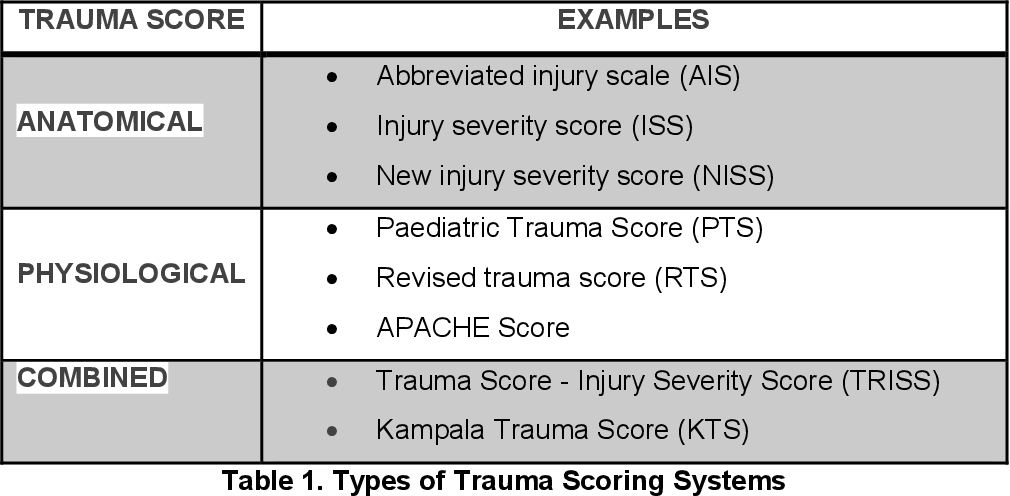
Scoring systemsScore typeBrief descriptionScore interpretation
Revised trauma score (RTS)PhysiologicRR + SBP + GCSEach parameter is scored 0-4 (Total range = 0-12)

Lower score indicates more severe injury (RTS 12 = <1% mortality; RTS 0 = >99% mortality)

Score <11 – transfer to trauma center
Injury severity score (ISS)AnatomicBody divided into 6 regions (head, face, chest, abdomen, extremities including pelvis & external) & each injury is assigned the AIS (1-6)Sum of the square of 3 highest scoring regions

Highest score is 75 (5² + 5² + 5²)

AIS of 6 is regarded as unsurvivable (automatically gets score of 75)
New injury severity score (NISS)AnatomicEach injury assigned a severity from 1 to 6, allowing multiple injuries in a body region to be consideredSum of the square of 3 highest AIS irrespective of body regions
Trauma & Injury severity score (TRISS)CombinedAttempts to predict mortality by combining anatomic and physiological derangementsCalculates a probability of survival based on logistic regression of RTS, ISS & age
  • Facebook
  • Twitter
PGMEE, MRCS, USMLE, MBBS, MD/MS General conceptsOrthopedics

Post navigation

Previous post
Next post

Related Posts

PGMEE, MRCS, USMLE, MBBS, MD/MS

Dupuytren’s contracture : Mnemonics

Apr 20, 2023Apr 20, 2023

Associations of Dupuytren’s Contracture Mnemonic: DEAFEST LIAR Dupuytren’s diathesis Mnemonic: ABCDEF Severity and recurrence risk is increased in: If all 6 diathesis risk factors are present: risk of recurrence is 71% If none of diathesis risk factors are present: risk of recurrence is 23% Involvement of fingers Mnemonic: RaSMIT In…

Read More
PGMEE, MRCS, USMLE, MBBS, MD/MS lysosomal storage disorders

Lysosomal Storage Disorders Made Easy

Jan 22, 2017Jul 29, 2018

Among the common lysosomal storage disorders: Two of them are Mucopolysaccharidoses (Hunter and Hurler syndrome) Pompe’s disease is Glycogen Storage Disease. Others are Sphingolipidoses. Inheritance of Lysosomal Storage Diseases All are inherited as Autosomal Recessive (AR) condition except: Hunter syndrome (X-linked recessive) Fabry’s disease (X-linked recessive) Higher risk in Ashkenazi…

Read More
PGMEE, MRCS, USMLE, MBBS, MD/MS hematopoiesis

Hematopoietic growth factors list with mnemonics

May 23, 2019May 23, 2019

a. SCF (Steel factor): Multipontent stem cells b. IL-3: Myeloid stem cells (“3” turned down looks like “m“) c. IL-7: Lymphoid stem cell (“L” turned up looks like “7“) d. GM-CSF (Granulocyte macrophage Colony stimulating factor): Myeloid lineage (Erythrocytes, Thrombocytes, Granulocytes and Monocytes) Pharmaceutical: Sargramostim e. G-CSF: Granulocytes (Neutrophil, Eosinophil,…

Read More

Leave a Reply Cancel reply

Your email address will not be published. Required fields are marked *

This site uses Akismet to reduce spam. Learn how your comment data is processed.

Pre-clinical (Basic Sciences)

Anatomy

Biochemistry

Community medicine (PSM)

Embryology

Microbiology

Pathology

Pharmacology

Physiology

Clinical Sciences

Anesthesia

Dermatology

Emergency medicine

Forensic

Internal medicine

Gynecology & Obstetrics

Oncology

Ophthalmology

Orthopedics

Otorhinolaryngology (ENT)

Pediatrics

Psychiatry

Radiology

Surgery

RSS Ask Epomedicine

  • What to study for Clinical examination in Orthopedics?
  • What is the mechanism of AVNRT?

Epomedicine weekly

  • About Epomedicine
  • Contact Us
  • Author Guidelines
  • Submit Article
  • Editorial Board
  • USMLE
  • MRCS
  • Thesis
©2026 Epomedicine | WordPress Theme by SuperbThemes