Skip to content
Epomedicine

Mnemonics, Simplified Concepts & Thoughts

Epomedicine

Mnemonics, Simplified Concepts & Thoughts

Casting technique related Radiographic indices

Epomedicine, Jul 5, 2020Jul 5, 2020
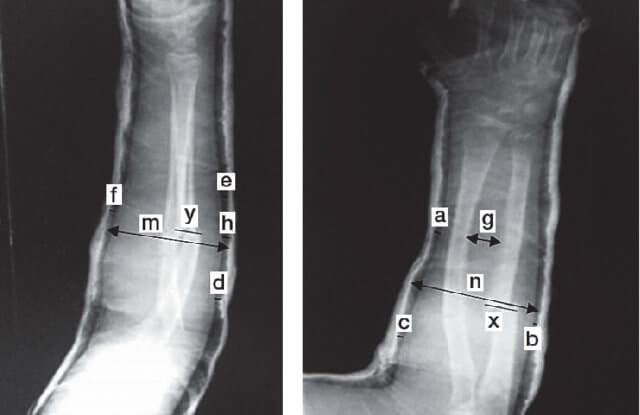
casting related indices
Source: Asadollahi S, Pourali M, Heidari K. Predictive factors for re-displacement in diaphyseal forearm fractures in children-role of radiographic indices. Acta Orthop. 2017 Feb;88(1):101-108. doi: 10.1080/17453674.2016.1255784. Epub 2016 Nov 14. PMID: 27841692; PMCID: PMC5251255. [CC-BY NC]

Cast index

Formula: Inner diameter of cast on lateral view (m) / Inner diameter of cast on AP view (n)

Cut-off: 0.7-0.8

Padding index

Formula: Dorsal fracture site gap (h) / Maximum interosseous length in AP view (g)

Cut-off: 0.3

Cantebury index

Formula: Cast index (m/n) + Padding index (h/g)

Cut-off: 1.1

Three Point Index (TPI)

[(distal radial gap + ulnar fracture site gap + proximal radial gap) divided by the contact between fracture fragments in transverse projection] + [(distal dorsal gap + volar fracture site gap + proximal dorsal gap) divided by the contact between fracture fragments in sagittal projection]
i.e. [(a+b+c)/x] + [(d+e+f)/y]

Cut-off: 0.8

Original Three Point Index
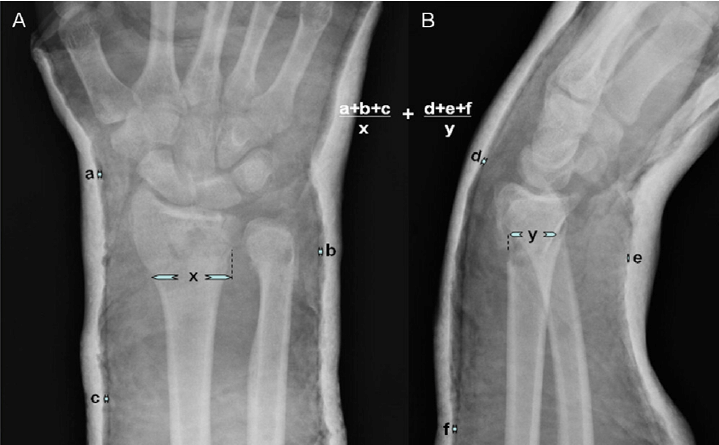
original three point index

The formula for the three-point index is [( a + b + c )/ x ] + [( d + e + f )/ y ].

(A) On the anteroposterior radiograph, ‘‘a’’ is the narrowest distal radial side gap at the level of radiocarpal or proximal carpal joint, ‘‘b’’ is the narrowest ulnar-side gap at the level of the fracture (within 1 cm of the fracture line), and ‘‘c’’ is the narrowest proximal radial side gap within the area between 3-7 cm proximal to the fracture site. ‘‘x’’ is the projection of the contact length between the proximal and distal fragments in the horizontal plane on the anteroposterior radiograph.

(B) On the lateral radiograph of an extension-type fracture, ‘‘d’’ is the narrowest distal dorsal-side gap at the level of the radiocarpal joint or proximal carpal bones, ‘‘e’’ is the narrowest volar-side gap within 1 cm of the level of the fracture line, and ‘‘f’’ is the narrowest proximal dorsal-side gap within the area between 3-7 cm of the fracture site. ‘‘y’’ is the projection of the contact length between the proximal and distal fragments in the sagittal plane on the lateral radiograph.
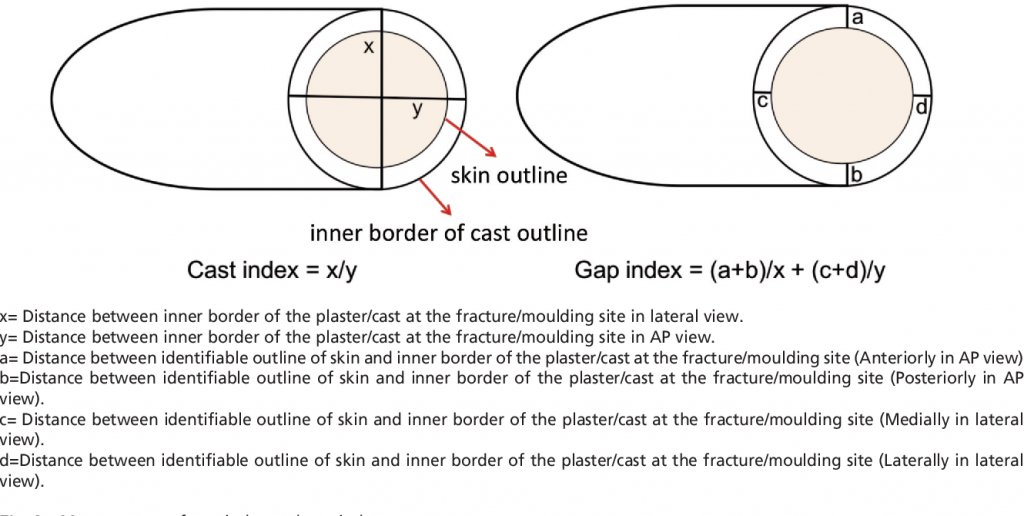
gap index
Source: Shalabh K, Ajai S, Vineet K, Sabir A. Are Gap and Cast Indices Predictors of Efficacy of Reduction in Fractures of Both Bones of the Leg? A Cohort Study. Malays Orthop J. 2018 Jul;12(2):15-19. doi: 10.5704/MOJ.1807.003. PMID: 30112123; PMCID: PMC6092537.

Gap index

Formula: [(Radial fracture site gap + Ulnar fracture site gap)/Inner diameter of cast in AP plane] + [(Dorsal fracture site gap + Volar fracture site gap)/Inner diameter of cast in lateral plane]
i.e. (a+b)/x + (c+d)/y

Cut-off: 0.15
13 shares
  • Facebook13
  • Twitter
PGMEE, MRCS, USMLE, MBBS, MD/MS OrthopedicsRadiology

Post navigation

Previous post
Next post

Related Posts

PGMEE, MRCS, USMLE, MBBS, MD/MS pulmonary edema mnemonics

Cardiac (Heart) Failure Made Easy (Pathophysiology and Diagnosis)

Feb 19, 2016Jun 18, 2016

DEFINITION OF CARDIAC FAILURE It is a state in which there is: a. Forward failure: inability of heart to maintain cardiac output sufficient to meet the metabolic demands of peripheral tissues AND/OR b. Backward failure: ability to do so with elevated filling pressure PATHOGENESIS OF CARDIAC FAILURE 1. Myocyte loss…

Read More
PGMEE, MRCS, USMLE, MBBS, MD/MS adrenal steroidogenesis

Congenital Adrenal Hyperplasia Basics : Explained with Mnemonics

Jul 24, 2018

Adrenal cortex synthesize steroids. Mnemonic: GFR – Salt, Sugar, Sex Zona gomerulosa: Salt (Aldosterone) Zona fasciculata: Sugar (Cortisol) Zona reticulosa: Sex (Testosterone) Congenital adrenal hyperplasia (CAH) Deficiency of 3 different enzymes can cause Congenital Adrenal Hyperplasia. Mnemonic: Remember the mnemonic GFR, first layer of cortex synthesizes aldosterone and the last layer…

Read More
PGMEE, MRCS, USMLE, MBBS, MD/MS

Timing of Wound Closure (Primary, Secondary, Tertiary)

Aug 26, 2020Aug 26, 2020

Before moving to the concept of wound closure, it is necessary to understand the pathophysiology behind different types of healing. We have covered stages of wound healing in general previously. There are three types of wound healing: Primary intention Secondary intention Tertiary intention Healing by primary intention occurs when the…

Read More

Leave a Reply Cancel reply

Your email address will not be published. Required fields are marked *

This site uses Akismet to reduce spam. Learn how your comment data is processed.

Pre-clinical (Basic Sciences)

Anatomy

Biochemistry

Community medicine (PSM)

Embryology

Microbiology

Pathology

Pharmacology

Physiology

Clinical Sciences

Anesthesia

Dermatology

Emergency medicine

Forensic

Internal medicine

Gynecology & Obstetrics

Oncology

Ophthalmology

Orthopedics

Otorhinolaryngology (ENT)

Pediatrics

Psychiatry

Radiology

Surgery

RSS Ask Epomedicine

  • What to study for Clinical examination in Orthopedics?
  • What is the mechanism of AVNRT?

Epomedicine weekly

  • About Epomedicine
  • Contact Us
  • Author Guidelines
  • Submit Article
  • Editorial Board
  • USMLE
  • MRCS
  • Thesis
©2026 Epomedicine | WordPress Theme by SuperbThemes