Skip to content
Epomedicine

Mnemonics, Simplified Concepts & Thoughts

Epomedicine

Mnemonics, Simplified Concepts & Thoughts

shoulder xray

Shoulder X-ray views

Epomedicine, Jan 2, 2021Aug 7, 2024

Shoulder X-ray views

AP Shoulder: in plane of thorax

AP in plane of scapula: Angled 45 degrees lateral

  • Neutral rotation: Grashey view (estimation of glenohumeral space)
  • Internal rotation/External rotation 30 degrees: Hill sach’s lesion and other humeral head morphology
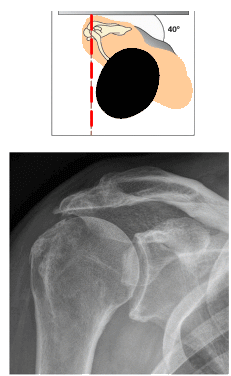
grashey view
Grashey view

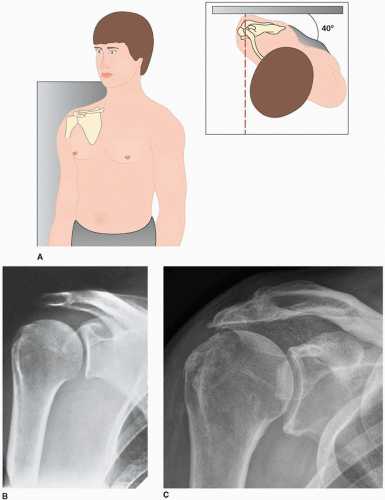
Scapular Y lateral: Erect with opposite shoulder rotated 40 degrees out and beam centered on spine of scapula (shoulder dislocations and scapula fractures)
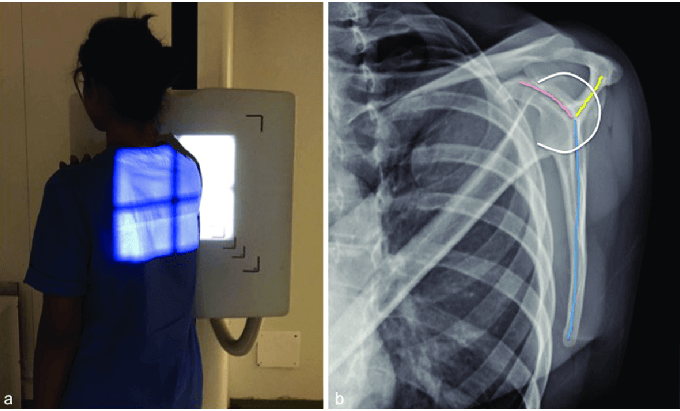
scapular y view
Berritto, Daniela & Pinto, António & Russo, Anna & Urraro, Fabrizio & Laporta, Antonella & Belfiore, Maria Paola & Grassi, Roberto. (2018). Scapular fractures: A common diagnostic pitfall. Acta bio-medica : Atenei Parmensis. 89. 102-110. 10.23750/abm.v89i1-S.7014. [CC BY-NC-SA 4.0]

Supraspinatus outlet view: Scapular Y view with beam caudally tilted 10 degrees (Acromion morphology)

Axillary views:

  • Standard axillary (Lawrence): Supine; arm abducted 90 degrees; beam inferior to superior, 15 to 30 degrees medial angulation depending on abduction
  • West Point axillary: Prone; arm abducted 90 degrees and hanging over the table edge; beam angulated 25 degrees medially and anteriorly (detect Bankart fractures)
  • Velpeau: Standing; wearing arm sling, leans backward over table 30 degrees; beam directed superior to inferior
  • Trauma axillary lateral: Supine; arm supported in 20 degrees flexion by placing radiolucent material under elbow
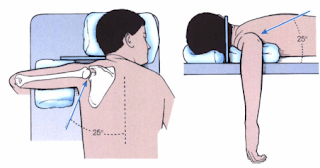
westpoint view
INFEROSUPERIOR AXIAL SHOULDER X-RAY – RadTechOnDuty [CC BY-NC-ND]

Apical Oblique (Garth view): Grashey (True AP) view with beam 45 degrees caudally (to show anterior/inferior capsule; bony bankart/Hill Sachs)
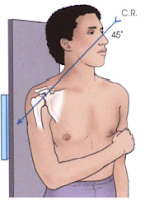
Garth view
INFEROSUPERIOR AXIAL SHOULDER X-RAY – RadTechOnDuty [CC BY-NC-ND]

Stryker-notch view: Supine; palm on head with elbow straight up; beam directed AP with 10 degrees cephalic aiming coracoid (Hill Sachs)
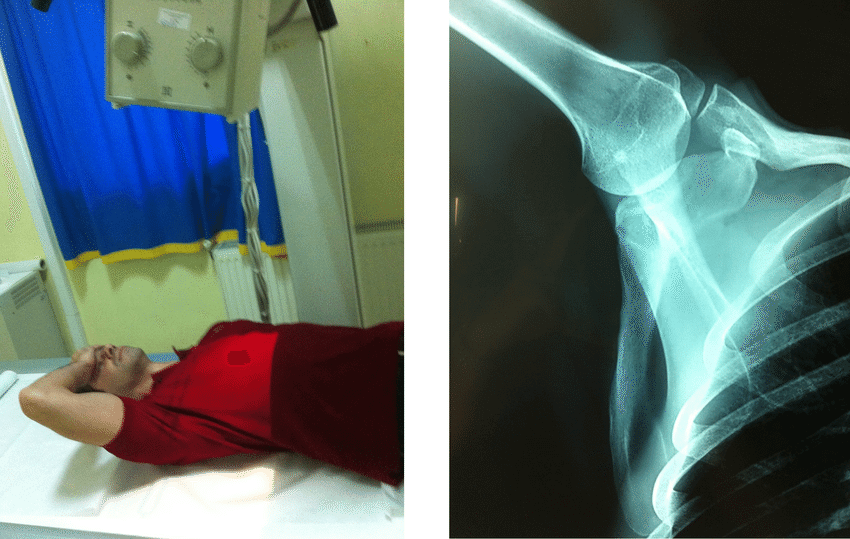
Stryker notch view
Kostretzis, Lazaros & Theodoroudis, Ioannis & Boutsiadis, Achilleas & Papadakis, Nikolaos & Papadopoulos, Pericles. (2017). Suprascapular Nerve Pathology: A Review of the Literature. The Open Orthopaedics Journal. 11. 140-153. 10.2174/1874325001711010140. [CC BY 4.0]

Zanca view: Erect; Beam centered on AC joint with 10 degrees cephalic tilt and 50% exposure (AC Joint)

Serendipity view: Supine; Beam centered on clavicle/manubrium with 40 degrees cephalic tilt (SC Joint)
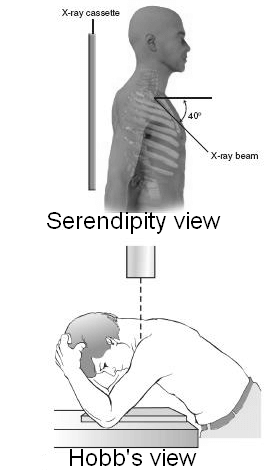
sternoclavicular joint views

Hobb’s view (90 degree cephalocaudal lateral): Sitting; Leans forward so that the anterior chest is in contact with film cassette & the flexed elbows straddle the cassette & support the patient; X-ray beam is directed directly down
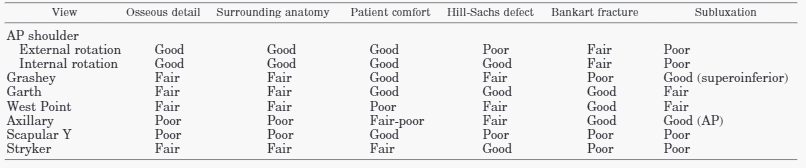

For specific pathologies

a. Obligatory: AP, Lateral or axillary

b. Subacromial impingement: “Y” view

c. Coracoid impingement: Axillary, Lateral

d. Scapular pathology: “Y” view

e. Bankart: Garth view, West point view

f. Hill Sach’s: Stryker notch view, AP with Internal rotation

g. Glenohumeral arthritis: True AP in internal and external rotation and Axillary lateral view

h. Sternoclavicular pathology: Serendipity view, Hobb’s view

i. Acromioclavicular pathology: Zanca view; Stress view with 5 kg weight suspended on wrist and showing both shoulders

  • Facebook
  • Twitter
PGMEE, MRCS, USMLE, MBBS, MD/MS Musculoskeletal systemOrthopedicsRadiology

Post navigation

Previous post
Next post

Related Posts

PGMEE, MRCS, USMLE, MBBS, MD/MS

Osteogenesis Imperfecta : Mnemonic

Oct 28, 2022Aug 13, 2023

Synonym: Brittle Bone Disease Incidence: 1 in 20,000 Gene defect: Col1A1 (17q) and Col1A2 (7q) Mnemonic: Remember “one” for “bone”. Collagen one is the main composition of bone. OI is a disorder of bone. Hence, the defect is is in Col1. Features Mnemonic: BLOOD Sillence Type Inheritance Features Mnemonic Collagen…

Read More
PGMEE, MRCS, USMLE, MBBS, MD/MS

Alpha and Beta Adrenergic Receptors : Mnemonics

Jun 20, 2023Jun 20, 2023

Location Alpha = Arteries and smooth muscles Beta = Beats or Breaths Types and Action 1 = Contract 2 = Dilate Receptors Alpha 1: Alpha 2: Beta 1: Mnemonic: We have 1 HEART Beta 2: Mnemonic: We have 2 LUNGS Beta 3: Mnemonic: 3 = Triglyceride

Read More
PGMEE, MRCS, USMLE, MBBS, MD/MS

Joint Lubrication Made Easy

Jan 20, 2024Jan 20, 2024

Boundary lubrication A monolayer of lubricant molecule (lubricin) adsorbed on each surface (boundary) of the joint prevents direct cartilage to cartilage (articular) contact Fluid-film lubrication Cartilage surfaces are separated by a fluid film 1. Hydrodynamic lubrication: 2. Squeeze film lubrication: 2. Elastohydrodynamic lubrication: Combination of hydrodynamic and squeeze film Mixed…

Read More

Leave a Reply Cancel reply

Your email address will not be published. Required fields are marked *

This site uses Akismet to reduce spam. Learn how your comment data is processed.

Epomedicine. Shoulder X-ray views [Internet]. Epomedicine; 2021 Jan 2 [cited 2026 May 30]. Available from: https://epomedicine.com/medical-students/shoulder-x-ray-views/.

Pre-clinical (Basic Sciences)

Anatomy

Biochemistry

Community medicine (PSM)

Embryology

Microbiology

Pathology

Pharmacology

Physiology

Clinical Sciences

Anesthesia

Dermatology

Emergency medicine

Forensic

Internal medicine

Gynecology & Obstetrics

Oncology

Ophthalmology

Orthopedics

Otorhinolaryngology (ENT)

Pediatrics

Psychiatry

Radiology

Surgery

RSS Ask Epomedicine

  • What to study for Clinical examination in Orthopedics?
  • What is the mechanism of AVNRT?

Epomedicine weekly

  • About Epomedicine
  • Contact Us
  • Author Guidelines
  • Submit Article
  • Editorial Board
  • USMLE
  • MRCS
  • Thesis
©2026 Epomedicine | WordPress Theme by SuperbThemes