Skip to content
Epomedicine

Mnemonics, Simplified Concepts & Thoughts

Epomedicine

Mnemonics, Simplified Concepts & Thoughts

Tonnis and IHDI (International Hip Dysplasia Institute) Classification for DDH

Dr. Sulabh Kumar Shrestha, MS Orthopedics, Nov 10, 2025Nov 10, 2025

IHDI method is a new radiographic classification of the severity of hip dislocation in DDH. It is based on the location of the midpoint of superior part of ossified metaphysis (H-point) relative to acetabulum. In contrast to Tonnis classification method, IHDI method:

  • Has superior reliability
  • Can be applied reliably even when the ossification center is absent
  • Uses Hilgenreiner’s line (H-line) instead of Superolateral margin of acetabulum line (SMA-line)

Tonnis classification:

It is assessed according to the relative position of the femoral proximal ossific nucleus to Perkin’s line (P-line) and the superolateral margin of the acetabulum line (SMA-line). The P-line is a perpendicular line from the superolateral margin of the acetabulum SMA, and the SMA-line is a single line drawn through the superolateral margin of the acetabulum bilaterally.
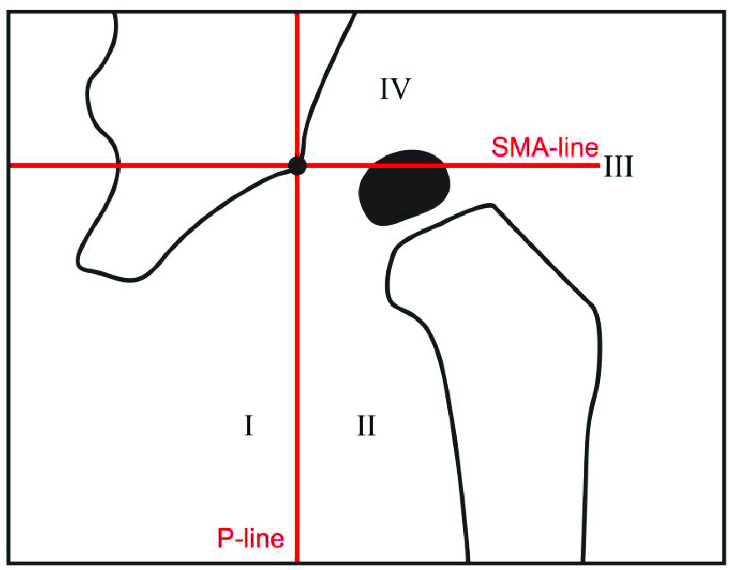
tonnis classification DDH
Terjesen, Terje & Horn, Joachim. (2020). Prognostic value of severity of dislocation in late-detected developmental dysplasia of the hip. Journal of Children’s Orthopaedics. 14. 1-7. 10.1302/1863-2548.14.200079. [CC BY SA 4.0]
  • Grade I: Ossific nucleus is medial to P-line (Infero-medial quadrant)
  • Grade II: Ossific nucleus is lateral to P-line but inferior to SMA-line (Infero-lateral quadrant)
  • Grade III: Ossific nucleus is lateral to P-line leveled to SMA-line
  • Grade IV: Ossific nucleus in superior to SMA-line (Supero-lateral quadrant)

IHDI classification

The position of the proximal femoral metaphysis (instead of the ossific nucleus) is used as the important reference landmark to determine the position of the femoral head. This classification requires supine AP X-ray of pelvis with the hips at rest while the lower limbs are gently held in neutral position without traction and patellae forward.

  • H-point is the midpoint of the superior margin of the ossified metaphysis
  • H-line is drawn through the top of the tri-radiate cartilages bilaterally
  • P-line is then drawn perpendicular to the H-line at the superolateral margin of the acetabulum
  • An additional diagonal line (D-line) is then drawn 45 degrees from the junction of H-line and P-line
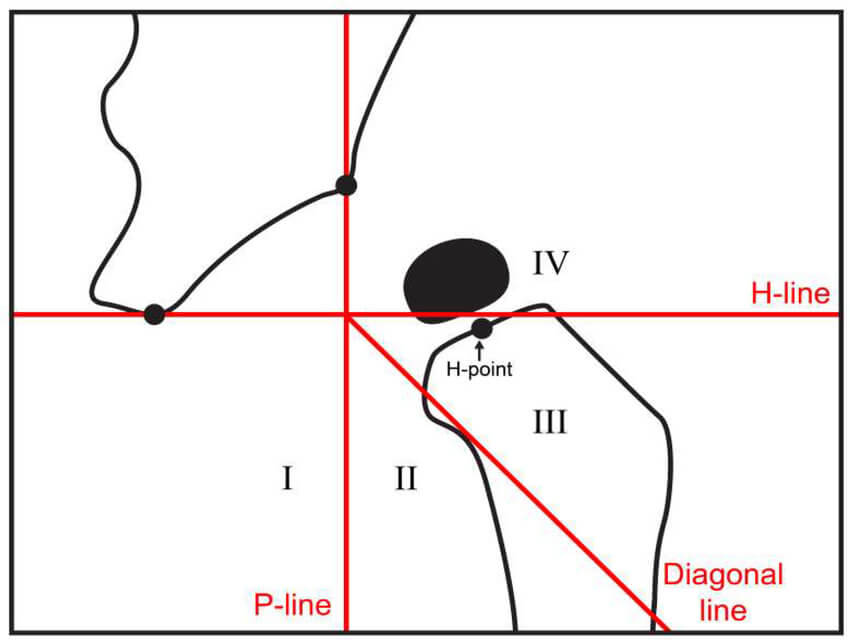
IHDI classification ddh
Terjesen, Terje & Horn, Joachim. (2020). Prognostic value of severity of dislocation in late-detected developmental dysplasia of the hip. Journal of Children’s Orthopaedics. 14. 1-7. 10.1302/1863-2548.14.200079. [CC BY SA 4.0]

The position of the H-point then determines the IHDI grade:

  • IHDI grade I: H-point is at or medial to the P-line
  • IHDI grade II: H-point is lateral to the P-line and at or medial to the D-Line
  • IHDI grade III: H-point is lateral to the D-line and at or inferior to the H-line
  • IHDI grade IV: H-point is superior to the H-line

References:

1. IHDI Standards – International Hip Dysplasia Institute

2. Pasupathy B, Sathish M. Reliability of a New Radiographic Classification System for Developmental Dysplasia of the Hip. International Journal of Paediatric Orthopaedics Jan-April 2020; 6(1): 16-19.

dr. sulabh kumar shrestha
Dr. Sulabh Kumar Shrestha, MS Orthopedics

He is the section editor of Orthopedics in Epomedicine. He searches for and share simpler ways to make complicated medical topics simple. He also loves writing poetry, listening and playing music. He is currently pursuing Fellowship in Hip, Pelvi-acetabulum and Arthroplasty at B&B Hospital.

  • Facebook
  • Twitter
PGMEE, MRCS, USMLE, MBBS, MD/MS OrthopedicsPediatric hipPediatrics

Post navigation

Previous post
Next post

Related Posts

PGMEE, MRCS, USMLE, MBBS, MD/MS

Ulnar styloid impaction syndrome

Apr 8, 2025Apr 8, 2025

Definition: Impaction of triquetrum against the ulnar styloid causing chondromalacia, synovitis and ulnar-sided wrist pain Pathology: Etiology: Clinical features: 1. Asymptomatic 2. Ulnar-sided wrist pain, aggravated by wrist extension and specific positioning (having hands on hip or back pockets) 3. Potential history of trauma to distal radius or ulna, surgery…

Read More
PGMEE, MRCS, USMLE, MBBS, MD/MS thyroglossal cyst

Thyroglossal Duct Cyst

May 6, 2014May 6, 2014

Synonyms: Thyroglossal cyst, Thyrolingual cyst, Thyroglossal duct remnant, TGDC, TDC, TGDR Definition: Thyroglossal duct cyst is a congenital malformation that occurs due to incomplete closure of the thyroglossal duct which presents as a cystic midline neck swelling at birth. Thyroglossal fistulas are usually recognized by their external opening (typically located…

Read More
PGMEE, MRCS, USMLE, MBBS, MD/MS macrophage

Tissue Specific and Named Macrophages

Jan 17, 2017Jan 19, 2017

Subtle differences in the morphology and functions of macrophages develop as a result of the influence of a particular microenvironment. Appearance of macrophages to histologists have been described as a kind of mythological Proteus, “a creature who had the power of changing his appearance at will”. The life-span of these fixed…

Read More

Leave a Reply Cancel reply

Your email address will not be published. Required fields are marked *

This site uses Akismet to reduce spam. Learn how your comment data is processed.

Shrestha SK. Tonnis and IHDI (International Hip Dysplasia Institute) Classification for DDH [Internet]. Epomedicine; 2025 Nov 10 [cited 2025 Dec 20]. Available from: https://epomedicine.com/medical-students/tonnis-and-ihdi-international-hip-dysplasia-institute-classification-for-ddh/.

Pre-clinical (Basic Sciences)

Anatomy

Biochemistry

Community medicine (PSM)

Embryology

Microbiology

Pathology

Pharmacology

Physiology

Clinical Sciences

Anesthesia

Dermatology

Emergency medicine

Forensic

Internal medicine

Gynecology & Obstetrics

Oncology

Ophthalmology

Orthopedics

Otorhinolaryngology (ENT)

Pediatrics

Psychiatry

Radiology

Surgery

RSS Ask Epomedicine

  • What to study for Clinical examination in Orthopedics?
  • What is the mechanism of AVNRT?

Epomedicine weekly

  • About Epomedicine
  • Contact Us
  • Author Guidelines
  • Submit Article
  • Editorial Board
  • USMLE
  • MRCS
  • Thesis
©2025 Epomedicine . All rights reserved.