Skip to content
Epomedicine

Mnemonics, Simplified Concepts & Thoughts

Epomedicine

Mnemonics, Simplified Concepts & Thoughts

screening multiple

Screening tests in Series and Parallel

Epomedicine, May 28, 2019Aug 24, 2024

A. Parallel testing

2 screening tests are applied simultaneously:

  1. Disease positives: Test positive in either of the two tests (If one test is negative, still the other test can prove positive)
  2. Disease negatives: Test negative in both the tests (If one test is negative, the other test must also be negative)

So, this test will have:

  1. Less false negatives (increased sensitivity and increased negative predictive value or NPV)
  2. More false positives (decreased specificity and decreased positive predictive value or PPV)

B. Series testing

After the 1st screening test is conducted, those who test positive are only tested with the 2nd screening test:

  1. Disease positives: Those who test positive in both the tests (If 1st test is positive, he must test positive in 2nd test as well)
  2. Disease negatives: Those who test negative in either of the tests

So, this test will have:

  1. Less false positives: Increased specificity and PPV
  2. More false negatives: Decreased sensitivity and NPV
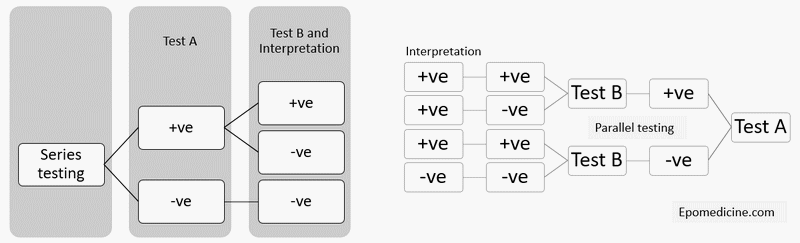
Multiple screening testing
Screening tests in series and parallel (Multiple testing)

Formulae for combined specificity and sensitivity

A. Parallel testing:

  1. Combined specificity = Specificity of test A X Specificity of test B
  2. Combined sensitivity = Sensitivity of test A + Sensitivity of test B – [Sensitivity of test A X Sensitivity of test B]

B. Series testing:

  1. Combined specificity = Specificity of test A + Specificity of test B – [Specificity of test A X Specificity of test B]
  2. Combined sensitivity = Sensitivity of test A X Sensitivity of test B

Mnemonic:

Remember:

1. Sensitivity is True Positive rate
2. Specificity is True Negative rate

In probability testing, AND = multiplication and OR = Addition

Example: Probability of getting head in coin and/or 1 in dice

a. Head and 1 = P (head) X P (1)
b. Head or 1 = P (head) + P (1) – P (head and 1)

In parallel testing:

1. Negative (A and B) = Specificity A X Specificity B

2. Positive (A or B) = Sensitivity A + Sensitivity B – [Sensitivity A X Sensitivity B]

In series testing:

1. Negative (A or B) = Specificity A + Specificity B – [Specificity A X Specificity B]

2. Positive (A and B) = Sensitivity A X Sensitivity B

Mnemonic:

“P” letter words decrease in Parallel.

SeriesParallel
SensitivityDecreaseIncrease
SpecificityIncreaseDecrease
PPVIncreaseDecrease
NPVDecreaseIncrease
21 shares
  • Facebook21
  • Twitter
PGMEE, MRCS, USMLE, MBBS, MD/MS Community medicine

Post navigation

Previous post
Next post

Related Posts

PGMEE, MRCS, USMLE, MBBS, MD/MS

Median, Ulnar and Radial Nerve – Course and Innervation

Aug 8, 2023Aug 8, 2023

Median nerve, Ulnar nerve and Radial nerve are the 3 major nerves of the upper limb originating from the brachial plexus. Some important neuroanatomic relationships in the forearm are: 1. Medial nerve: Crossed by brachial artery from lateral to medial just above the elbow to lie medial to brachial artery…

Read More
PGMEE, MRCS, USMLE, MBBS, MD/MS

Approach to a Child with Short Stature

Jan 15, 2022Jan 15, 2022

Definition of Short Stature Short stature refers to the height below 3rd Centile or 2 Standard Deviations (-2 SD) or more below the mean height for chronological age and gender for the standard population. When height is >-3 SD it’s most likely pathological. Assessment of Short stature 1. Accurate height…

Read More
PGMEE, MRCS, USMLE, MBBS, MD/MS rosette types

Rosettes in Pathology

Jan 26, 2017Jan 27, 2017

Rosette refers to a decoration or pattern resembling a rose. In pathology, rosette refers to aa halo or “spoke-wheel” arrangement of cells around a central structure especially in neoplasms of neuroblastic or neuroectoderma origin. The central structure can be: a. Empty lumen: True ependymal rosette Well differentiated ependymomas (minority of cases)…

Read More

Comments (3)

  1. Mirjam says:
    Feb 5, 2021 at 6:27 pm

    A parallel testing:
    Shouldn`t it be correctly:
    1. Less false negatives (incresed seinsitivity……)
    2. More false positives (decresed SPECIFICITY….)?

    Reply
    1. LB says:
      Feb 12, 2021 at 3:48 pm

      Yes you are correct.

      Reply
    2. Epomedicine says:
      Aug 12, 2024 at 4:58 pm

      Correction done. Thank you Mirjam.

      Reply

Leave a Reply to Epomedicine Cancel reply

Your email address will not be published. Required fields are marked *

This site uses Akismet to reduce spam. Learn how your comment data is processed.

Epomedicine. Screening tests in Series and Parallel [Internet]. Epomedicine; 2019 May 28 [cited 2025 Dec 19]. Available from: https://epomedicine.com/medical-students/screening-tests-in-series-and-parallel/.

Pre-clinical (Basic Sciences)

Anatomy

Biochemistry

Community medicine (PSM)

Embryology

Microbiology

Pathology

Pharmacology

Physiology

Clinical Sciences

Anesthesia

Dermatology

Emergency medicine

Forensic

Internal medicine

Gynecology & Obstetrics

Oncology

Ophthalmology

Orthopedics

Otorhinolaryngology (ENT)

Pediatrics

Psychiatry

Radiology

Surgery

RSS Ask Epomedicine

  • What to study for Clinical examination in Orthopedics?
  • What is the mechanism of AVNRT?

Epomedicine weekly

  • About Epomedicine
  • Contact Us
  • Author Guidelines
  • Submit Article
  • Editorial Board
  • USMLE
  • MRCS
  • Thesis
©2025 Epomedicine . All rights reserved.