Skip to content
Epomedicine

Mnemonics, Simplified Concepts & Thoughts

Epomedicine

Mnemonics, Simplified Concepts & Thoughts

screening multiple

Screening tests in Series and Parallel

Epomedicine, May 28, 2019Aug 24, 2024

A. Parallel testing

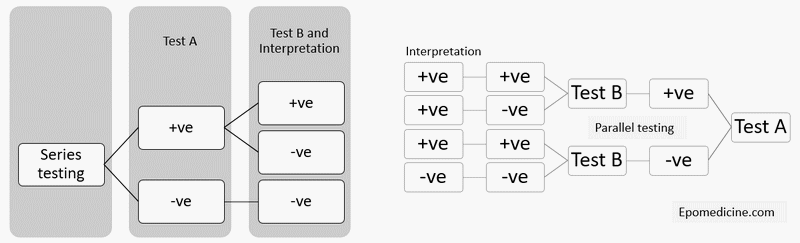
2 screening tests are applied simultaneously:

  1. Disease positives: Test positive in either of the two tests (If one test is negative, still the other test can prove positive)
  2. Disease negatives: Test negative in both the tests (If one test is negative, the other test must also be negative)

So, this test will have:

  1. Less false negatives (increased sensitivity and increased negative predictive value or NPV)
  2. More false positives (decreased specificity and decreased positive predictive value or PPV)

B. Series testing

After the 1st screening test is conducted, those who test positive are only tested with the 2nd screening test:

  1. Disease positives: Those who test positive in both the tests (If 1st test is positive, he must test positive in 2nd test as well)
  2. Disease negatives: Those who test negative in either of the tests

So, this test will have:

  1. Less false positives: Increased specificity and PPV
  2. More false negatives: Decreased sensitivity and NPV
Multiple screening testing
Screening tests in series and parallel (Multiple testing)

Formulae for combined specificity and sensitivity

A. Parallel testing:

  1. Combined specificity = Specificity of test A X Specificity of test B
  2. Combined sensitivity = Sensitivity of test A + Sensitivity of test B – [Sensitivity of test A X Sensitivity of test B]

B. Series testing:

  1. Combined specificity = Specificity of test A + Specificity of test B – [Specificity of test A X Specificity of test B]
  2. Combined sensitivity = Sensitivity of test A X Sensitivity of test B

Mnemonic:

Remember:

1. Sensitivity is True Positive rate
2. Specificity is True Negative rate

In probability testing, AND = multiplication and OR = Addition

Example: Probability of getting head in coin and/or 1 in dice

a. Head and 1 = P (head) X P (1)
b. Head or 1 = P (head) + P (1) – P (head and 1)

In parallel testing:

1. Negative (A and B) = Specificity A X Specificity B

2. Positive (A or B) = Sensitivity A + Sensitivity B – [Sensitivity A X Sensitivity B]

In series testing:

1. Negative (A or B) = Specificity A + Specificity B – [Specificity A X Specificity B]

2. Positive (A and B) = Sensitivity A X Sensitivity B

Mnemonic:

“P” letter words decrease in Parallel.

SeriesParallel
SensitivityDecreaseIncrease
SpecificityIncreaseDecrease
PPVIncreaseDecrease
NPVDecreaseIncrease
21 shares
  • Facebook21
  • Twitter
PGMEE, MRCS, USMLE, MBBS, MD/MS Community medicine

Post navigation

Previous post
Next post

Related Posts

PGMEE, MRCS, USMLE, MBBS, MD/MS antidepressant side effects

Antidepressants Made Easy

Jan 4, 2017

Tricyclic Antidepressants (TCA) Mnemonic: -pramine, -triptyline, -pin Secondary amines: predominantly norepinephrine reuptake inhibitors Nor-triptyline Desi-pramine Tertiary amines: Ami-triptyline Imi-pramine Clomi-pramine Doxe-pin Irreversible MAO Inhibitors Mnemonic: TIPS Non-selective MAO inhibitors: Tranylcypromine Isocarboxazid Phenelzine Selective MAO-B inhibitor: Selegiline (transdermal patch) Reversible Inhibitor of MAO-A (RIMA) Moclobemide Tolaxatone Tetracyclic Antidepressants Nonselective inhibitor of…

Read More
PGMEE, MRCS, USMLE, MBBS, MD/MS goodsall rule

Goodsall’s rule : Mnemonic

Apr 17, 2020Oct 1, 2020

Synonym: Goodsall-Salmon’s law In anal fistula, goodsall’s rule predicts the type of track and location of internal opening. An anterior external opening is more likely to have a straight track while a psoteriorly placed external opening is more likely to have a curved track. Mnemonic: Think of a dog with…

Read More
PGMEE, MRCS, USMLE, MBBS, MD/MS

Wolff’s law and Hueter-Volkmann law

Jul 30, 2024Jul 30, 2024

Bone remodeling involves the removal of mineralized bone by osteoclasts followed by the formation of bone matrix through the osteoblasts that subsequently become mineralized. There are 2 prominent concepts of bone remodelling: 1. Hueter-Volkmann law or Delpech’s law: It states that bone growth in the skeletally immature is inhibited in…

Read More

Comments (3)

  1. Mirjam says:
    Feb 5, 2021 at 6:27 pm

    A parallel testing:
    Shouldn`t it be correctly:
    1. Less false negatives (incresed seinsitivity……)
    2. More false positives (decresed SPECIFICITY….)?

    Reply
    1. LB says:
      Feb 12, 2021 at 3:48 pm

      Yes you are correct.

      Reply
    2. Epomedicine says:
      Aug 12, 2024 at 4:58 pm

      Correction done. Thank you Mirjam.

      Reply

Leave a Reply Cancel reply

Your email address will not be published. Required fields are marked *

This site uses Akismet to reduce spam. Learn how your comment data is processed.

Pre-clinical (Basic Sciences)

Anatomy

Biochemistry

Community medicine (PSM)

Embryology

Microbiology

Pathology

Pharmacology

Physiology

Clinical Sciences

Anesthesia

Dermatology

Emergency medicine

Forensic

Internal medicine

Gynecology & Obstetrics

Oncology

Ophthalmology

Orthopedics

Otorhinolaryngology (ENT)

Pediatrics

Psychiatry

Radiology

Surgery

RSS Ask Epomedicine

  • What to study for Clinical examination in Orthopedics?
  • What is the mechanism of AVNRT?

Epomedicine weekly

  • About Epomedicine
  • Contact Us
  • Author Guidelines
  • Submit Article
  • Editorial Board
  • USMLE
  • MRCS
  • Thesis
©2026 Epomedicine | WordPress Theme by SuperbThemes