Skip to content
Epomedicine

Mnemonics, Simplified Concepts & Thoughts

Epomedicine

Mnemonics, Simplified Concepts & Thoughts

PPV NPV baye

Baye’s theorem derived PPV and NPV

Epomedicine, May 28, 2019Oct 26, 2022

Let’s unveil the mathematics behind the relation between:

  1. Prevalence (Pre-test probability)
  2. Predictive value (Post-test probability)
  3. Sensitivity
  4. Specificity
PPV NPV Baye theorem

SYMBOLS:

Total screened population = n
Prevalence = P
Sensitivity = Sn
Specificity = Sp
True positive = TP
True negative = TN
False positive = FP
False negative = FN
With disease = D+
Without disease = D-
Positive predictive value = PPV
Negative predictive value = NPV

Since, we calculate all these in percentage, lets assume n = 1
If n = 1,
Total diseased = D+ = P
Total without disease = D- = 1-P

WE WILL PLAY WITH THESE SYMBOLS:

Sn = TP rate = TP/D+
or, TP = Sn X D+ = SnXP

Sp = TN rate = TN/D-
or, TN = Sp X D – = SpX(1-P)

1-Sn = (D+ – TP)/D+ = FN/D+ = FN/P
or, FN = (1-Sn)XP

1-Sp = (D- – TN)/D- = FP/D- = FP/(1-P)
or, FP = (1-Sp)(1-P)

Mnemonic:

Just remember, prevalence (P) is there in all.
a. TP = + X + (truly positive)
b. TN = + X – (one positive and one negative)
c. FN = – X + (one positive and one negative)
d. FP = – X – (both negative by product is falsely positive)

FN has letter N, Sensitivity has letter N and there will be minus (-) on Sensitivity: FN = (1-Sn)XP — one negative, one positive

FP has letter P, Specificity and Prevalence both have letter P and there will be minus (-) on both: FP = (1-Sp) X (1-P) — both negative

Remember the other two, these are opposite. While FN relates to Sn, TN relates to Sp and while FP relates to Sp, TP relates to Sn.

TN = Sp X (1-P) — one positive one negative
TP = Sn X P — both positive


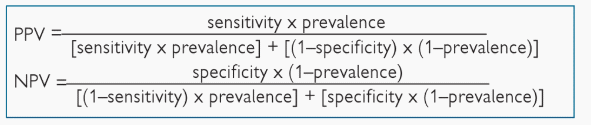
PPV = TP/(TP+FP)
= SnXP/[SnXP + (1-Sp)(1-P)]

NPV = TN/(TN+FN)
= SpX(1-P)/[SpX(1-P) + (1-Sn)XP]

You are often tested on exams with numerical questions. This is how, I try to figure out the Bayism in PPV and NPV when forgotten.
  • Facebook
  • Twitter
PGMEE, MRCS, USMLE, MBBS, MD/MS Community medicine

Post navigation

Previous post
Next post

Related Posts

PGMEE, MRCS, USMLE, MBBS, MD/MS

Flexor Tendon Rehabilitation : Simplified

Jul 29, 2021Jul 29, 2021

Immobilization Protocol Dorsal blocking orthosis Early stage (0-3/4 weeks) Intermediate stage (4-6 weeks) Late stage (6-8 weeks) Wrist: 20-30 degrees flexionMCP: 40-60 degrees flexionIP: Neutral ROM of elbow and shoulder Increase wrist extension (towards neutral) within splint Tendon gliding exercises (hold each position 3 seconds, repeat 10 times, do 3…

Read More
PGMEE, MRCS, USMLE, MBBS, MD/MS

Mediastinum : Simplified

Aug 7, 2023Sep 7, 2023

It is the region in thoracic cavity between the pulmonary cavities (covered by mediastinal pleura and excludes the lungs). Extent: Thoracic outlet (1st rib) to Diaphragm (T12) Superior mediastinum: Upper extent Thoracic outlet Contents (superficial to deep) 1. Glands (Thymus and Lymph nodes)2. 3 Veins (Brachiocephalic Lt. and Rt. and…

Read More
PGMEE, MRCS, USMLE, MBBS, MD/MS

Hypertrophic Scar vs Keloid

May 21, 2024May 21, 2024

Hypertrophic scars and keloids are both raised, firm scars formed from excess fibrinogen production and collagen during healing. Mnemonic: BAD SCARS Mnemonic Basis Hypertrophic scar Keloid B Behavior Natural regression No spontaneous regressio A Acuteness Appears in weeks Appears over months to years D Demographic All races affected More prevalent…

Read More

Comment

  1. Farhat says:
    Aug 22, 2021 at 3:08 pm

    I have three genes as a biomarker for CRC disease and need to combine their diagnostic values?

    Reply

Leave a Reply Cancel reply

Your email address will not be published. Required fields are marked *

This site uses Akismet to reduce spam. Learn how your comment data is processed.

Epomedicine. Baye’s theorem derived PPV and NPV [Internet]. Epomedicine; 2019 May 28 [cited 2026 Jan 21]. Available from: https://epomedicine.com/medical-students/unforget-bayes-theorem-derived-ppv-and-npv/.

Pre-clinical (Basic Sciences)

Anatomy

Biochemistry

Community medicine (PSM)

Embryology

Microbiology

Pathology

Pharmacology

Physiology

Clinical Sciences

Anesthesia

Dermatology

Emergency medicine

Forensic

Internal medicine

Gynecology & Obstetrics

Oncology

Ophthalmology

Orthopedics

Otorhinolaryngology (ENT)

Pediatrics

Psychiatry

Radiology

Surgery

RSS Ask Epomedicine

  • What to study for Clinical examination in Orthopedics?
  • What is the mechanism of AVNRT?

Epomedicine weekly

  • About Epomedicine
  • Contact Us
  • Author Guidelines
  • Submit Article
  • Editorial Board
  • USMLE
  • MRCS
  • Thesis
©2026 Epomedicine . All rights reserved.