Skip to content
Epomedicine

Mnemonics, Simplified Concepts & Thoughts

Epomedicine

Mnemonics, Simplified Concepts & Thoughts

respiratory center lesion

Respiratory Center Simplified

Epomedicine, Jul 9, 2018

Mnemonic: Boat starts and PRASaD DIVEs
respiratory center

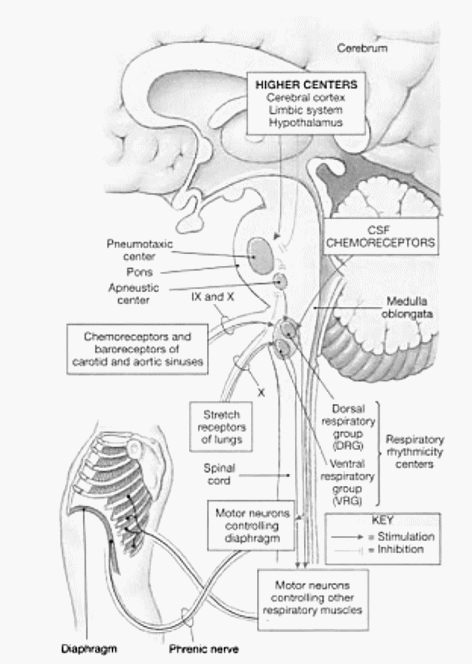
1. pre-Botzinger complex Starts respiratory rhythm (pacemaker): Boat Starts

  • Location: Between nucleus ambiguus and lateral reticular nucleus (upper medulla)

2. Pneumotaxic center Represses Apneustic center: PR-A

  • Location: Upper pons (Nucleus parabrachialis and Kolliker-fuse nucleus)

3. Apneustic center Stimulates DRG: A-SaD

  • Location: Lower pons

4. Dorsal respiratory group (DRG) for Inspiration (tidal): DI

  • Location: Dorsal medulla (Nucleus Tractus Solitarius)

5. Ventral respiratory group (VRG) for Expiration (forced): VE

  • Location: Ventrolateral medulla (Nucleus ambiguus and Nucelus retro-ambiguus)

In summary:

  1. Rhythmic cycle of breathing originates in medulla (pre-botzinger complex).
  2. Voluntary respiration is controlled by cerebral cortex. Limbic system and hypothalamus alter pattern of breathing in emotional stress such as fear and rage.
  3. Involuntary respiration is controlled by upper brainstem.
  4. DRG (NTS) is Inspiratory center (receives CN 9 and 10 afferents from peripheral chemoreceptors, airways and lungs)
  5. VRG (Nucleus ambiguus and retro-ambiguus) is Expiratory center (however, it has both inspiratory and expiratory neurons)
  6. Apneustic center stimulates DRG (inspiratory center) and causes inspiration (Apneusis = Prolonged inspiratory gasps).
  7. Pneumotaxic center (Nucleus parabrachialis and Kolliker fuse nucleus) and CN 10 inhibit Apneustic center to limit inspiration (volume) and increase the rate of respiration. Under normal conditions, after 2 seconds, apneustic center is inhibited by pneumotaxic center.

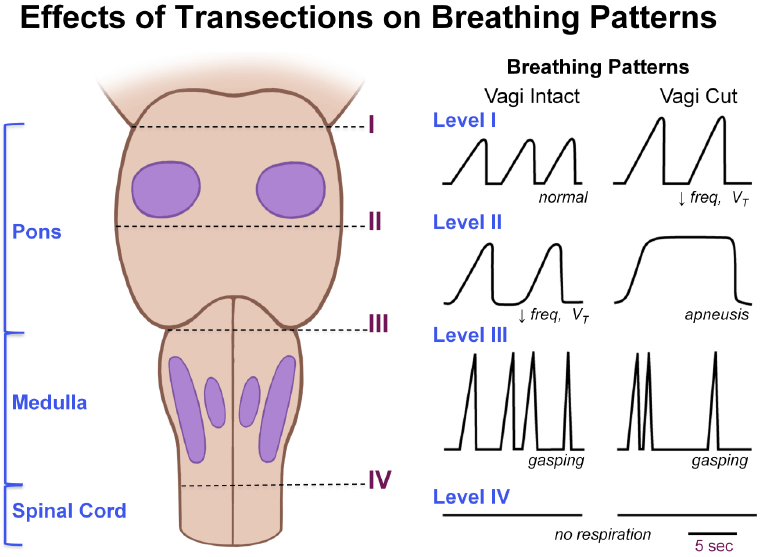
Effect of lesion/transection:
respiratory center lesion

From superior to inferior:

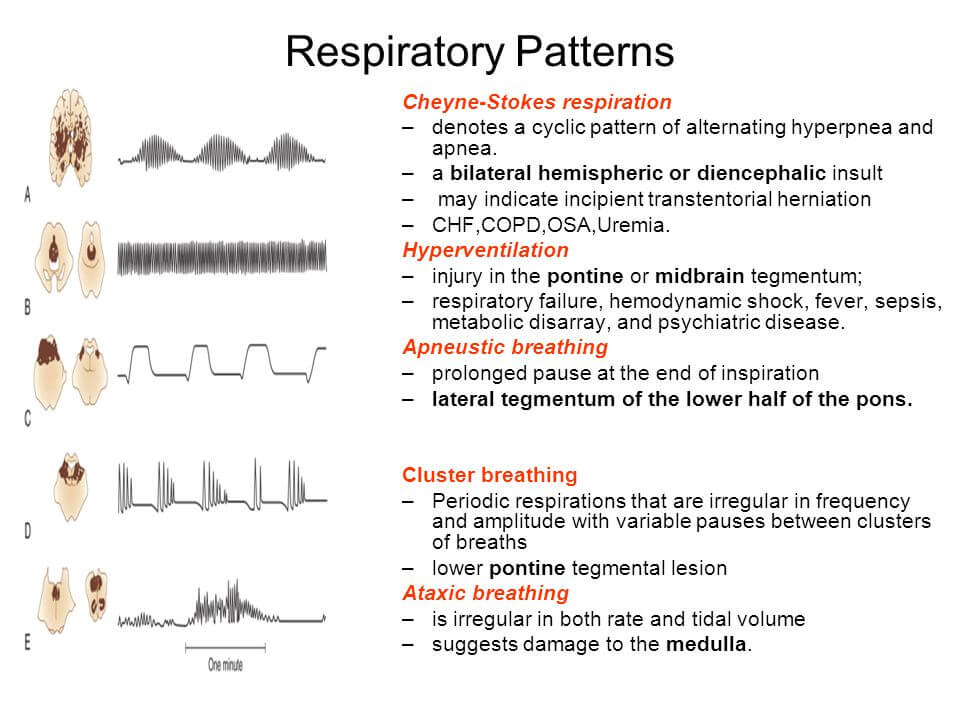
respiratory patterns

36 shares
  • Facebook35
  • Twitter
PGMEE, MRCS, USMLE, MBBS, MD/MS Nervous systemPhysiologyRespiratory system

Post navigation

Previous post
Next post

Related Posts

PGMEE, MRCS, USMLE, MBBS, MD/MS medial brainstem syndrome

Medial Medullary (Dejerine’s) Syndrome : Anatomical basis mnemonic

Jan 22, 2016Oct 26, 2022

As already discussed in the previous section about Lateral Medullary (Wallenberg) Syndrome: 6 “S” pass/lie on the Side (latetral) of Medulla Except the anteromedian part supplied by vertebral artery, rest of the medulla is supplied by PICA Let us now review the relevant anatomy and physiology of the medial portion…

Read More
PGMEE, MRCS, USMLE, MBBS, MD/MS dna replication

DNA Replication Explained With Zipper Model

Jan 25, 2017Jan 26, 2017

Imagine DNA as a zipper Prokaryotic DNA as a zipper with single slider (single origin of replication) and Eukaryotic DNA as a zipper with two sliders (multiple origin of replication). Zipper teeth: Purines and pyrimidine bases Complementary teeth pair: Complementary base pairs attached by hydrogen bonds Top stops: Origin of…

Read More
PGMEE, MRCS, USMLE, MBBS, MD/MS

Median, Ulnar and Radial Nerve – Course and Innervation

Aug 8, 2023Aug 8, 2023

Median nerve, Ulnar nerve and Radial nerve are the 3 major nerves of the upper limb originating from the brachial plexus. Some important neuroanatomic relationships in the forearm are: 1. Medial nerve: Crossed by brachial artery from lateral to medial just above the elbow to lie medial to brachial artery…

Read More

Leave a Reply Cancel reply

Your email address will not be published. Required fields are marked *

This site uses Akismet to reduce spam. Learn how your comment data is processed.

Epomedicine. Respiratory Center Simplified [Internet]. Epomedicine; 2018 Jul 9 [cited 2025 Dec 6]. Available from: https://epomedicine.com/medical-students/respiratory-center-simplified/.

Pre-clinical (Basic Sciences)

Anatomy

Biochemistry

Community medicine (PSM)

Embryology

Microbiology

Pathology

Pharmacology

Physiology

Clinical Sciences

Anesthesia

Dermatology

Emergency medicine

Forensic

Internal medicine

Gynecology & Obstetrics

Oncology

Ophthalmology

Orthopedics

Otorhinolaryngology (ENT)

Pediatrics

Psychiatry

Radiology

Surgery

RSS Ask Epomedicine

  • What to study for Clinical examination in Orthopedics?
  • What is the mechanism of AVNRT?

Epomedicine weekly

  • About Epomedicine
  • Contact Us
  • Author Guidelines
  • Submit Article
  • Editorial Board
  • USMLE
  • MRCS
  • Thesis
©2025 Epomedicine . All rights reserved.