Skip to content
Epomedicine

Mnemonics, Simplified Concepts & Thoughts

Epomedicine

Mnemonics, Simplified Concepts & Thoughts

lung volumes and capacities

Lung Volumes and Capacities : Mnemonic

Epomedicine, Jul 10, 2018

Mnemonic: 6 LITERs

Lung Capacity (TLC = 6L) = Inspiratory reserve volume (IRV = 3.3 L) + Tidal volume (TV = 0.5 L) + Expiratory reserve volume (ERV = 1 L) + Reserve volume (RV = 1.2 L)

Mnemonic: There are 4 lung volumes that do not overlap and 4 lung capacities that overlap.
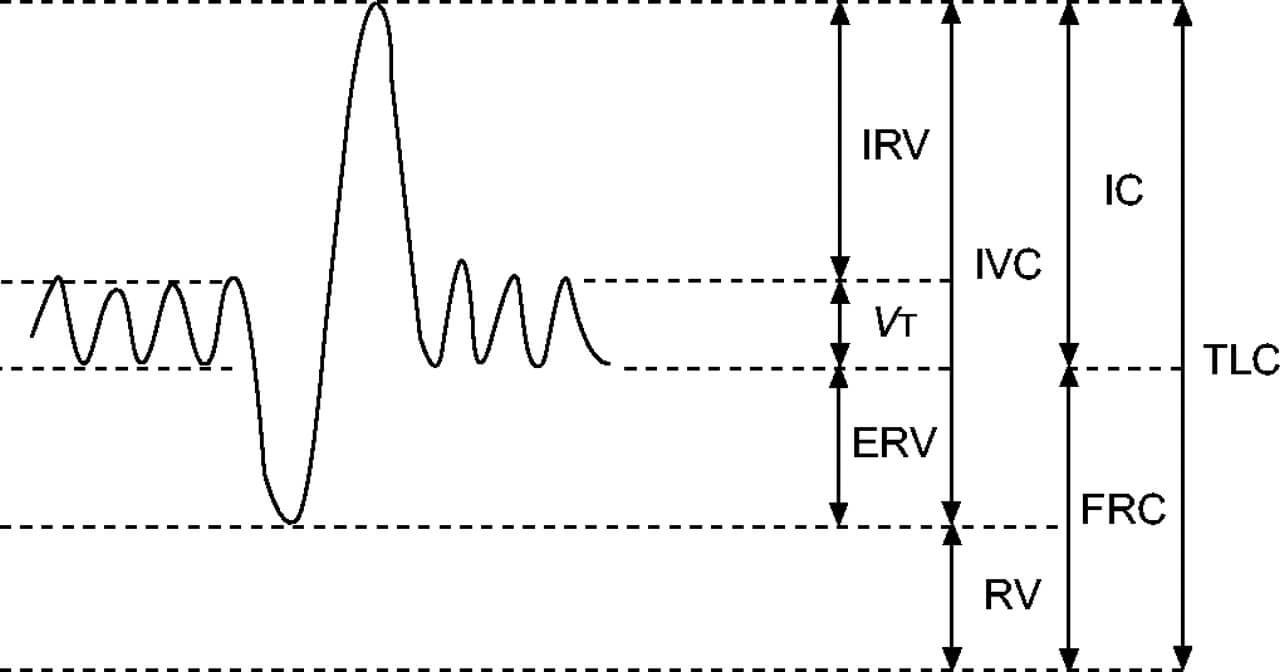
lung volumes and capacities

Lung volumes

1. Tidal volume (TV): Air inhaled and exhaled during quiet breathing

2. Inspiratory reserve volume (IRV): Maximum volume of air that can be inspired in excess of normal inspiration

3. Expiratory reserve volume (ERV): Maximum volume of air that can be expired in excess of normal expiration

4. Residual volume (RV): Volume remaining after maximal expiration

Lung capacities

1. Inspiratory capacity (IC) = TV + IRV

2. Vital capacity (VC) = TV + IRV + ERV or IC + ERV

3. Functional Residual Capacity (FRC) = ERV + RV

4. Total lung capacity (TLC) = IRV + TV + ERV + RV or IC + FRC
  • Facebook
  • Twitter
PGMEE, MRCS, USMLE, MBBS, MD/MS PhysiologyRespiratory system

Post navigation

Previous post
Next post

Related Posts

PGMEE, MRCS, USMLE, MBBS, MD/MS

Osteoid Osteoma : Mnemonic

May 13, 2022May 13, 2022

Epidemiology and Clinical features Mnemonic: LMNOP Lower extremity predilection (proximal femur > tibial diaphysis) Male predilection (2:1 to 3:1) Night pain relieved by NSAIDs (absent in osteoblastoma) Osteogenic benign tumor Prostaglandins (PGE2) and Cyclooxygenase (COX1 and 2) release by nidus (explains night pain and response to NSAIDs) 3 Concentric layers…

Read More
PGMEE, MRCS, USMLE, MBBS, MD/MS

Lasers in Ophthalmology – Mnemonic

May 27, 2020May 27, 2020

Order of decreasing wavelength Mnemonic: CHyNa PuRE The laser tissue interaction can be remembered in the reverse order using the mnemonic ACiDiTy. Carbon dioxide (CO2): 10600 (photoThermal) Holmium YAG: 2100 (photoDisruption) Nd:YAG: 1064 (photoDisruption) Pulsed dye laser: 585-600 (photoChemical) aRgon green: 514 (photoChemical) Excimer: 193 (photoAblation) Indications of Laser aRgon…

Read More
PGMEE, MRCS, USMLE, MBBS, MD/MS

How to check an Error in ABG ? ABG analysis

May 1, 2023May 1, 2023

Sometimes, clinicians might find ABG result not matching with the patient condition. These results might arise from technical errors in machine and there are certain points which can be used to check the error. How to Check whether ABG result is Right or has Error? X= 24X PaCO2/HCO3 Y= 80-…

Read More

Leave a Reply Cancel reply

Your email address will not be published. Required fields are marked *

This site uses Akismet to reduce spam. Learn how your comment data is processed.

Pre-clinical (Basic Sciences)

Anatomy

Biochemistry

Community medicine (PSM)

Embryology

Microbiology

Pathology

Pharmacology

Physiology

Clinical Sciences

Anesthesia

Dermatology

Emergency medicine

Forensic

Internal medicine

Gynecology & Obstetrics

Oncology

Ophthalmology

Orthopedics

Otorhinolaryngology (ENT)

Pediatrics

Psychiatry

Radiology

Surgery

RSS Ask Epomedicine

  • What to study for Clinical examination in Orthopedics?
  • What is the mechanism of AVNRT?

Epomedicine weekly

  • About Epomedicine
  • Contact Us
  • Author Guidelines
  • Submit Article
  • Editorial Board
  • USMLE
  • MRCS
  • Thesis
©2026 Epomedicine | WordPress Theme by SuperbThemes