Skip to content
Epomedicine

Mnemonics, Simplified Concepts & Thoughts

Epomedicine

Mnemonics, Simplified Concepts & Thoughts

Regression Analysis for Medical Students and Doctors

Epomedicine, Mar 25, 2026Mar 25, 2026

Regression is a statistical tool used mainly to study the association between:

  • one or more predictor/explanatory/independent variables (x; plotted on x-axis) and
  • an outcome/response/dependent variable (y; plotted on y-axis).

Uses:

  1. Prediction: Use of 1 or more independent variables to estimate the value of a dependent variable
  2. To control for confounders: To study the association between independent variable(s) and the outcome of interest while controlling for (adjusting) the effect of one or more variables

Types of regression based on outcome variable (y):

Remember the “NOIR” mnemonic for the types of variable.

Which statistical test to use?
  1. Continuous: Linear regression
    • Reported as: coefficient
  2. Binomial (nominal): Logistic regression
    • Reported as: odds ratio (OR)
  3. Time to event: Cox regression (survival analysis)
    • Reported as: hazard ratio (HR)
  4. Count and rates: Poisson regression
    • Reported as: incident rate ratio (IRR)
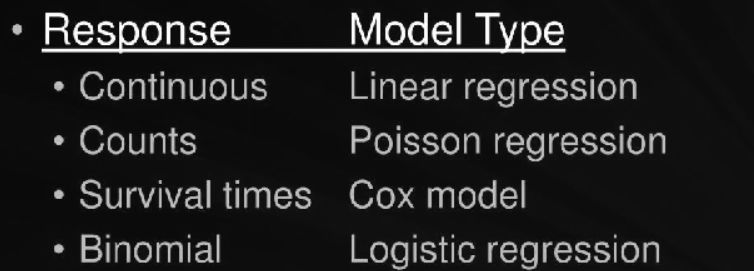
regression types

Types of regression based on number of independent variables (x):

  1. Simple: 1 x
    • Resulting estimates: called crude or unadjusted
  2. Multiple: >1 x
    • Resulting estimates: called adjusted

Regression vs Correlation:

Correlation measures the strength of the association between variables.

Regression quantifies the association. It should only be used if one of the variables is thought to precede
or cause the other.

References:

  1. Short notes in medical statistics for medical examinations – Dr. Mohamed Elsherif
  2. Medical statistics made easy – M. Harris and G. Taylor

  • Facebook
  • Twitter
PGMEE, MRCS, USMLE, MBBS, MD/MS Biostatistics

Post navigation

Previous post
Next post

Related Posts

PGMEE, MRCS, USMLE, MBBS, MD/MS trinucleotide repeat disorders

Trinucleotide Repeat Disorders and Anticipation Mnemonics

Jan 23, 2017Jan 25, 2017

Anticipation in genetics refers to an increase in severity and decrease in age of onset in successive generations, most likely due to increased size of trinucleotide repeats. Paternal anticipation: Huntington’s disease, Friedreich’s Ataxia Maternal anticipation: Myotonic dystrophy, Fragile X syndrome Diseases Trinucleotide Repeat Affected gene Chromosome Fragile X syndrome CGG…

Read More
PGMEE, MRCS, USMLE, MBBS, MD/MS

Blood supply of femoral head

May 29, 2020Jan 11, 2024

Three sources of Blood supply Vascular arragement of Proximal Femur a. Extracapsular ring (At the base of femoral neck) These circumflex femoral arteries branch from: Trochanteric anastomosis (centered on trochanteric fossa): Descending branch of SGA + ascending branch of LFCA, MFCA and IGA Cruciate anastomosis (centered on lesser trochanter): Descending…

Read More
PGMEE, MRCS, USMLE, MBBS, MD/MS

Approach to Rheumatoid Factor Positive test

Feb 21, 2023Feb 21, 2023

Rheumatoid factor (RF; also mistakenly called RA factor) is an auto-antibody (commonly IgM and rarely IgG or IgA) directed against the Fc portion of IgG. Increase in both IgM and IgA RFs is almost exclusively observed in patients with RA (Rheumatoid Arthritis). Clinical Significance of Rheumatoid Factor 1. A positive…

Read More

Leave a Reply Cancel reply

Your email address will not be published. Required fields are marked *

This site uses Akismet to reduce spam. Learn how your comment data is processed.

Pre-clinical (Basic Sciences)

Anatomy

Biochemistry

Community medicine (PSM)

Embryology

Microbiology

Pathology

Pharmacology

Physiology

Clinical Sciences

Anesthesia

Dermatology

Emergency medicine

Forensic

Internal medicine

Gynecology & Obstetrics

Oncology

Ophthalmology

Orthopedics

Otorhinolaryngology (ENT)

Pediatrics

Psychiatry

Radiology

Surgery

RSS Ask Epomedicine

  • What to study for Clinical examination in Orthopedics?
  • What is the mechanism of AVNRT?

Epomedicine weekly

  • About Epomedicine
  • Contact Us
  • Author Guidelines
  • Submit Article
  • Editorial Board
  • USMLE
  • MRCS
  • Thesis
©2026 Epomedicine | WordPress Theme by SuperbThemes