Skip to content
Epomedicine

Mnemonics, Simplified Concepts & Thoughts

Epomedicine

Mnemonics, Simplified Concepts & Thoughts

Anesthetic Management of Pediatric Extracranial Scalp Arteriovenous Malformation (AVM) : A Case-Based Review with Perioperative Management Algorithm

Dr. Pooja Shrestha, Mar 21, 2026Mar 21, 2026

Introduction

  • Extracranial scalp AVMs are rare high-flow vascular shunts.
  • Can cause massive blood loss & high-output cardiac stress.
  • Steal phenomenon reversal: Sudden AV shunt removal → ↑SVR & ↓venous return → ↓BP

Case Description

  • 10-year-old female
  • Progressive right post-auricular swelling for 2 years (Fig. 1)
  • Palpable thrill & audible bruit
  • PAC: METS >4 & Stable vitals; Investigations – unremarkable (Echocardiography revealed EF 61%)
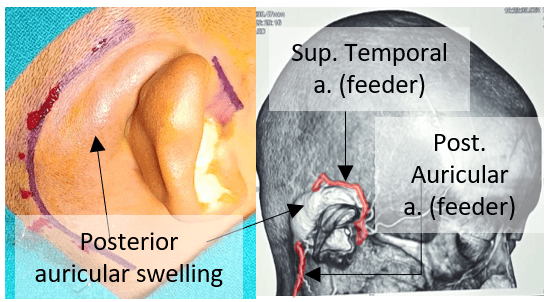
AVM clinical image and CT angiogram
Fig.1: Preoperative clinical photograph & 3D CT  demonstrating AVM & feeder arteries

Anesthetic Challenges

Airway & positioningHemodynamic instability
Massive blood lossHypothermia and metabolic disturbances
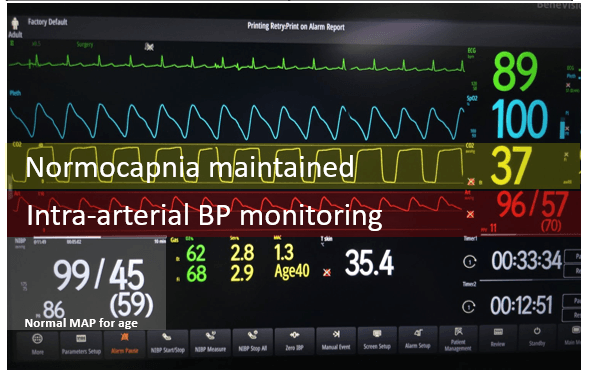
AVM monitoring
Fig.2: A snapshot of anesthesia monitor readings

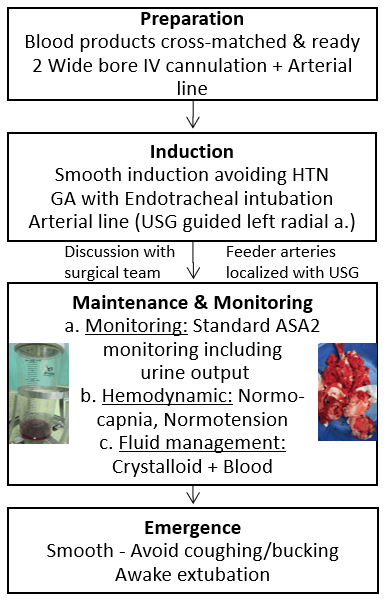
Intraoperative Management

AVM anesthetic algorithm

Postoperative Considerations

  • Ongoing bleeding & hemodynamic instability
  • Delayed cardiac effects
  • Adequate analgesia
PearlsPitfalls
Anticipate hemodynamic shift after ligationUnder-estimated blood loss
Controlled hypotension during dissectionVenous air embolism (open scalp veins)
Normothermia +/- Tranexamic acidAggressive hypotension

Conclusion

  • Pediatric Scalp AVMs behave like systemic AV shunts.
  • Anesthetic success depends on anticipation, monitoring & blood readiness.

Abbreviations:

  • AVM: Arteriovenous Malformation
  • HTN: Hypertension
  • MAC: Minimum Alveolar Concentration
  • TIVA: Total Intravenous Anesthesia
  • GA: General Anesthesia
  • SVR: Systemic Vascular Resistance

Reference: Shamim et.al. 2012 (JOACP)

Dr. Pooja Shrestha
Dr. Pooja Shrestha

Anesthesiology Resident (PGY-1) at Tribhuvan University Teaching Hospital, Institute of Medicine (TUTH, IOM). Her academic interests include perioperative medicine, regional anesthesia, and evidence-based practices in anesthesiology. She contributes scholarly articles on anesthesia to Epomedicine.
  • Facebook
  • Twitter
Case Reports AnesthesiaNervous system

Post navigation

Previous post
Next post

Related Posts

Case Reports

A case of EA/TOF (esophageal atresia/tracheoesophageal fistula)

Jan 26, 2024Jan 26, 2024

Case summary A female neonate was born via emergency cesarean section at 36 weeks of gestation. The indication of LSCS was polyhydramnios with fetal bradycardia. The birth weight of the neonate was 1700 grams following which the baby was shifted to NICU for observation. I, as a surgical resident was…

Read More
Case Reports

A Case of Neonatal Umbilical Infection leading to Septic Shock

Jun 20, 2020Jun 20, 2020

Case report A Preterm neonate of 33 weeks gestation deteriorated on day 2 with septic shock and decreased urine output rapidly over 12 hours. Baby was pale and CRT was prolonged. A Workup was sent and empirical antibiotics were started. Baby needed Inotrope support and improved over next 24-48 hours….

Read More
Case Reports

Mohr Syndrome (OFD2): An Orthopedic Insight from a Rare Case

Nov 9, 2025Nov 23, 2025

Introduction Mohr syndrome, or Orofaciodigital syndrome type II (OFD2), represents a very rare genetic disorder in which there is a triad of craniofacial anomalies, oral malformations, and digital deformities. While classic findings such as lobulated tongue, cleft palate, and broad nasal root mainly remain in the domain of pediatricians and…

Read More

Leave a Reply Cancel reply

Your email address will not be published. Required fields are marked *

This site uses Akismet to reduce spam. Learn how your comment data is processed.

Pre-clinical (Basic Sciences)

Anatomy

Biochemistry

Community medicine (PSM)

Embryology

Microbiology

Pathology

Pharmacology

Physiology

Clinical Sciences

Anesthesia

Dermatology

Emergency medicine

Forensic

Internal medicine

Gynecology & Obstetrics

Oncology

Ophthalmology

Orthopedics

Otorhinolaryngology (ENT)

Pediatrics

Psychiatry

Radiology

Surgery

RSS Ask Epomedicine

  • What to study for Clinical examination in Orthopedics?
  • What is the mechanism of AVNRT?

Epomedicine weekly

  • About Epomedicine
  • Contact Us
  • Author Guidelines
  • Submit Article
  • Editorial Board
  • USMLE
  • MRCS
  • Thesis
©2026 Epomedicine | WordPress Theme by SuperbThemes