Skip to content
Epomedicine

Mnemonics, Simplified Concepts & Thoughts

Epomedicine

Mnemonics, Simplified Concepts & Thoughts

Regression Analysis for Medical Students and Doctors

Epomedicine, Mar 25, 2026Mar 25, 2026

Regression is a statistical tool used mainly to study the association between:

  • one or more predictor/explanatory/independent variables (x; plotted on x-axis) and
  • an outcome/response/dependent variable (y; plotted on y-axis).

Uses:

  1. Prediction: Use of 1 or more independent variables to estimate the value of a dependent variable
  2. To control for confounders: To study the association between independent variable(s) and the outcome of interest while controlling for (adjusting) the effect of one or more variables

Types of regression based on outcome variable (y):

Remember the “NOIR” mnemonic for the types of variable.

Which statistical test to use?
  1. Continuous: Linear regression
    • Reported as: coefficient
  2. Binomial (nominal): Logistic regression
    • Reported as: odds ratio (OR)
  3. Time to event: Cox regression (survival analysis)
    • Reported as: hazard ratio (HR)
  4. Count and rates: Poisson regression
    • Reported as: incident rate ratio (IRR)
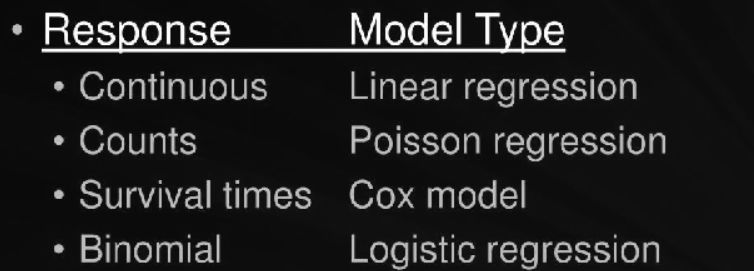
regression types

Types of regression based on number of independent variables (x):

  1. Simple: 1 x
    • Resulting estimates: called crude or unadjusted
  2. Multiple: >1 x
    • Resulting estimates: called adjusted

Regression vs Correlation:

Correlation measures the strength of the association between variables.

Regression quantifies the association. It should only be used if one of the variables is thought to precede
or cause the other.

References:

  1. Short notes in medical statistics for medical examinations – Dr. Mohamed Elsherif
  2. Medical statistics made easy – M. Harris and G. Taylor
  • Facebook
  • Twitter
PGMEE, MRCS, USMLE, MBBS, MD/MS Biostatistics

Post navigation

Previous post

Related Posts

PGMEE, MRCS, USMLE, MBBS, MD/MS

Dizziness : History and Examination

Oct 25, 2017

HISTORY Mnemonic: 4D-3E-2Fg-2H 1. Define “Dizziness”: Room is spinning/rocking/somersaulting – Vertigo Feel like “going to faint” – Near-syncope “Going to fall” or “Unsteady on feet” – Disequilibrium Feel like they’ve or are “left their body” or “floating/swimming” – Psychophysiologic dizziness 2. Duration of each episode: Seconds: BPPV Minutes: TIA or…

Read More
PGMEE, MRCS, USMLE, MBBS, MD/MS

Definitions, Criteria and Classifications in Osteomyelitis

May 27, 2020Jul 23, 2022

Morrey and Peterson’s Definition of Osteomyelitis Definite osteomyelitis: Positive bone or adjacent soft tissue culture or histologic evidence Probable osteomyelitis: Positive blood culture + Clinical & radiological evidence of osteomyelitis Likely osteomyelitis: Typical clinical and radiographic features of osteomyelitis responding to antibiotic therapy (in absence of positive culture) Peltola and…

Read More
PGMEE, MRCS, USMLE, MBBS, MD/MS normal chest xray

Systematic Approach to Frontal Chest X-ray

Jun 18, 2015

To make an appropriate diagnosis through a chest radiograph, it must be analyzed in a systematic manner. One of the common mistakes that students do is to miss the regions that needs to be looked for – commonest being the rib fractures. A mnemonic has been devised for this purpose:…

Read More

Leave a Reply Cancel reply

Your email address will not be published. Required fields are marked *

This site uses Akismet to reduce spam. Learn how your comment data is processed.

Pre-clinical (Basic Sciences)

Anatomy

Biochemistry

Community medicine (PSM)

Embryology

Microbiology

Pathology

Pharmacology

Physiology

Clinical Sciences

Anesthesia

Dermatology

Emergency medicine

Forensic

Internal medicine

Gynecology & Obstetrics

Oncology

Ophthalmology

Orthopedics

Otorhinolaryngology (ENT)

Pediatrics

Psychiatry

Radiology

Surgery

RSS Ask Epomedicine

  • What to study for Clinical examination in Orthopedics?
  • What is the mechanism of AVNRT?

Epomedicine weekly

  • About Epomedicine
  • Contact Us
  • Author Guidelines
  • Submit Article
  • Editorial Board
  • USMLE
  • MRCS
  • Thesis
©2026 Epomedicine | WordPress Theme by SuperbThemes