Skip to content
Epomedicine

Mnemonics, Simplified Concepts & Thoughts

Epomedicine

Mnemonics, Simplified Concepts & Thoughts

Parotid Gland : Mnemonics

Epomedicine, Aug 23, 2023May 3, 2024

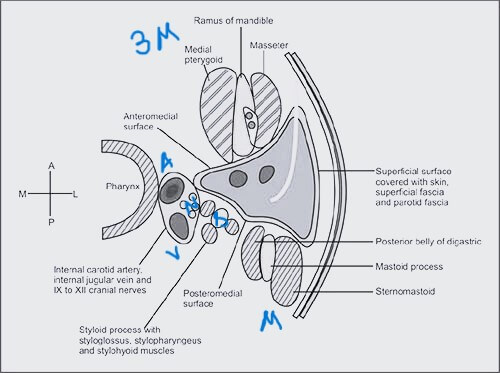
Relations

Anterior: 3 “M”

  • Mandible ramus
  • Medial pterygoid (medially)
  • Masseter (laterally)

Posterior: Mastoid and attachments

  • Mastoid
  • SCM
  • Posterior belly of Digastric

Medial (Parotid bed): VANS

  • 1 Vein (IJV)
    • Deep in floor of parotid bed
  • 2 Arteries (ECA and ICA)
    • Anterior to vein
  • 4 Nerves (last 4 cranial nerves, i.e., CN IX, X, XI, XII)
    • CN IX (related to “S” muscles)
    • CN X (between ICA and IJV)
    • CN XI and XII (superficial to carotid sheath but proceeding downward behind the posterior belly of digastric muscle)
  • 4″S” structures (Styloid process with 3 “S” muscles) –
    • Styloglossus
    • Stylopharyngeus
    • Stylohyoid
parotid gland relations

Structures traversing the parotid gland

Mnemonic: FACER

  1. Facial nerve and terminal branches
  2. Auriculotemporal nerve (CN V3)
  3. Carotid artery – External (provides arterial supply)
  4. Retromandibular vein (provides venous drainage)

Parotid gland innervation

1. Parasympathetic: Secretomotor (from Otic ganglion) – Serous, water rich saliva

Mnemonic: PAR–O–T–Id G–L–And

PARotid gland ← Auriculotemporal nerve ← Otic ganglion ← Lesser petrosal nerve ← Tympanic plexus ← Glossopharyngeal nerve ← Inferior salivatory nucleus

Another mnemonic is: IT has Lesser Options Anywhere

  • Inferior salivatory nucleus
  • Tympanic branch of CN IX
  • Lesser petrosal nerve
  • Otic ganglion
  • Auriculotemporal nerve

2. Sympathetic: Superior cervical ganglion – Enzyme rich saliva

3. Sensory: Greater auricular nerve
  • Facebook
  • Twitter
PGMEE, MRCS, USMLE, MBBS, MD/MS AnatomyOtorhinolaryngology

Post navigation

Previous post
Next post

Related Posts

PGMEE, MRCS, USMLE, MBBS, MD/MS hemolysis causes

Hemolytic Anemia – Quick review

Feb 4, 2017Feb 5, 2017

Although, we classify as intravascular and extravascular hemolysis, “diseases” don’t read the book. These disorders may be described as causing extravascular hemolysis, but your case may be the uncommon exception with intravascular hemolysis that was not mentioned. Diseases may cause anemia by both intravascular and extravascular hemolysis. Extravascular hemolysis typically…

Read More
PGMEE, MRCS, USMLE, MBBS, MD/MS pulmonary embolism xray

Perioperative Management of Venous thromboembolism (VTE)

Nov 3, 2021Nov 3, 2021

Recommended duration of anticoagulant prophylaxis The recommendations are as follows: 1. Provoked DVT (with reversible surgical or nonsurgical provoking factor): 3 months 2. Unprovoked isolated distal DVT (has low risk of recurrence): 3 months 3. Unprovoked proximal DVT or PE: Indefinite therapy if D-dimer positive after 1 month after 3 months of therapy or second VTE…

Read More
PGMEE, MRCS, USMLE, MBBS, MD/MS erythropoietin mechanism

Erythropoietin (EPO) Physiology

Sep 2, 2017

Structure of erythropoietin (EPO) Glycoprotein hormone 165 amino acids Molecular mass – 30 kDa Site of production/synthesis of erythropoietin (EPO) Kidneys (75-90%): Peritubular interstitial cells Liver (15%; chief source in fetus and neonates): Centrilobular hepatocytes After birth, erythropoietin is not detectable until 8-12 weeks after birth leading to physiological anaemia…

Read More

Leave a Reply Cancel reply

Your email address will not be published. Required fields are marked *

This site uses Akismet to reduce spam. Learn how your comment data is processed.

Epomedicine. Parotid Gland : Mnemonics [Internet]. Epomedicine; 2023 Aug 23 [cited 2026 Jul 22]. Available from: https://epomedicine.com/medical-students/parotid-gland-mnemonics/.

Pre-clinical (Basic Sciences)

Anatomy

Biochemistry

Community medicine (PSM)

Embryology

Microbiology

Pathology

Pharmacology

Physiology

Clinical Sciences

Anesthesia

Dermatology

Emergency medicine

Forensic

Internal medicine

Gynecology & Obstetrics

Oncology

Ophthalmology

Orthopedics

Otorhinolaryngology (ENT)

Pediatrics

Psychiatry

Radiology

Surgery

RSS Ask Epomedicine

  • What to study for Clinical examination in Orthopedics?
  • What is the mechanism of AVNRT?

Epomedicine weekly

  • About Epomedicine
  • Contact Us
  • Author Guidelines
  • Submit Article
  • Editorial Board
  • USMLE
  • MRCS
  • Thesis
©2026 Epomedicine | WordPress Theme by SuperbThemes