Skip to content
Epomedicine

Mnemonics, Simplified Concepts & Thoughts

Epomedicine

Mnemonics, Simplified Concepts & Thoughts

Parotid Gland : Mnemonics

Epomedicine, Aug 23, 2023May 3, 2024

Relations

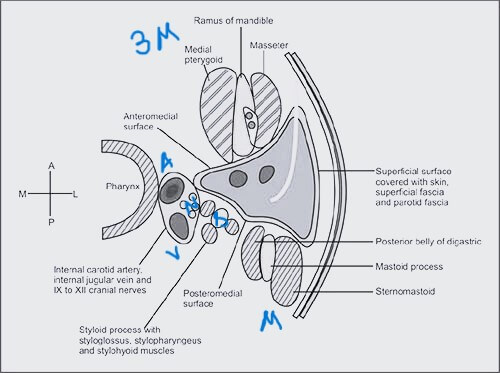
Anterior: 3 “M”

  • Mandible ramus
  • Medial pterygoid (medially)
  • Masseter (laterally)

Posterior: Mastoid and attachments

  • Mastoid
  • SCM
  • Posterior belly of Digastric

Medial (Parotid bed): VANS

  • 1 Vein (IJV)
    • Deep in floor of parotid bed
  • 2 Arteries (ECA and ICA)
    • Anterior to vein
  • 4 Nerves (last 4 cranial nerves, i.e., CN IX, X, XI, XII)
    • CN IX (related to “S” muscles)
    • CN X (between ICA and IJV)
    • CN XI and XII (superficial to carotid sheath but proceeding downward behind the posterior belly of digastric muscle)
  • 4″S” structures (Styloid process with 3 “S” muscles) –
    • Styloglossus
    • Stylopharyngeus
    • Stylohyoid
parotid gland relations

Structures traversing the parotid gland

Mnemonic: FACER

  1. Facial nerve and terminal branches
  2. Auriculotemporal nerve (CN V3)
  3. Carotid artery – External (provides arterial supply)
  4. Retromandibular vein (provides venous drainage)

Parotid gland innervation

1. Parasympathetic: Secretomotor (from Otic ganglion) – Serous, water rich saliva

Mnemonic: PAR–O–T–Id G–L–And

PARotid gland ← Auriculotemporal nerve ← Otic ganglion ← Lesser petrosal nerve ← Tympanic plexus ← Glossopharyngeal nerve ← Inferior salivatory nucleus

Another mnemonic is: IT has Lesser Options Anywhere

  • Inferior salivatory nucleus
  • Tympanic branch of CN IX
  • Lesser petrosal nerve
  • Otic ganglion
  • Auriculotemporal nerve

2. Sympathetic: Superior cervical ganglion – Enzyme rich saliva

3. Sensory: Greater auricular nerve

  • Facebook
  • Twitter
PGMEE, MRCS, USMLE, MBBS, MD/MS AnatomyOtorhinolaryngology

Post navigation

Previous post
Next post

Related Posts

PGMEE, MRCS, USMLE, MBBS, MD/MS rosette types

Rosettes in Pathology

Jan 26, 2017Jan 27, 2017

Rosette refers to a decoration or pattern resembling a rose. In pathology, rosette refers to aa halo or “spoke-wheel” arrangement of cells around a central structure especially in neoplasms of neuroblastic or neuroectoderma origin. The central structure can be: a. Empty lumen: True ependymal rosette Well differentiated ependymomas (minority of cases)…

Read More
PGMEE, MRCS, USMLE, MBBS, MD/MS

DSM-5 & ICD-11 Diagnostic Criteria for Mania : Mnemonic

Apr 7, 2026Apr 7, 2026

Mnemonic: ME DIG FAST Required symptoms: Other symptoms: Several symptoms (ICD-11) or Atleast 3 (DSM-5) of – Mania Hypomania Required duration 7 days 4 days Functional impairment Yes No Flight of ideas & Psychotic symptoms Can have No

Read More
PGMEE, MRCS, USMLE, MBBS, MD/MS Ostiomeatal unit anatomic variants

Anatomy of Ostiomeatal complex

May 14, 2014May 14, 2014

Synonyms: Ostiomeatal unit, Osteomeatal complex, OMC Definition: The term “ostiomeatal unit” represents the area on the lateral nasal wall (middle meatus) that receives drainage from the anterior  and medial ethmoid cells, frontal sinus, and maxillary sinus. It is an antomically constricted area that is prone to blockage, especially in the…

Read More

Leave a Reply Cancel reply

Your email address will not be published. Required fields are marked *

This site uses Akismet to reduce spam. Learn how your comment data is processed.

Pre-clinical (Basic Sciences)

Anatomy

Biochemistry

Community medicine (PSM)

Embryology

Microbiology

Pathology

Pharmacology

Physiology

Clinical Sciences

Anesthesia

Dermatology

Emergency medicine

Forensic

Internal medicine

Gynecology & Obstetrics

Oncology

Ophthalmology

Orthopedics

Otorhinolaryngology (ENT)

Pediatrics

Psychiatry

Radiology

Surgery

RSS Ask Epomedicine

  • What to study for Clinical examination in Orthopedics?
  • What is the mechanism of AVNRT?

Epomedicine weekly

  • About Epomedicine
  • Contact Us
  • Author Guidelines
  • Submit Article
  • Editorial Board
  • USMLE
  • MRCS
  • Thesis
©2026 Epomedicine | WordPress Theme by SuperbThemes