Skip to content
Epomedicine

Mnemonics, Simplified Concepts & Thoughts

Epomedicine

Mnemonics, Simplified Concepts & Thoughts

erythropoietin mechanism

Erythropoietin (EPO) Physiology

Epomedicine, Sep 2, 2017

Structure of erythropoietin (EPO)

  • Glycoprotein hormone
  • 165 amino acids
  • Molecular mass – 30 kDa

Site of production/synthesis of erythropoietin (EPO)

  1. Kidneys (75-90%): Peritubular interstitial cells
  2. Liver (15%; chief source in fetus and neonates): Centrilobular hepatocytes

After birth, erythropoietin is not detectable until 8-12 weeks after birth leading to physiological anaemia of the newborn.

Gene for erythropoietin is on chromosome 7.

Mechanism of action of erythropoietin (EPO)

1. Receptor: Tyrosine-kinase (JAK/STAT pathway)

2. Functions in hematopoiesis:

  • Poerthyroblast production:
    • Proliferation: Stimulates mitosis in committed erythroid progenitor cells; it doesn’t act on pluripotent stem cells
    • Differentiation (major): Prevents DNA breakdown
  • Speeds up RBC maturation: Shortens time between recrutiment of precursor stem cells and release of reticulocytes
  • Hemoglobin synthesis: Erythropoietin stimulates the rate-limiting step in hemoglobin synthesis, i.e. formation of ALA from glycine and succininc acid by ALA synthase

Increase in circulating RBCs triggered by erythropoietin takes 2-3 days to appear, since red cell maturation is a slow process.
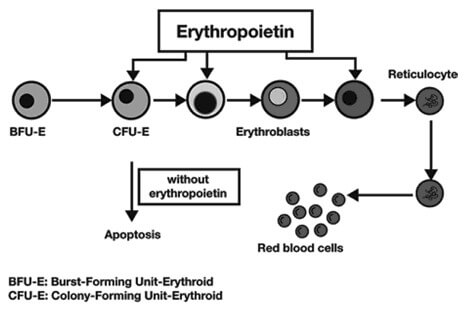
erythropoietin mechanism

3. Proposed functions outside bone marrow:

  • Blood vessels: Angiogenesis
  • Brain: Neurotrophic and neuroprotective

Stimulation of erythropoietin (EPO) production

1. Hypoxia sensed by kidney (renal hypoxia): Hypoxia increases the abundance of the α subunit of the hypoxia-inducible factor (HIF-1α) which would otherwise undergo ubiquitin-proteasome degradation under normoxic conditions. Abundance of HIF-1α enchances production of erythropoietin mRNA. This can be due to hypoxemia or renal vasoconstriction.

2. Hormones: Androgens, Thyroxine,  Growth hormone, Prolactin, ACTH, Adrenocortical steroids

3. Hemolysates: Products released following hemolysis of RBCs

Mnemonic: Remember 3 “H” that stimulate erythropoietin production.

Erythropoietin (EPO) metabolism

  • Principal site of inactivation is liver.
  • Half-life in circulation is about 5 hours.

Clinical uses of erythropoietin (EPO)

  1. Anemia of chronic renal failure
  2. Myelodysplastic syndrome
  3. Anemia associated with malignancy
  4. Anemia of chronic disease
  5. AIDS
  6. Anemia of prematurity
  7. Presurgical uses (Jeovah’s witness)

Erythropoietin abuse

In blood doping to increase endurance and physical fitness in sports


References

  1. Kumar and Clark’s Clinical Medicine By Parveen Kumar, Michael L Clark
  2. Principles of Physiology for the Anaesthetist, Second edition By Peter Kam, Ian Power
  3. Ganong’s review of Medical Physiology, 24th edition
  4. Medical Physiology, 2nd Edition by Walter Boron Emile Boulpaep
  • Facebook
  • Twitter
PGMEE, MRCS, USMLE, MBBS, MD/MS HematologyPhysiology

Post navigation

Previous post
Next post

Related Posts

PGMEE, MRCS, USMLE, MBBS, MD/MS mathes and nahai

Mathes and Nahai Classification of Muscle Flap based on Vascular Anatomy

Oct 16, 2017

Type Dominant pedicle Minor pedicle Example I 1 – Tensor Fascia Lata (TFL) II 1 1 Gracilis III 2 – Gluteus maximus IV – Multiple Sartorius V 1 Multiple Lattisimus dorsi Mnemonic: Ten Graceful Glutes Sat on Latrines Type I: TFL Type II: Gracilis Type III: Gluteus maximus Type IV:…

Read More
PGMEE, MRCS, USMLE, MBBS, MD/MS

Ketamine : Mnemonic

Feb 11, 2023Feb 11, 2023

K: Kids (Induction agent of choice in children) E: Emergence reaction (floating sensations, vivid dreams and hallucination; reduced using benzodiazepines), Enantiomers (S-Ketamine and R-Ketamine) T: Thalamo-cortical dissociation with limbic system causing dissociative anesthesia A: Analgesic, Amnesic, Antidepressant, All routes (IV, IM, PO, Intranasal, Epidural, Intrathecal) M: Meals – can be…

Read More
PGMEE, MRCS, USMLE, MBBS, MD/MS venous draianage of face schematic

Venous drainage of Face : “W” shaped arrangement

Oct 18, 2017

When we look from lateral side, the veins on each side form a “W” shaped arrangement. Each corner of the “W” is prolonged upward into the scalp, and downward into the neck. Remember the 3 verticla stems of letter “W”: 1st stem (in face): Facial vein 2nd stem (behind mandible,…

Read More

Leave a Reply Cancel reply

Your email address will not be published. Required fields are marked *

This site uses Akismet to reduce spam. Learn how your comment data is processed.

Epomedicine. Erythropoietin (EPO) Physiology [Internet]. Epomedicine; 2017 Sep 2 [cited 2026 May 20]. Available from: https://epomedicine.com/medical-students/erythropoietin-epo-physiology/.

Pre-clinical (Basic Sciences)

Anatomy

Biochemistry

Community medicine (PSM)

Embryology

Microbiology

Pathology

Pharmacology

Physiology

Clinical Sciences

Anesthesia

Dermatology

Emergency medicine

Forensic

Internal medicine

Gynecology & Obstetrics

Oncology

Ophthalmology

Orthopedics

Otorhinolaryngology (ENT)

Pediatrics

Psychiatry

Radiology

Surgery

RSS Ask Epomedicine

  • What to study for Clinical examination in Orthopedics?
  • What is the mechanism of AVNRT?

Epomedicine weekly

  • About Epomedicine
  • Contact Us
  • Author Guidelines
  • Submit Article
  • Editorial Board
  • USMLE
  • MRCS
  • Thesis
©2026 Epomedicine | WordPress Theme by SuperbThemes