Skip to content
Epomedicine

Mnemonics, Simplified Concepts & Thoughts

Epomedicine

Mnemonics, Simplified Concepts & Thoughts

ORS resomal

ORS and ReSoMal – Mnemonic

Epomedicine, Jun 11, 2019Jun 11, 2019

Oral Rehydration Solution (ORS)

Grams per litre:

  1. SoDIum C-hloride: 2.6 gm
  2. SoDIum Ci-Trate: 2.9 gm
  3. Potassium chloride: 1.5 gm
  4. Glucose anhydrous: 13.5 gm

Mnemonic:

DI = 2 and C = 6
Ci-Trate = Rotate 6, i.e. 9
For Potassium chloride: Deduct 1 from the whole number and decimal both, i.e. (2-1).(6-1) = 1.5 gm

mmol per litre:

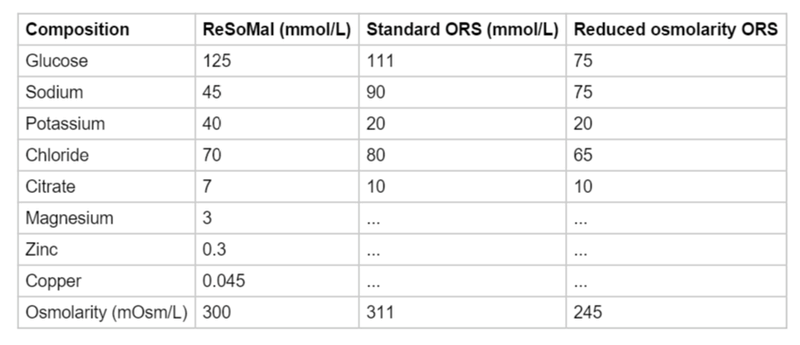
  1. Sodium and Glucose (Sugar): 75 each
  2. Chloride: 65
  3. Potassium: 20
  4. Citrate: 10
    Total: 245

Mnemonic:

S for Sodium and Sugar; S for 75
Sodium – 10 = Chloride = 65
Potassium – 10 = Citrate = 10
ors resomal

Rehydration Solution for Malnutrition (ReSoMal)

1 ORS packet + 50 gm sugar + 40 gm electrolytes and minerals (Cu, Zn, Mg) + 2 litre water

mmol/litre

  1. Sodium: ORS – 30 = 75-30 = 45
  2. Citrate: ORS – 3 = 10-3 = 7
  3. Glucose: ORS + 50 = 75+50 = 125
  4. Chloride: ORS + 5 = 65+5 = 70
  5. Potassium: ORS X 2 = 20 X 2 = 40
  6. Cu, Zn, Mn = 4
    Total = 300

Another Mnemonic:
1. Sodium and Potassium are almost equal. Take the mean of their ORS concentration, i.e. (75+20)/2 ~ 45 + 40
2. Remember the pairs:
Potassium and Minerals: 40 and 4 respsectively
Chloride and Citrate: 70 and 7 respectively

  • Facebook
  • Twitter
PGMEE, MRCS, USMLE, MBBS, MD/MS Gastrointestinal systemPediatrics

Post navigation

Previous post
Next post

Related Posts

PGMEE, MRCS, USMLE, MBBS, MD/MS opioid receptors

Opioid Adverse Effects – Mnemonic

Apr 14, 2021Apr 14, 2021

Mnemonic: MORPHINES 1. Miosis Mechanism: Stimulation of Edinger-Westphal nucleus of Cranial nerve III 2. Orthostatic hypotension Mechanism: Vasodilation due to – Direct action decreasing tone of blood vessels Histamine release Depression of vasomotor center 3. Respiratory depression Mechanism: Inhibits respiratory center in a dose-dependent manner (neurogenic, hypercapneic and hypoxic drives…

Read More
PGMEE, MRCS, USMLE, MBBS, MD/MS

Linea Aspera

Oct 26, 2022May 14, 2024

Linea aspera is a ridge of roughened surface on the posterior surface of the shaft of femur which serves as a site for attachment of muscles and intermuscular septum. The various structures attached to linea aspera can be remembered using few mnemonics: Mnemonic 1#: 1, 2, 3 It gives attachment…

Read More
PGMEE, MRCS, USMLE, MBBS, MD/MS

Modified Ficat-Arlet Staging for AVN hip : Mnemonic

Jun 15, 2020Jun 15, 2020

Ficat and Arlet first classified avascular necrosis of femoral head (AVN) in 1964 before the advent of MRI which was later modified and published in 1985 to include pre-radiographic stages relying on invasive testing procedures. The classification system later underwent further modifications that include MRI findings, patient symptoms and modifies…

Read More

Comment

  1. Deepak Das says:
    Jun 14, 2019 at 5:00 am

    Excellent mnemonics every week you send to me.Extremely grateful.I need more like the following.
    1.Ac.pancreatitis :BISHAP,RANSON score etc.
    2.Hepatic encephalopathy

    Reply

Leave a Reply to Deepak Das Cancel reply

Your email address will not be published. Required fields are marked *

This site uses Akismet to reduce spam. Learn how your comment data is processed.

Pre-clinical (Basic Sciences)

Anatomy

Biochemistry

Community medicine (PSM)

Embryology

Microbiology

Pathology

Pharmacology

Physiology

Clinical Sciences

Anesthesia

Dermatology

Emergency medicine

Forensic

Internal medicine

Gynecology & Obstetrics

Oncology

Ophthalmology

Orthopedics

Otorhinolaryngology (ENT)

Pediatrics

Psychiatry

Radiology

Surgery

RSS Ask Epomedicine

  • What to study for Clinical examination in Orthopedics?
  • What is the mechanism of AVNRT?

Epomedicine weekly

  • About Epomedicine
  • Contact Us
  • Author Guidelines
  • Submit Article
  • Editorial Board
  • USMLE
  • MRCS
  • Thesis
©2026 Epomedicine | WordPress Theme by SuperbThemes