Skip to content
Epomedicine

Mnemonics, Simplified Concepts & Thoughts

Epomedicine

Mnemonics, Simplified Concepts & Thoughts

Obstacles to reduction in Developmental Dysplasia of Hip (DDH)

Dr. Sulabh Kumar Shrestha, MS Orthopedics, Nov 25, 2025Nov 25, 2025

Extra-articular obstacles: Secondary muscle shortening due to hip in subluxed/dislocated position

  1. Contracted adductor longus
  2. Contracted iliopsoas
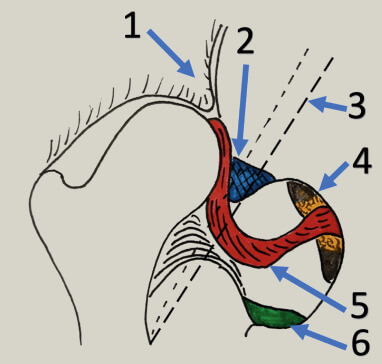
    • Curves in front of the joint capsule
From: Farrow L et al., Surgical management for developmental dysplasia of the hip, Orthopaedics and Trauma, https://doi.org/
10.1016/j.mporth.2020.09.001
1. Anteromedial capsule; 2. Inverted limbus; 3. Iliopsoas tendon; 4. Pulvinar; 5. Ligamentum teres; 6. TAL

Intra-articular obstacles: Results in decreased volume of the acetabulum

  1. Thickened/elongated ligamentum teres
  2. Hypertrophied transverse acetabular ligament (TAL)
    • In crawling or walking child, caused by constant pull of ligamentum teres on its attachment at the base of the acetabulum
  3. Constricted anteromedial joint capsule
    • Most common and significant intra-articular obstacle
    • Caused by overlying contracted iliopsoas tendon
  4. Inverted and hypertrophied labrum (limbus)
    • Rare finding (seen only in teratologic dislocations and previously failed closed reductions)
  5. Pulvinar hypertrophy

Neo-limbus (acetabular roof hyaline cartilage): Neolimbus is a hypertrophied ridge of fibrocartilage in the superolateral region of the acetabulum caused by pressure from the dislocated hip on this region. While some authors consider it can be an obstacle to reduction of hip, others have made following considerations:
a. Unlike limbus, it can invert or evert and is not an obstacle to reduction.
b. Neolimbus is not a fixed deformity and will spontaneously resolve once the femoral head has been reduced.
c. Neolimbus contains acetabular cartilage, and therefore epiphyseal cartilage, which is involved in the growth and development of the older child’s acetabulum and hence, should never be removed.

Further reading and references:

  1. Lovell and Winter’s Pediatric Orthopedics
  2. Landa J, Benke M, Feldman DS. The limbus and the neolimbus in developmental dysplasia of the hip. Clin Orthop Relat Res. 2008 Apr;466(4):776-81. doi: 10.1007/s11999-008-0158-y. Epub 2008 Mar 12. PMID: 18335297; PMCID: PMC2504652.
  3. Studer K, Williams N, Studer P, et al. Obstacles to reduction in infantile developmental dysplasia of the hip. Journal of Children’s Orthopaedics. 2017;11(5):358-366. doi:10.1302/1863-2548.11.170031

Mnemonic: PLACE

  1. Pulvinar
  2. Labrum (limbus), Ligaments (TAL, Ligamentum teres)
  3. Acetabular roof cartilage hypertrophy (Neolimbus) – controversial
  4. Capsule (anteromedial)
  5. Extra-articular (iliopsoas and adductor longus tendon)

    dr. sulabh kumar shrestha
    Dr. Sulabh Kumar Shrestha, MS Orthopedics

    He is the section editor of Orthopedics in Epomedicine. He searches for and share simpler ways to make complicated medical topics simple. He also loves writing poetry, listening and playing music. He is currently pursuing Fellowship in Hip, Pelvi-acetabulum and Arthroplasty at B&B Hospital.
    • Facebook
    • Twitter
    PGMEE, MRCS, USMLE, MBBS, MD/MS OrthopedicsPediatric hip

    Post navigation

    Previous post
    Next post

    Related Posts

    PGMEE, MRCS, USMLE, MBBS, MD/MS auditory pathway

    Auditory Pathway Mnemonic

    Jul 26, 2016Jul 26, 2016

    Auditory Pathway Component Mnemonic E.C.O.L.I.M.A Ascending from peripheral to central the components are: Ear receptors (Hair cells) in Cochlea and Eighth Cranial nerve (CN VIII) Cochlear nucleus Superior Olivary nucleus Lateral lemniscus Inferior colliculus Medial geniculate body Auditory cortex Explanation of the Mnemonic Ear receptors and Eighth cranial nerve (Organ…

    Read More
    PGMEE, MRCS, USMLE, MBBS, MD/MS

    Gastric Acid Secretion Made Easy

    Aug 12, 2023Aug 12, 2023

    Steps for gastric acid secretion by parietal cells 1. H+ and HCO3- are produced from CO2 and H2O. 2. H+ is secreted into the lumen by H+/K+ ATPase pump. 3. HCO3- moves out of the cell, across the basolateral membrane via antiport with Cl-. 4. Cl- diffuses passively into the…

    Read More
    PGMEE, MRCS, USMLE, MBBS, MD/MS

    Development of Pituitary Gland

    Jun 15, 2020Jun 15, 2020

    The pituitary gland (hypophysis cerebri) is derived from 2 sources. The anterior lobe is an upgrowth of ectoderm from the roof of the stomodeum (primitive buccal cavity), while the posterior lobe is a down growth of neuroectoderm from the diencephalon. 4th week: a diverticulum, Rathke’s pouch, grows upwards from the roof of the stomodeum towards the…

    Read More

    Leave a Reply Cancel reply

    Your email address will not be published. Required fields are marked *

    This site uses Akismet to reduce spam. Learn how your comment data is processed.

    Shrestha SK. Obstacles to reduction in Developmental Dysplasia of Hip (DDH) [Internet]. Epomedicine; 2025 Nov 25 [cited 2025 Dec 6]. Available from: https://epomedicine.com/medical-students/obstacles-to-reduction-in-developmental-dysplasia-of-hip-ddh/.

    Pre-clinical (Basic Sciences)

    Anatomy

    Biochemistry

    Community medicine (PSM)

    Embryology

    Microbiology

    Pathology

    Pharmacology

    Physiology

    Clinical Sciences

    Anesthesia

    Dermatology

    Emergency medicine

    Forensic

    Internal medicine

    Gynecology & Obstetrics

    Oncology

    Ophthalmology

    Orthopedics

    Otorhinolaryngology (ENT)

    Pediatrics

    Psychiatry

    Radiology

    Surgery

    RSS Ask Epomedicine

    • What to study for Clinical examination in Orthopedics?
    • What is the mechanism of AVNRT?

    Epomedicine weekly

    • About Epomedicine
    • Contact Us
    • Author Guidelines
    • Submit Article
    • Editorial Board
    • USMLE
    • MRCS
    • Thesis
    ©2025 Epomedicine . All rights reserved.