Skip to content
Epomedicine

Mnemonics, Simplified Concepts & Thoughts

Epomedicine

Mnemonics, Simplified Concepts & Thoughts

Morel Lavallee Lesion

Dr. Sulabh Kumar Shrestha, MS Orthopedics, May 22, 2025May 22, 2025

Definition: Post-traumatic closed degloving injury, in which the skin and subcutaneous tissue is detached from the underlying fascia by a shearing force which can disrupt perforating vessels and nerves, creating a potential space that fills with blood, lymph, debris and fat (necrotic and/or viable).

Clinical features:

The diagnosis can be challenging because the overlying skin may appear normal, although dermal changes such as ecchymosis and necrosis can occur.
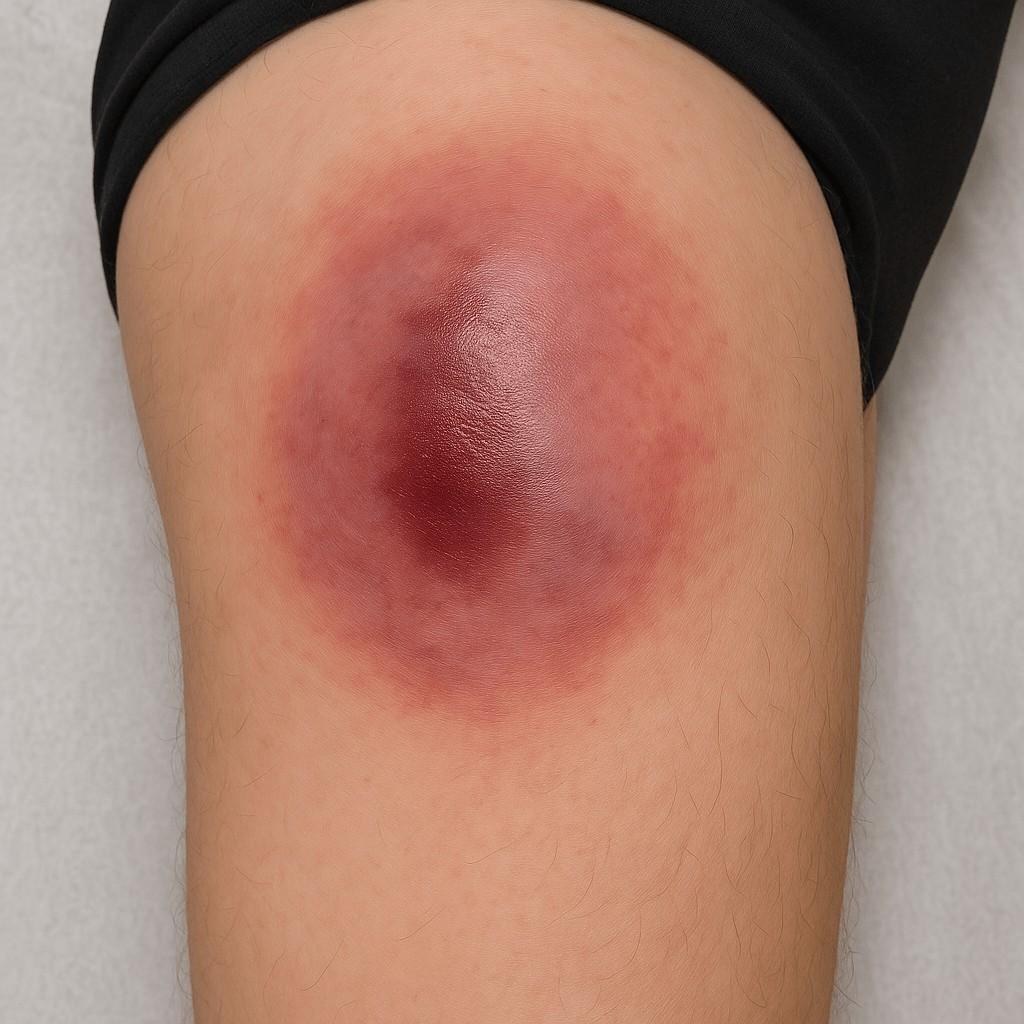
morel-lavalle lesion
AI Generated Image

Onset:

  • 2/3rd cases: within hours to days after the inciting trauma
  • 1/3rd cases: present months or years after the initial trauma

Symptoms:

  • Pain
  • Swelling
  • Stiffness

Signs:

  • Soft fluctuant area of contour deformity, with or without skin discoloration and skin hypermotility
  • Decreased skin sensation if cutaneous nerves are disrupted
  • Skin necrosis (acute or delayed)

Investigation of choice: MRI

  • Acute lesions: Heterogenous signal intensity
  • Chronic lesions:
    • Hypointense on T1-weighted images and hyperintense on T2-weighted images
    • Peripheral hypointense pseudo-capsule on T1 and T2 weighted images

Treatment:

There are no consensus algorithm for management of Morel-Lavalle lesions.
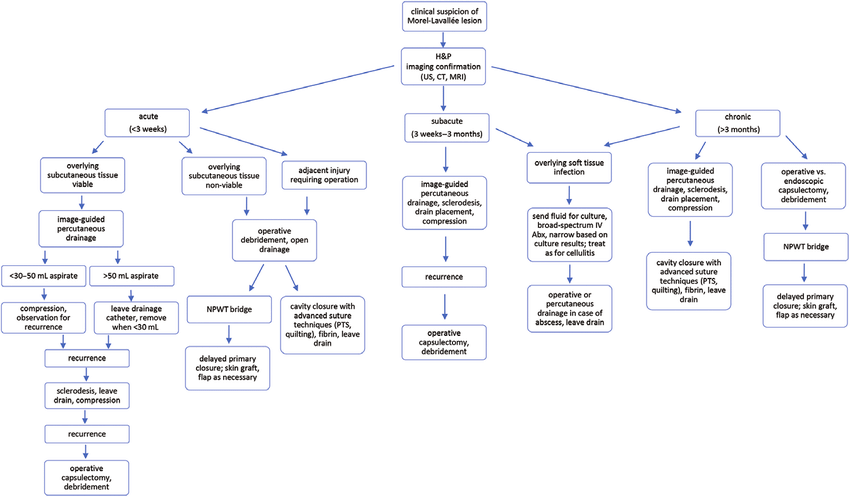
morel-lavallee lesion
Molina, Bianca & Ghazoul, Erika & Janis, Jeffrey. (2021). Practical Review of the Comprehensive Management of Morel-Lavallée Lesions. Plastic and Reconstructive Surgery – Global Open. 9. e3850. 10.1097/gox.0000000000003850. [CC BY 4.0]
dr. sulabh kumar shrestha
Dr. Sulabh Kumar Shrestha, MS Orthopedics

He is the section editor of Orthopedics in Epomedicine. He searches for and share simpler ways to make complicated medical topics simple. He also loves writing poetry, listening and playing music. He is currently pursuing Fellowship in Hip, Pelvi-acetabulum and Arthroplasty at B&B Hospital.
  • Facebook
  • Twitter
PGMEE, MRCS, USMLE, MBBS, MD/MS General SurgeryMusculoskeletal systemOrthopedics

Post navigation

Previous post
Next post

Related Posts

PGMEE, MRCS, USMLE, MBBS, MD/MS

Calcium Channel Blockers : Mnemonic

Sep 20, 2019Sep 20, 2019

Dihydropyridines Mnemonics:a. D for “-dipine”b. D for Dilation of vessels Nifedipine Nicardipine Isradipine Felodipine Amlodipine Non-dihydropyridines Mnemonics:a. N-D for Non “-dipines”b. N-D for Node supression + Dilation of vessels Verapamil Diltiazem Dr. Sulabh Kumar Shrestha, MS Orthopedics He is the section editor of Orthopedics in Epomedicine. He searches for and…

Read More
PGMEE, MRCS, USMLE, MBBS, MD/MS

“5-Ps” Mnemonic for Preoperative Antibiotic Prophylaxis

Jul 10, 2025Jul 10, 2025

Potential indications for antibiotic prophylaxis before surgical procedure are: 1. Penetration into gastrointestinal, respiratory and genital lumens 2. Prosthesis 3. Presence of infection 4. Prolonged surgery 5. Poor patient immunity Reference: Hasanin A, Mostafa M. The “5-Ps” Mnemonic for Antibiotic Prophylaxis Before Surgery. Anesth Analg. 2025 May 7. doi: 10.1213/ANE.0000000000007596….

Read More
PGMEE, MRCS, USMLE, MBBS, MD/MS

Dizziness : History and Examination

Oct 25, 2017

HISTORY Mnemonic: 4D-3E-2Fg-2H 1. Define “Dizziness”: Room is spinning/rocking/somersaulting – Vertigo Feel like “going to faint” – Near-syncope “Going to fall” or “Unsteady on feet” – Disequilibrium Feel like they’ve or are “left their body” or “floating/swimming” – Psychophysiologic dizziness 2. Duration of each episode: Seconds: BPPV Minutes: TIA or…

Read More

Leave a Reply Cancel reply

Your email address will not be published. Required fields are marked *

This site uses Akismet to reduce spam. Learn how your comment data is processed.

Pre-clinical (Basic Sciences)

Anatomy

Biochemistry

Community medicine (PSM)

Embryology

Microbiology

Pathology

Pharmacology

Physiology

Clinical Sciences

Anesthesia

Dermatology

Emergency medicine

Forensic

Internal medicine

Gynecology & Obstetrics

Oncology

Ophthalmology

Orthopedics

Otorhinolaryngology (ENT)

Pediatrics

Psychiatry

Radiology

Surgery

RSS Ask Epomedicine

  • What to study for Clinical examination in Orthopedics?
  • What is the mechanism of AVNRT?

Epomedicine weekly

  • About Epomedicine
  • Contact Us
  • Author Guidelines
  • Submit Article
  • Editorial Board
  • USMLE
  • MRCS
  • Thesis
©2026 Epomedicine | WordPress Theme by SuperbThemes