Skip to content
Epomedicine

Mnemonics, Simplified Concepts & Thoughts

Epomedicine

Mnemonics, Simplified Concepts & Thoughts

Coccyx Types

Epomedicine, May 23, 2025May 23, 2025

Postacchini and Massobrio Classification (Nathan Modification)

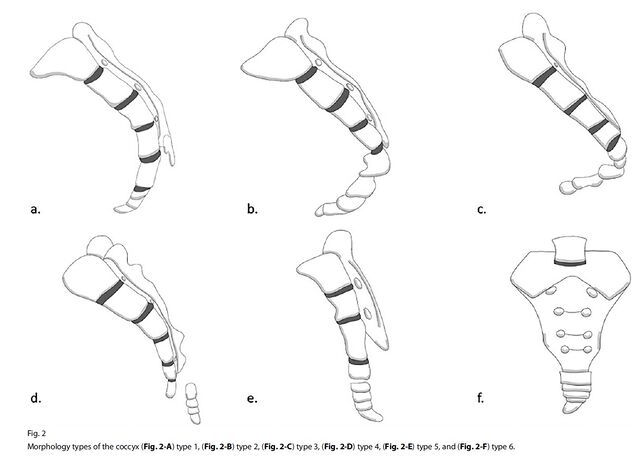
Can be classified into 6 types:

coccyx types
https://wikism.org/w/index.php?curid=4367

Type I (slight curve): Curved slightly forward with apex pointing caudally (>50% incidence)

Type II (forward curve): More prominent ventral curvature with coccyx apex pointing anteriorly (8-32% incidence)

Type III (sharp angle): Acute anterior angulation of coccyx but no subluxation (4-16% incidence)

Type IV (subluxation): Focal anterior angulation with anterior subluxation (1-9% incidence)

Type V (retroverted): Posteriorly angulated coccyx (1-11% incidence)

Type VI (scoliotic): Scoliotic deformity or lateral angulation of coccyx (1-6% incidence)

Clinical implication

Patients with a type II-IV coccyx are more prone to develop idiopathic coccygodynia
  • Facebook
  • Twitter
PGMEE, MRCS, USMLE, MBBS, MD/MS AnatomyMusculoskeletal systemOrthopedicsRadiology

Post navigation

Previous post
Next post

Related Posts

PGMEE, MRCS, USMLE, MBBS, MD/MS concentration effect

Concentration effect, Second gas effect and Diffusion hypoxia

Oct 20, 2016Oct 20, 2016

Concentration effect The higher the concentration of an inhaled anesthetic, the faster the alveolar concentration approaches the inhaled concentration. This is referred to as concentration effect and is clinically significant only in cases where gases are administered in high concentration: Nitrous oxide Xenon Ostwald’s blood gas solubility coefficient: ratio of…

Read More
PGMEE, MRCS, USMLE, MBBS, MD/MS hilum signs

Chest Xray – Approach to hilum

Jun 24, 2015Jun 24, 2015

Hilum in human anatomy refers to the depression where structures such as blood vessels and nerves enter an organ. The structures contributing to hilar shadows in a Chest X-ray are: Major: Pulmonary artery and veins Minor: Fat, Lymph nodes and Bronchial walls Normal Hilum: Position: Left hilum is slightly higher…

Read More
PGMEE, MRCS, USMLE, MBBS, MD/MS

ECG Axis Determination : Mnemonic

Aug 11, 2019Aug 11, 2019

Lead I = left (0 degrees)Lead aVF = floor (90 degrees) Lead I +ve and Lead aVF +ve = Between 0-90 degrees (Normal axis) Lead I -ve and Lead aVF +ve = Between 90-180 degrees (Right axis deviation) Lead I +ve and Lead aVF -ve = Between 0 to -90…

Read More

Leave a Reply Cancel reply

Your email address will not be published. Required fields are marked *

This site uses Akismet to reduce spam. Learn how your comment data is processed.

Pre-clinical (Basic Sciences)

Anatomy

Biochemistry

Community medicine (PSM)

Embryology

Microbiology

Pathology

Pharmacology

Physiology

Clinical Sciences

Anesthesia

Dermatology

Emergency medicine

Forensic

Internal medicine

Gynecology & Obstetrics

Oncology

Ophthalmology

Orthopedics

Otorhinolaryngology (ENT)

Pediatrics

Psychiatry

Radiology

Surgery

RSS Ask Epomedicine

  • What to study for Clinical examination in Orthopedics?
  • What is the mechanism of AVNRT?

Epomedicine weekly

  • About Epomedicine
  • Contact Us
  • Author Guidelines
  • Submit Article
  • Editorial Board
  • USMLE
  • MRCS
  • Thesis
©2026 Epomedicine | WordPress Theme by SuperbThemes