Skip to content
Epomedicine

Mnemonics, Simplified Concepts & Thoughts

Epomedicine

Mnemonics, Simplified Concepts & Thoughts

Corona Mortis

Epomedicine, May 22, 2025May 22, 2025

Synonym: Crown of Death

Definition: Retropubic vascular anastomoses between the obturator and external iliac systems

Location: Behind the superior pubic ramus at varying distance from the symphysis pubis (range 40-96 mm)
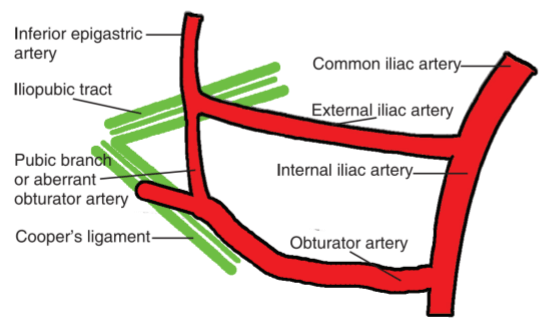
corona mortis

Morphologies:

a. Arterial corona mortis (8-65% incidence):

  • Obturator artery (OA) arising from External Iliac Artery (EIA)
  • Obturator artery (OA) arising from Inferior Epigastric Artery (IEA) – a branch of EIA
  • Anastomosis between OA and EIA
  • Pubic branches of OA, without any anastomosis with EIA system

b. Venous corona mortis (40-96% incidence):

  • Obturator vein (OV) which drains into External iliac vein (EIV)
  • Obturator vein (OV) which drains into Inferior epigastric vein (IEV)
  • Venous anastomosis of OV and EIV

c. Combined arterial and venous corona mortis

Clinical significance of corona mortis:

1. Pelvic fracture: Massive extraperitoneal hemorrhage can arise due to injury of corona mortis.

2. Femoral hernia surgery: If it is medial to the femoral ring, widening the neck of femoral hernia during surgery by releasing the lacunar ligament may cause injury to corona mortis.

3. Ilioinguinal approach: Corona mortis can be injured if the iliopectineal ligament is cut blindly or the medial lacunar ligament is overenthusiastically released to improve exposure.

Further reading (it also clarifies the use of term “accessory” and “abberrant” obturator artery): Corona Mortise- anatomical variants and implications in pelvic-acetabular surgery: An evidence based review – PMC
  • Facebook
  • Twitter
PGMEE, MRCS, USMLE, MBBS, MD/MS Cardiovascular systemGeneral SurgeryOrthopedics

Post navigation

Previous post
Next post

Related Posts

PGMEE, MRCS, USMLE, MBBS, MD/MS

Oestern and Tscherne Classification for Closed fractures

Sep 6, 2020Sep 6, 2020

The classification system for closed fractures is based on the physiologic concept that the energy imparted to the bone (and the resultant fracture pattern) directly correlates with the energy transferred to the surrounding soft tissues. Grade Soft tissue injury Fracture Compartment C0 Absent or Negligible Simple (Spiral) Soft and/or Normal…

Read More
PGMEE, MRCS, USMLE, MBBS, MD/MS

Apt Test in Newborn: Maternal vs Neonatal Blood

Nov 19, 2022Nov 19, 2022

We had few cases of suspected GI bleeding, admitted or referred to our NICU. One was case of Hematochezia and other was case of fresh blood in vomitus. Both babies were born to mother with Antepartum hemorrhage. The general condition of the babies were fine, and the vitals. There was…

Read More
PGMEE, MRCS, USMLE, MBBS, MD/MS

Wrist Extensor Compartments

Jun 20, 2020Oct 15, 2020

The Extensor Zone VII (wrist) contains 6 extensor compartments comprising of 6 synovial sheath lined tunnels separated from each other by fibrous sheath. These compartments contain tendons of muscles that pass from forearm to hand. The number of tendons passinf thorugh the compartments (radial to ulnar) can be remembered using…

Read More

Leave a Reply Cancel reply

Your email address will not be published. Required fields are marked *

This site uses Akismet to reduce spam. Learn how your comment data is processed.

Pre-clinical (Basic Sciences)

Anatomy

Biochemistry

Community medicine (PSM)

Embryology

Microbiology

Pathology

Pharmacology

Physiology

Clinical Sciences

Anesthesia

Dermatology

Emergency medicine

Forensic

Internal medicine

Gynecology & Obstetrics

Oncology

Ophthalmology

Orthopedics

Otorhinolaryngology (ENT)

Pediatrics

Psychiatry

Radiology

Surgery

RSS Ask Epomedicine

  • What to study for Clinical examination in Orthopedics?
  • What is the mechanism of AVNRT?

Epomedicine weekly

  • About Epomedicine
  • Contact Us
  • Author Guidelines
  • Submit Article
  • Editorial Board
  • USMLE
  • MRCS
  • Thesis
©2026 Epomedicine | WordPress Theme by SuperbThemes