Skip to content
Epomedicine

Mnemonics, Simplified Concepts & Thoughts

Epomedicine

Mnemonics, Simplified Concepts & Thoughts

Medial and Lateral Plantar Nerves

Epomedicine, Sep 7, 2023Sep 7, 2023

Origin: Tibial nerve (both medial and lateral plantar nerve)

Similar to:

  • Medial plantar nerve: similar to median nerve in upper limb
  • Lateral plantar nerve: similar to ulnar nerve in upper limb
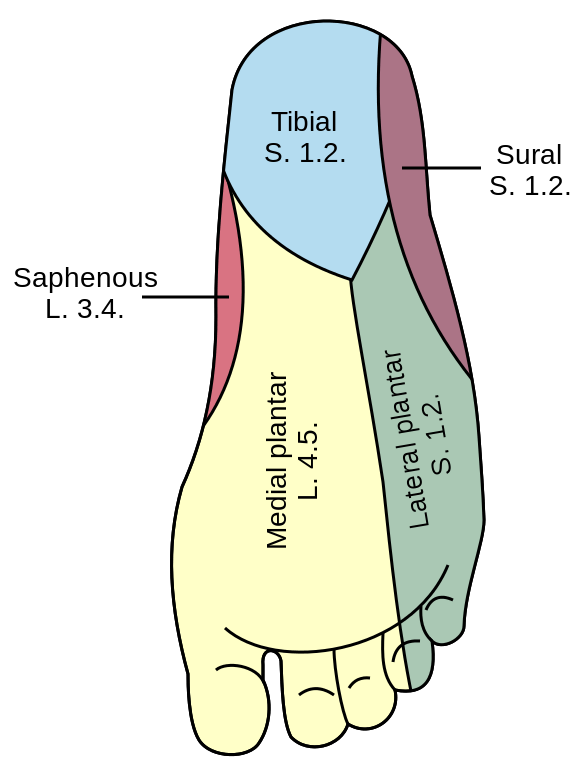
plantar nerves
Henry Vandyke Carter, Public domain, via Wikimedia Commons

Course and innervation:

Medial plantar nerveLateral plantar nerve
OriginLarger branch of tibial nerveSmaller branch of tibial nerve
CourseDeep to abductor hallucis muscle
Between 1st and 2nd plantar layers
Deep to abductor hallucis muscle
Between 1st and 2nd plantar layers
Motor innervationMnemonic: LAFF muscles
1. 1st Lumbrical
2. Abductor hallucis
3. Flexor digitorum brevis
4. Flexor hallucis brevis
All other intrinsic plantar muscles
Sensory innervationAnterior 2/3 of medial sole and medial 3 and 1/2 toes including nail beds on dorsumAnterior 1/3 of lateral sole and lateral 1 and 1/2 toes
Sensory innervation of the sole of heel comes from medial calcaneal nerve which is also a branch of tibial nerve.

Baxter’s nerve:

  • Also known as inferior calcaneal nerve
  • 1st branch of the lateral plantar nerve arising within the tarsal tunnel
  • Courses vertically between abductor hallucis and quadratus plantae, then makes a 90 degree horizontal turn, coursing laterally beneath the calcaneus to innervate abductor digiti minimi muscle.
  • Can be entrapped as it passes:
    • through the fascia of the abductor hallucis
    • in close proximity to a plantar spur or the medial calcaneal tuberosity
    • gets enmeshed in scar tissue from prior surgery
  • Entrapment can be misdiagnosed as plantar fasciitis
  • Plantar fascia pain is predominantly felt under the heel itself, whereas Baxter’s nerve entrapment is felt more on the heel and the medial arch of the foot and can also include a sensation of numbness or pins and needles.
  • Facebook
  • Twitter
PGMEE, MRCS, USMLE, MBBS, MD/MS AnatomyMusculoskeletal systemNervous systemOrthopedics

Post navigation

Previous post
Next post

Related Posts

PGMEE, MRCS, USMLE, MBBS, MD/MS

Dengue : Mnemonics

Oct 23, 2024Oct 23, 2024

Pathophysiology Mnemonic: ABC Classification Lab Diagnosis

Read More
PGMEE, MRCS, USMLE, MBBS, MD/MS

Dengue Classification : Mnemonic

Aug 22, 2019Oct 23, 2024

Probable Dengue Mnemonic: FEVeR TLC (Send Total Leukocyte Count in Fever) a. Feverb. Endemic area (living or travel)and 2 of –c. Vomiting and nausead. Rashe. Tourniquet test positivef. Leukopenia (EARLIEST sign)g. Cramps and cries (Aches and pains) Tourniquet test: Inflate the BP cuff between SBP and DBP and keep it…

Read More
PGMEE, MRCS, USMLE, MBBS, MD/MS

Edward Syndrome : Mnemonic

Sep 16, 2022Jul 23, 2024

Mnemonic: EDWARDS 1. Eighteen trisomy, Elongated skull 2. Digit overlapping with clenched fist 3. Webbing of 2nd and 3rd toes 4. Absent radii, Arthrogryposis 5. Rocker-bottom feet 6. Dysplastic ears, Disability (intellectual), Diseased heart (VSD) 7. Small lower jaw

Read More

Leave a Reply Cancel reply

Your email address will not be published. Required fields are marked *

This site uses Akismet to reduce spam. Learn how your comment data is processed.

Pre-clinical (Basic Sciences)

Anatomy

Biochemistry

Community medicine (PSM)

Embryology

Microbiology

Pathology

Pharmacology

Physiology

Clinical Sciences

Anesthesia

Dermatology

Emergency medicine

Forensic

Internal medicine

Gynecology & Obstetrics

Oncology

Ophthalmology

Orthopedics

Otorhinolaryngology (ENT)

Pediatrics

Psychiatry

Radiology

Surgery

RSS Ask Epomedicine

  • What to study for Clinical examination in Orthopedics?
  • What is the mechanism of AVNRT?

Epomedicine weekly

  • About Epomedicine
  • Contact Us
  • Author Guidelines
  • Submit Article
  • Editorial Board
  • USMLE
  • MRCS
  • Thesis
©2026 Epomedicine | WordPress Theme by SuperbThemes