Skip to content
Epomedicine

Mnemonics, Simplified Concepts & Thoughts

Epomedicine

Mnemonics, Simplified Concepts & Thoughts

Clavipectoral Fascia

Epomedicine, Sep 7, 2023Sep 7, 2023

Extent:

  • Between subclavius and pectoralis minor
  • Deep to pectoralis major (which is enclosed anteriorly by pectoral fascia)

Function:

  • Acts to suspend the floor of axilla
  • Encloses 2 muscles – subclavius and pectoralis minor
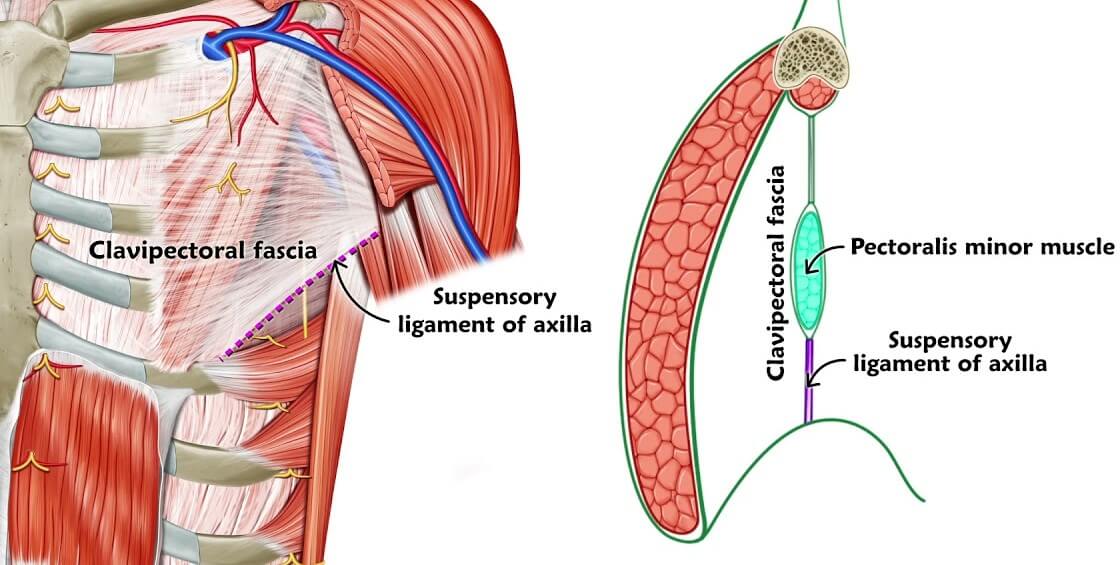
clavipectoral fascia

Structures piercing the clavipectoral fascia:

Mnemonic: CLAP

  1. Cephalic vein
  2. Lymphatics (passing between infraclavicular and apical nodes of axilla)
  3. Acromiothoracic artery
  4. Pectoral nerve (lateral)

Surgical relevance:

  • Joint immobility after shoulder arthroplasty – one of the factor is replacement of true clavipectoral fascia by fibrotic tissue.
  • Facebook
  • Twitter
PGMEE, MRCS, USMLE, MBBS, MD/MS AnatomyMusculoskeletal system

Post navigation

Previous post
Next post

Related Posts

PGMEE, MRCS, USMLE, MBBS, MD/MS

Liver Anatomy : Mnemonics

May 13, 2024May 13, 2024

Ligaments Mnemonic: TV TFCL 1. True ligaments: 2. False ligaments (Peritoneal folds): Posteroinferior (Visceral) Surface of Liver Anatomical halves are separated by Ligamentum venosum and Ligamentum teres. Vascular halves are separated by IVC and Gall bladder. Caudate lobe and Quadrate lobe: Mnemonic: IVC are in one line Mnemonic: LGBTQ are…

Read More
PGMEE, MRCS, USMLE, MBBS, MD/MS gastrinoma triangle

Gastrinoma (Passaro’s) triangle

Feb 17, 2017

Boundaries of Gastrinoma Triangle It is an imaginary triangle formed by 3 points in upper abdomen: Apex: Cystic duct-CBD junction Inferior point: 2nd part duodenum-3rd part duodenum junction Left lateral point: Pancreatic neck-body junction This area is located to the right of Superior Mesenteric Artery (SMA) i.e. Proximal duodenum and…

Read More
PGMEE, MRCS, USMLE, MBBS, MD/MS tyrosinemia

Tyrosinemia Enzymes : Mnemonic

Aug 12, 2018Aug 12, 2018

Mnemonic: FAHeem TATtooes because of Histrionic Personality Disorder (HPD) Tyrosine is necessary for biosynthesis of catecholamines, thyroid hormones and melanin pigment. 1. Tyrosinemia type I (Tyrosinosis/Hepatorenal tyrosinemia): Enzyme defect: FAH (Fumaryl-acetoacetate hydroxylase) Last enzyme in the cycle Cabbage like odor Hepatocellular carcinoma Renal tubular acidosis Peripheral neuropathy 2. Tyrosinemia type II…

Read More

Leave a Reply Cancel reply

Your email address will not be published. Required fields are marked *

This site uses Akismet to reduce spam. Learn how your comment data is processed.

Pre-clinical (Basic Sciences)

Anatomy

Biochemistry

Community medicine (PSM)

Embryology

Microbiology

Pathology

Pharmacology

Physiology

Clinical Sciences

Anesthesia

Dermatology

Emergency medicine

Forensic

Internal medicine

Gynecology & Obstetrics

Oncology

Ophthalmology

Orthopedics

Otorhinolaryngology (ENT)

Pediatrics

Psychiatry

Radiology

Surgery

RSS Ask Epomedicine

  • What to study for Clinical examination in Orthopedics?
  • What is the mechanism of AVNRT?

Epomedicine weekly

  • About Epomedicine
  • Contact Us
  • Author Guidelines
  • Submit Article
  • Editorial Board
  • USMLE
  • MRCS
  • Thesis
©2026 Epomedicine | WordPress Theme by SuperbThemes