Skip to content
Epomedicine

Mnemonics, Simplified Concepts & Thoughts

Epomedicine

Mnemonics, Simplified Concepts & Thoughts

Laryngeal Muscles : Mnemonics

Epomedicine, Apr 29, 2024Apr 29, 2024

Extrinsic muscles

Nerve supply: Ansa cervicalis (CN XII + C1, C2, C3)

Infrahyoid muscles (Depressors of larynx):

Mnemonic: TOSS

  1. Thyrohyoid (Thyroid to hyoid)
  2. Omohyoid (Suprascapular notch to hyoid)
  3. Sternohyoid (Sternum to hyoid)
  4. Sternothyroid (Sternum to thyroid)

Suprahyoid muscles (Elevators of larynx):

Mnemonic: MDGS

  1. Mylohyoid (Mandible to hyoid)
  2. Digastric (Mandible and Mastoid to hyoid)
  3. Geniohyoid (Tongue to hyoid)
  4. Stylohyoid (Styloid process to hyoid)

Intrinsic muscles
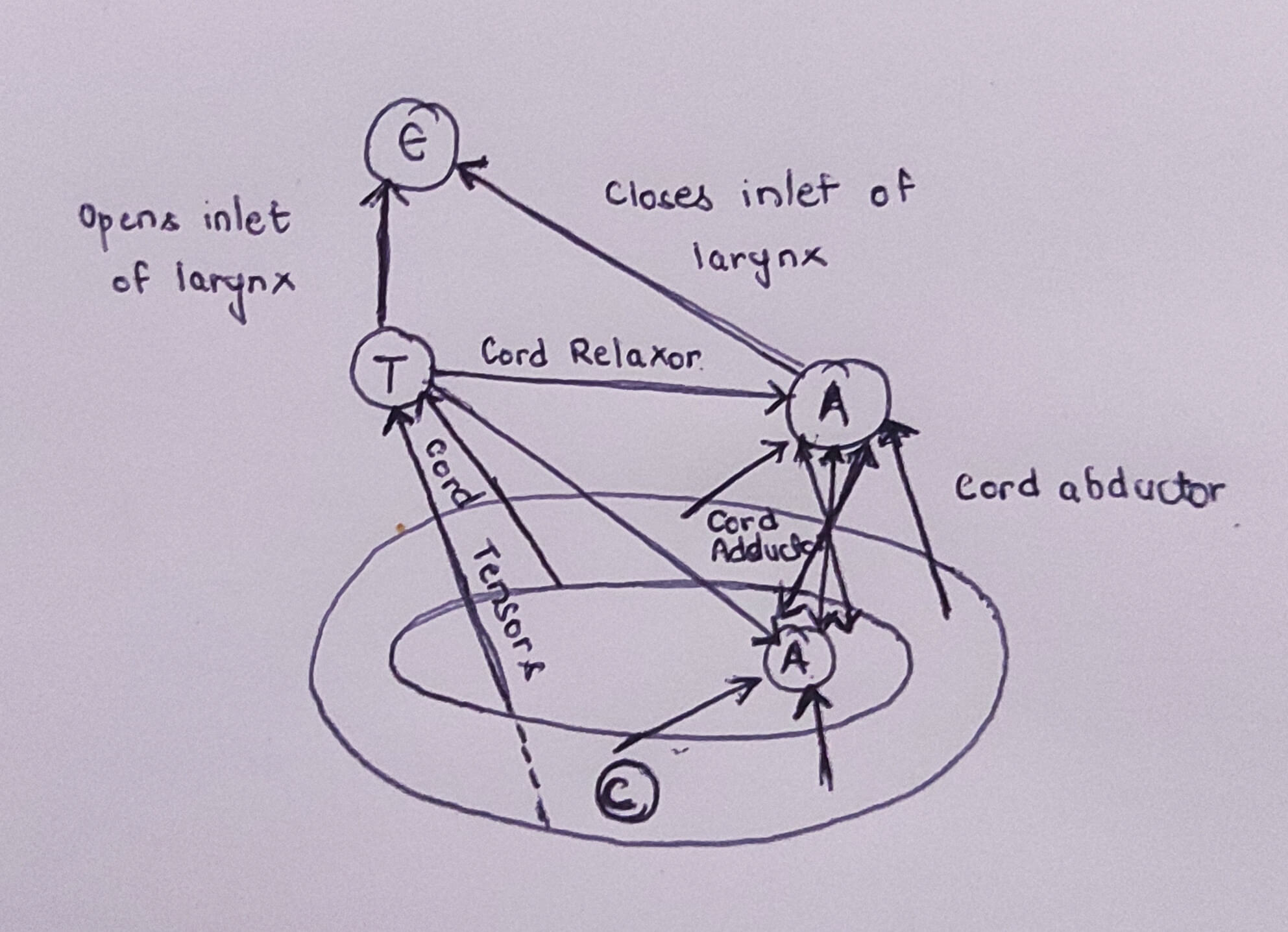
intrinsic muscles of larynx
Schematic diagram of intrinsic muscles of larynx. E – Epiglottis; T – Thyroid; C – Cricoid; A – Arytenoids.
MusclesOriginInsertionFunction
ThyroepiglotticusThyroaryetenoid muscleEpiglottis (lateral surface)Opens laryngeal inlet
AryepiglotticusOblique arytenoid muscleEpiglottisCloses laryngeal inlet
Posterior cricoarytenoidCricoid (posterior/lamina)ArytenoidAbductor of vocal cords
Lateral cricoarytenoidCricoid (lateral/arch)ArytenoidAdductor of vocal cords
Interarytenoid (Transverse and Oblique)ArytenoidArytenoidAdductor of vocal cords
CricothyroidCricoidThyroidTensor of vocal cords
Thyroarytenoid/VocalisThyroidArytenoid (Thyroarytenoid)/Vocal ligament (Vocalis)Relaxor of vocal cords
functions of intrinsic muscles of larynx

Nerve supply:

Mnemonic: SCAR

1. Superior laryngeal nerve (External laryngeal nerve): Cricothyroid

2. All other muscles: Recurrent laryngeal nerve
  • Facebook
  • Twitter
PGMEE, MRCS, USMLE, MBBS, MD/MS AnatomyOtorhinolaryngology

Post navigation

Previous post
Next post

Related Posts

PGMEE, MRCS, USMLE, MBBS, MD/MS

Lynch Syndrome (HNPCC) : Mnemonics

Jul 21, 2023Jul 30, 2023

Inheritance: Autosomal Dominant (AD) Cause: Microsatellite instability (MLH1, MSH2 mismatch repair gene mutation) Types: Amsterdam II Criteria for Diagnosis Mnemonic: 3-2-1-0 rule Colorectal cancers: More likely to be mucinous and right-sided Treatment: Total colectomy with ilio-rectal anastomosis Annual screening: Age 25 onwards or beginning no later than 5 years before…

Read More
PGMEE, MRCS, USMLE, MBBS, MD/MS

Regression Analysis for Medical Students and Doctors

Mar 25, 2026Mar 25, 2026

Regression is a statistical tool used mainly to study the association between: Uses: Types of regression based on outcome variable (y): Remember the “NOIR” mnemonic for the types of variable. Types of regression based on number of independent variables (x): Regression vs Correlation: Correlation measures the strength of the association…

Read More
PGMEE, MRCS, USMLE, MBBS, MD/MS

Osteoid Osteoma : Mnemonic

May 13, 2022May 13, 2022

Epidemiology and Clinical features Mnemonic: LMNOP Lower extremity predilection (proximal femur > tibial diaphysis) Male predilection (2:1 to 3:1) Night pain relieved by NSAIDs (absent in osteoblastoma) Osteogenic benign tumor Prostaglandins (PGE2) and Cyclooxygenase (COX1 and 2) release by nidus (explains night pain and response to NSAIDs) 3 Concentric layers…

Read More

Comment

  1. Dr. Pooja says:
    Aug 10, 2024 at 5:34 pm

    well structured.

    Reply

Leave a Reply to Dr. Pooja Cancel reply

Your email address will not be published. Required fields are marked *

This site uses Akismet to reduce spam. Learn how your comment data is processed.

Pre-clinical (Basic Sciences)

Anatomy

Biochemistry

Community medicine (PSM)

Embryology

Microbiology

Pathology

Pharmacology

Physiology

Clinical Sciences

Anesthesia

Dermatology

Emergency medicine

Forensic

Internal medicine

Gynecology & Obstetrics

Oncology

Ophthalmology

Orthopedics

Otorhinolaryngology (ENT)

Pediatrics

Psychiatry

Radiology

Surgery

RSS Ask Epomedicine

  • What to study for Clinical examination in Orthopedics?
  • What is the mechanism of AVNRT?

Epomedicine weekly

  • About Epomedicine
  • Contact Us
  • Author Guidelines
  • Submit Article
  • Editorial Board
  • USMLE
  • MRCS
  • Thesis
©2026 Epomedicine | WordPress Theme by SuperbThemes