Skip to content
Epomedicine

Mnemonics, Simplified Concepts & Thoughts

Epomedicine

Mnemonics, Simplified Concepts & Thoughts

Laryngeal Muscles : Mnemonics

Epomedicine, Apr 29, 2024Apr 29, 2024

Extrinsic muscles

Nerve supply: Ansa cervicalis (CN XII + C1, C2, C3)

Infrahyoid muscles (Depressors of larynx):

Mnemonic: TOSS

  1. Thyrohyoid (Thyroid to hyoid)
  2. Omohyoid (Suprascapular notch to hyoid)
  3. Sternohyoid (Sternum to hyoid)
  4. Sternothyroid (Sternum to thyroid)

Suprahyoid muscles (Elevators of larynx):

Mnemonic: MDGS

  1. Mylohyoid (Mandible to hyoid)
  2. Digastric (Mandible and Mastoid to hyoid)
  3. Geniohyoid (Tongue to hyoid)
  4. Stylohyoid (Styloid process to hyoid)

Intrinsic muscles
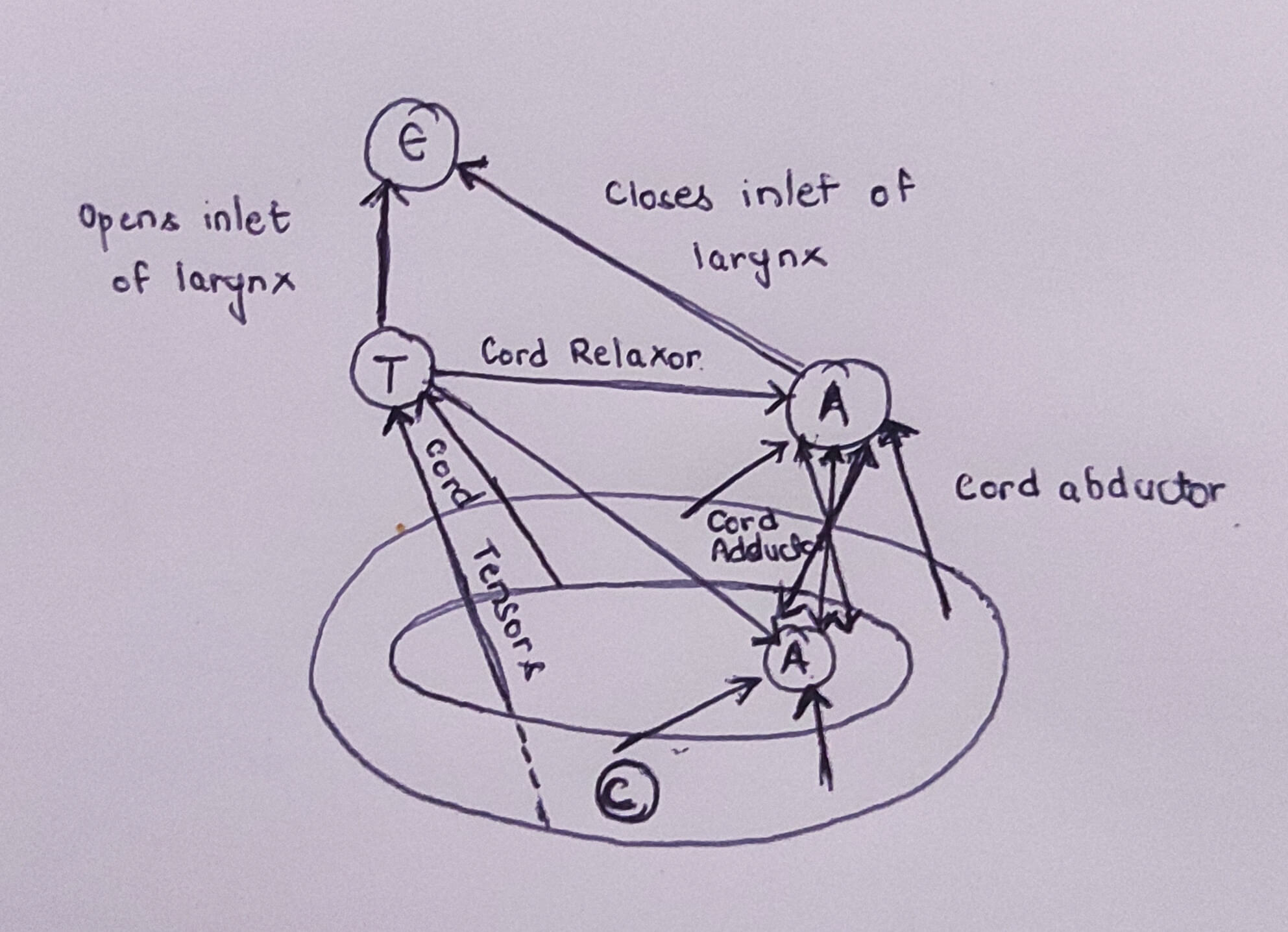
intrinsic muscles of larynx
Schematic diagram of intrinsic muscles of larynx. E – Epiglottis; T – Thyroid; C – Cricoid; A – Arytenoids.
MusclesOriginInsertionFunction
ThyroepiglotticusThyroaryetenoid muscleEpiglottis (lateral surface)Opens laryngeal inlet
AryepiglotticusOblique arytenoid muscleEpiglottisCloses laryngeal inlet
Posterior cricoarytenoidCricoid (posterior/lamina)ArytenoidAbductor of vocal cords
Lateral cricoarytenoidCricoid (lateral/arch)ArytenoidAdductor of vocal cords
Interarytenoid (Transverse and Oblique)ArytenoidArytenoidAdductor of vocal cords
CricothyroidCricoidThyroidTensor of vocal cords
Thyroarytenoid/VocalisThyroidArytenoid (Thyroarytenoid)/Vocal ligament (Vocalis)Relaxor of vocal cords
functions of intrinsic muscles of larynx

Nerve supply:

Mnemonic: SCAR

1. Superior laryngeal nerve (External laryngeal nerve): Cricothyroid

2. All other muscles: Recurrent laryngeal nerve

  • Facebook
  • Twitter
PGMEE, MRCS, USMLE, MBBS, MD/MS AnatomyOtorhinolaryngology

Post navigation

Previous post
Next post

Related Posts

PGMEE, MRCS, USMLE, MBBS, MD/MS

Zero Position of Saha

Jul 18, 2024Jul 18, 2024

Zero Position Zero position is the position during elevation in coronal or sagittal plane or in any plane where: Zero position of shoulder The humerus is elevated to about 165° with individual variations and is in the newly acquired scapular plane (around 45° anterior to the coronal plane). The humeral…

Read More

Basics of Fluid therapy

Nov 26, 2013

A. Anatomy and Physiology of Body Fluid Compartments: Remember the “60-40-20” rule of body water. 1. Total body water: 60% (50-70%) of Total Body Weight Greater in  lean individuals because fat contains little water Greatest percentage in newborns, then decreases with age 2. Intracellular fluid (ICF): 40% of Total Body…

Read More
PGMEE, MRCS, USMLE, MBBS, MD/MS preoperative aspirin

Aspirin and Clopidegrol : Perioperative Guidelines

Nov 27, 2015

The average lifespan of platelets is 7 to 10 days. Aspirin and Clopidegrol inhibits platelets for around 21 days. Hence, when these agents are stopped 7 days before the surgery, it allows 33% regeneration of platelets. Stents and coronary lesions act as unstable plaque until they are completely covered by…

Read More

Comment

  1. Dr. Pooja says:
    Aug 10, 2024 at 5:34 pm

    well structured.

    Reply

Leave a Reply Cancel reply

Your email address will not be published. Required fields are marked *

This site uses Akismet to reduce spam. Learn how your comment data is processed.

Pre-clinical (Basic Sciences)

Anatomy

Biochemistry

Community medicine (PSM)

Embryology

Microbiology

Pathology

Pharmacology

Physiology

Clinical Sciences

Anesthesia

Dermatology

Emergency medicine

Forensic

Internal medicine

Gynecology & Obstetrics

Oncology

Ophthalmology

Orthopedics

Otorhinolaryngology (ENT)

Pediatrics

Psychiatry

Radiology

Surgery

RSS Ask Epomedicine

  • What to study for Clinical examination in Orthopedics?
  • What is the mechanism of AVNRT?

Epomedicine weekly

  • About Epomedicine
  • Contact Us
  • Author Guidelines
  • Submit Article
  • Editorial Board
  • USMLE
  • MRCS
  • Thesis
©2026 Epomedicine | WordPress Theme by SuperbThemes