Skip to content
Epomedicine

Mnemonics, Simplified Concepts & Thoughts

Epomedicine

Mnemonics, Simplified Concepts & Thoughts

Thyroid Gland Blood Supply : Mnemonics

Epomedicine, Apr 29, 2024Apr 29, 2024

Arterial supply

  1. Superior thyroid artery (branch of ECA): Supplies Upper 1/3 of lobes + Upper 1/2 of isthmus
  2. Inferior thyroid artery (branch of thyrocervical trunk of Subclavian artery): Supplies Lower 2/3 of lobes + Lower 1/2 of isthmus + Parathyroid glands (by ascending branch)
  3. Thyroidea ima artery (only in 10%): from aortic arch or brachiocephalic trunk
  4. Accessory thyroid arteries: from tracheal and esophageal arteries

Arterial anastomosis

  1. Anterior aspect (at the upper border of isthmus): Between anterior branch of superior thyroid artery of 2 sides
  2. Posterior aspect: Between posterior branch of Superior thyroid artery and inferior branch of Inferior thyroid artery
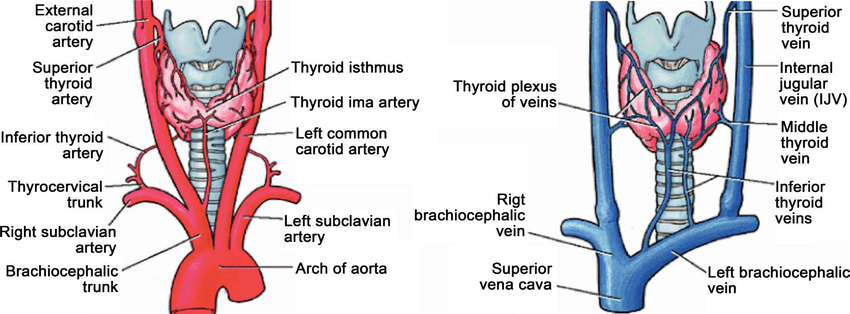
thyroid blood supply

Venous drainage

  1. Superior thyroid vein: drains into IJV
  2. Middle thyroid vein: drains into IJV
  3. Inferior thyroid vein: drains into left Brachiocephalic vein
  4. Fourth thyroid vein (of Kocher): may emerge between middle and inferior thyroid veins and drain into the IJV

The venous plexus lies beneath the true capsule (peripheral condensation of fibrous stroma of gland). Hence, during thyroidectomy, thyroid gland is removed along with the true capsule to avert the hemorrhage. False capsule (pre-tracheal fascia) is left intact.

Thyroid Arteries and Laryngeal Nerves

Mnemonic: SEEN InTRA

  1. Superior thyroid artery
    • External carotid artery
    • External laryngeal nerve is closely related
    • Near the gland – superior thyroid artery is relatively far from external laryngeal nerve and hence ligated here (mnemonic: to the thyroid I go)
  2. Inferior thyroid artery
    • Thyrocervical trunk
    • Recurrent laryngeal nerve is closely related
    • Away from the gland – inferior thyroid artery is relatively far from recurrent laryngeal nerve and hence ligated here (mnemonic: away from thyroid I flee)
  • Facebook
  • Twitter
PGMEE, MRCS, USMLE, MBBS, MD/MS AnatomyEndocrine systemOtorhinolaryngology

Post navigation

Previous post
Next post

Related Posts

PGMEE, MRCS, USMLE, MBBS, MD/MS chronic PPI use

Long term PPI use : Associated risks

Mar 1, 2018

Proton pump inhibitors (PPI) are often self-prescribed by the patients and since PPIs are available over-the-counter, patients can have free access to them and for long periods of time, without seeking medical attention. Although guidelines for OTC use suggest a short course (2 week treatment) of PPIs in patients with typical…

Read More
Emergency Medicine pulmonary embolism xray

Pulmonary Embolism : Chest X-ray Signs

Oct 25, 2017

1. Classic presentation is normal X-ray in patient with dyspnea and hypoxia 2. Atelectasis or parenchymal abnormality (68%) 3. Elevated hemidiaphragm 4. Pleural effusion (Felson’s sign – pleural effusion on left > right) 5. Hampton’s hump: peripheral pleural based wedge-shaped density above the diaphragm due to pulmonary infarct 6. Westermark’s…

Read More
PGMEE, MRCS, USMLE, MBBS, MD/MS internal capsule

Internal Capsule Simplified

Jul 30, 2016

Internal Capsule is a “boomerang” shaped (on horizontal section) and “funnel” shaped, i.e. tapering from superior to inferior (on sagittal section) white matter structure sandwiched between: Medially: Head of Caudate nucleus and Thalamus Laterally: Lenticular nucleus (Globus pallidus and Putamen) Parts of Internal Capsule 1. Anterior limb: Carries fibers to…

Read More

Leave a Reply Cancel reply

Your email address will not be published. Required fields are marked *

This site uses Akismet to reduce spam. Learn how your comment data is processed.

Pre-clinical (Basic Sciences)

Anatomy

Biochemistry

Community medicine (PSM)

Embryology

Microbiology

Pathology

Pharmacology

Physiology

Clinical Sciences

Anesthesia

Dermatology

Emergency medicine

Forensic

Internal medicine

Gynecology & Obstetrics

Oncology

Ophthalmology

Orthopedics

Otorhinolaryngology (ENT)

Pediatrics

Psychiatry

Radiology

Surgery

RSS Ask Epomedicine

  • What to study for Clinical examination in Orthopedics?
  • What is the mechanism of AVNRT?

Epomedicine weekly

  • About Epomedicine
  • Contact Us
  • Author Guidelines
  • Submit Article
  • Editorial Board
  • USMLE
  • MRCS
  • Thesis
©2026 Epomedicine | WordPress Theme by SuperbThemes