Skip to content
Epomedicine

Mnemonics, Simplified Concepts & Thoughts

Epomedicine

Mnemonics, Simplified Concepts & Thoughts

Anatomy of Tongue : Mnemonics

Epomedicine, Apr 29, 2024Apr 29, 2024

Muscles

IntrinsicExtrinsic
Alter the shape of tongueAttaches tongue to the bone
Mnemonic: VIST Mnemonic: Paris St. German Hour
1. Vertical1. Palatoglossus (Palate) – anatomically a pharyngeal muscle
2. Inferior longitudinal2. Styloglossus (Styloid)
3. Superior longitudinal3. Genioglossus (Genial tubercle of mandible)
4. Transverse4. Hyoglossus (Hyoid)
tongue muscles
OpenStax, CC BY 3.0, via Wikimedia Commons

All the intrinsic and extrinsic muscles are supplied by hypoglossal nerve (CN XII) except Palatoglossus which is supplied by the pharyngeal plexus (CN IX, CN X and sympathetics).

Genioglossus protrude tongue and if paralyzed will fall back on the oropharynx and block the air passage.

Sensory nerve supply

https://usmleaid.tumblr.com/post/51069358577/innervation-of-the-tongue
Nerve supplyAnterior 2/3Posterior 1/3Posterior-most (Vallecula)
SensoryLingual (CN V3)CN IXCN X (Internal laryngeal)
TasteChorda tympani (CN VII)CN IXCN X (Internal laryngeal)
Development of epithelium1st arch3rd arch4th arch
Vallate papillae is supplied by CN IX

Mnemonics:

  • Anterior 2/3 has 2 nerve supplies
  • Posterior 1/3 has 1 nerve supply
    • Mirror image of “P” resembles “9”
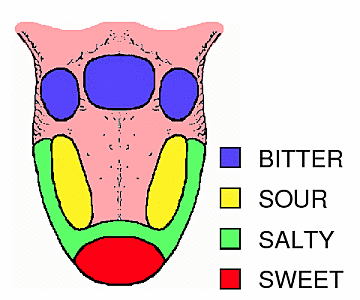
tongue taste modalities

Lymphatic drainage

All parts have Bilateral drainage except Lateral portions of Anterior 2/3 of tongue.

  1. Tip: Bilateral submental lymph nodes
  2. Anterior 2/3:
    • Lateral: Ipsilateral submandibular lymph nodes
    • Central: Bilateral inferior deep cervical lymph nodes (Jugulo-omohyoid)
  3. Posterior 1/3: Bilateral superior deep cervical lymph nodes (Jugulo-digastric)

Final drainage: Jugulo-omohyoid nodes (known as lymph nodes of tongue)

Blood supply

Arterial supply: Lingual artery (branch of ECA)

Venous drainage: Lingual vein (drains into IJV)
  • Facebook
  • Twitter
PGMEE, MRCS, USMLE, MBBS, MD/MS AnatomyOtorhinolaryngology

Post navigation

Previous post
Next post

Related Posts

PGMEE, MRCS, USMLE, MBBS, MD/MS cardiac-cycle-wiggers diagram

Cardiac Cycle – Summary and Wigger’s Diagram

Aug 30, 2016May 20, 2024

Cardiac Cycle Opening and closing of valves When the valve opens, different compartments act as a single chamber (atrio-ventricle or aorto-ventricle). For a blood to flow, pressure in “giver” must be higher then that in “receiver”. Pressure difference opens or closes the valve: Role of atrial contraction in Ventricular filling…

Read More
PGMEE, MRCS, USMLE, MBBS, MD/MS lymphatic draiange of uterus

Lymphatic drainage of Uterus and Cervix : Mnemonic

Jun 28, 2018Nov 24, 2018

Lymphatic drainage of the uterus is via the iliac, sacral, aortic and inguinal lymph nodes. Mnemonic: USA ME LIES   1. Upper portion: Superficial inguinal and Aortic Fundus and superior uterine body: Aortic (Pre- and Para-aortic) lymph node Cornu: Superficial inguinal lymph node 2. Middle portion (Uterine body): External iliac nodes 3. Lower…

Read More
PGMEE, MRCS, USMLE, MBBS, MD/MS internal capsule

Internal Capsule Simplified

Jul 30, 2016

Internal Capsule is a “boomerang” shaped (on horizontal section) and “funnel” shaped, i.e. tapering from superior to inferior (on sagittal section) white matter structure sandwiched between: Medially: Head of Caudate nucleus and Thalamus Laterally: Lenticular nucleus (Globus pallidus and Putamen) Parts of Internal Capsule 1. Anterior limb: Carries fibers to…

Read More

Leave a Reply Cancel reply

Your email address will not be published. Required fields are marked *

This site uses Akismet to reduce spam. Learn how your comment data is processed.

Pre-clinical (Basic Sciences)

Anatomy

Biochemistry

Community medicine (PSM)

Embryology

Microbiology

Pathology

Pharmacology

Physiology

Clinical Sciences

Anesthesia

Dermatology

Emergency medicine

Forensic

Internal medicine

Gynecology & Obstetrics

Oncology

Ophthalmology

Orthopedics

Otorhinolaryngology (ENT)

Pediatrics

Psychiatry

Radiology

Surgery

RSS Ask Epomedicine

  • What to study for Clinical examination in Orthopedics?
  • What is the mechanism of AVNRT?

Epomedicine weekly

  • About Epomedicine
  • Contact Us
  • Author Guidelines
  • Submit Article
  • Editorial Board
  • USMLE
  • MRCS
  • Thesis
©2026 Epomedicine | WordPress Theme by SuperbThemes