Skip to content
Epomedicine

Mnemonics, Simplified Concepts & Thoughts

Epomedicine

Mnemonics, Simplified Concepts & Thoughts

Laryngeal Muscles : Mnemonics

Epomedicine, Apr 29, 2024Apr 29, 2024

Extrinsic muscles

Nerve supply: Ansa cervicalis (CN XII + C1, C2, C3)

Infrahyoid muscles (Depressors of larynx):

Mnemonic: TOSS

  1. Thyrohyoid (Thyroid to hyoid)
  2. Omohyoid (Suprascapular notch to hyoid)
  3. Sternohyoid (Sternum to hyoid)
  4. Sternothyroid (Sternum to thyroid)

Suprahyoid muscles (Elevators of larynx):

Mnemonic: MDGS

  1. Mylohyoid (Mandible to hyoid)
  2. Digastric (Mandible and Mastoid to hyoid)
  3. Geniohyoid (Tongue to hyoid)
  4. Stylohyoid (Styloid process to hyoid)

Intrinsic muscles
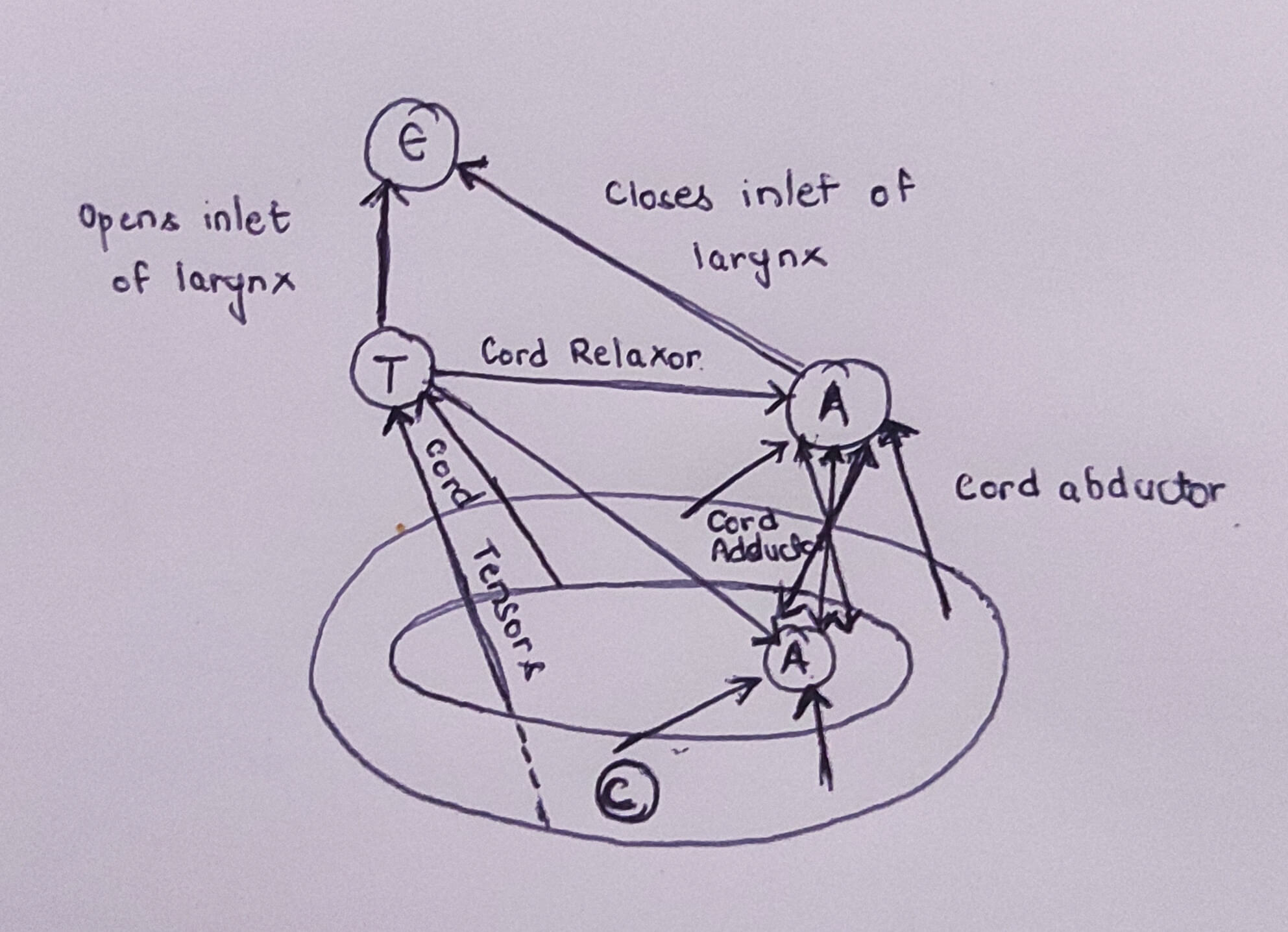
intrinsic muscles of larynx
Schematic diagram of intrinsic muscles of larynx. E – Epiglottis; T – Thyroid; C – Cricoid; A – Arytenoids.
MusclesOriginInsertionFunction
ThyroepiglotticusThyroaryetenoid muscleEpiglottis (lateral surface)Opens laryngeal inlet
AryepiglotticusOblique arytenoid muscleEpiglottisCloses laryngeal inlet
Posterior cricoarytenoidCricoid (posterior/lamina)ArytenoidAbductor of vocal cords
Lateral cricoarytenoidCricoid (lateral/arch)ArytenoidAdductor of vocal cords
Interarytenoid (Transverse and Oblique)ArytenoidArytenoidAdductor of vocal cords
CricothyroidCricoidThyroidTensor of vocal cords
Thyroarytenoid/VocalisThyroidArytenoid (Thyroarytenoid)/Vocal ligament (Vocalis)Relaxor of vocal cords
functions of intrinsic muscles of larynx

Nerve supply:

Mnemonic: SCAR

1. Superior laryngeal nerve (External laryngeal nerve): Cricothyroid

2. All other muscles: Recurrent laryngeal nerve
  • Facebook
  • Twitter
PGMEE, MRCS, USMLE, MBBS, MD/MS AnatomyOtorhinolaryngology

Post navigation

Previous post
Next post

Related Posts

PGMEE, MRCS, USMLE, MBBS, MD/MS tourniquet

Bruner’s Ten Rules of Pneumatic Tourniquet Use

Oct 17, 2019Oct 18, 2019

APPLICATION: Apply only to a healthy limb or with caution to an unhealthy limb SIZE OF TOURNIQUET: Arm, 10 cm; leg, 15 cm or wider in large legs SITE OF APPLICATION: Upper arm; mid/upper thigh ideally PADDING: At least two layers of orthopaedic felt SKIN PREPARATION: Occlude to prevent soaking…

Read More
PGMEE, MRCS, USMLE, MBBS, MD/MS

Elbow Anastomoses : Mnemonic

Mar 14, 2021Mar 14, 2021

First things first. It is essential to understand the meaning of collateral and recurrent arteries. Recurrent arteries turn back so as to reverse direction. Collateral arteries refer to side branches of the major arteries. Mnemonic: M.R. Deep On the posterior aspect of the shaft of the humerus: Profunda brachii (Deep…

Read More
PGMEE, MRCS, USMLE, MBBS, MD/MS

Foot muscles – Layers and Compartments

Sep 3, 2020Sep 3, 2020

Deep to the plantar fascia, muscles of plantar foot exist in 4 different layers. Extensor digitorum brevis makes dorsal layer of foot and remaining 18 muscles and 4 tendons make the 4 layers of plantar aspect or sole of foot. In general: Layer 1 and 3: 3 muscles each that…

Read More

Comment

  1. Dr. Pooja says:
    Aug 10, 2024 at 5:34 pm

    well structured.

    Reply

Leave a Reply Cancel reply

Your email address will not be published. Required fields are marked *

This site uses Akismet to reduce spam. Learn how your comment data is processed.

Pre-clinical (Basic Sciences)

Anatomy

Biochemistry

Community medicine (PSM)

Embryology

Microbiology

Pathology

Pharmacology

Physiology

Clinical Sciences

Anesthesia

Dermatology

Emergency medicine

Forensic

Internal medicine

Gynecology & Obstetrics

Oncology

Ophthalmology

Orthopedics

Otorhinolaryngology (ENT)

Pediatrics

Psychiatry

Radiology

Surgery

RSS Ask Epomedicine

  • What to study for Clinical examination in Orthopedics?
  • What is the mechanism of AVNRT?

Epomedicine weekly

  • About Epomedicine
  • Contact Us
  • Author Guidelines
  • Submit Article
  • Editorial Board
  • USMLE
  • MRCS
  • Thesis
©2026 Epomedicine | WordPress Theme by SuperbThemes