Skip to content
Epomedicine

Mnemonics, Simplified Concepts & Thoughts

Epomedicine

Mnemonics, Simplified Concepts & Thoughts

tourniquet

Bruner’s Ten Rules of Pneumatic Tourniquet Use

Epomedicine, Oct 17, 2019Oct 18, 2019

APPLICATION: Apply only to a healthy limb or with caution to an unhealthy limb

SIZE OF TOURNIQUET: Arm, 10 cm; leg, 15 cm or wider in large legs

SITE OF APPLICATION: Upper arm; mid/upper thigh ideally

PADDING: At least two layers of orthopaedic felt

SKIN PREPARATION: Occlude to prevent soaking of wool.
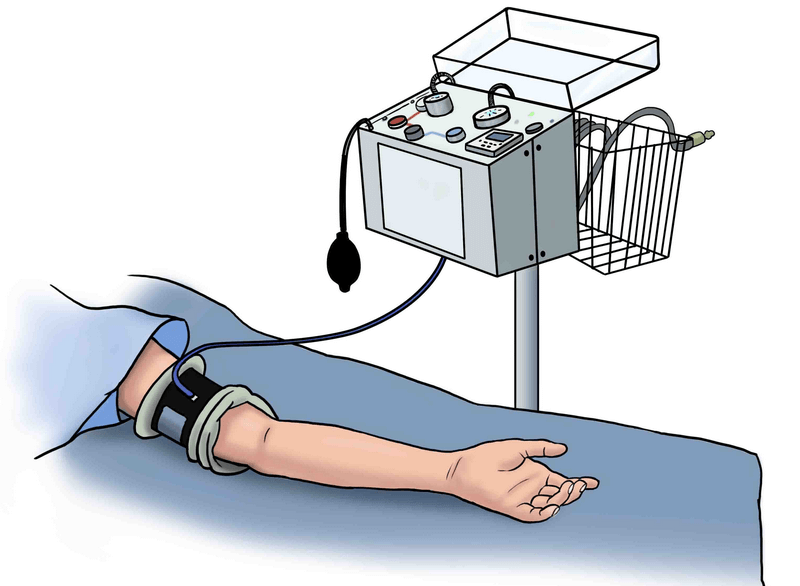
pneumatic tourniquet

PRESSURE: Use 50-100 mm Hg above systolic for the arm; double systolic for the thigh; or arm 200-250 mm Hg, leg 250-350 mm Hg (large cuffs are recommended for larger limbs instead of increasing pressure)

TIME: Absolute maximum 3 h (recovers in 5-7 days) generally not to exceed 2 h

TEMPERATURE: Avoid heating (e.g., hot lights), cool if feasible, and keep tissues moist

DOCUMENTATION: Duration and pressure

CALIBRATION AND MAINTENANCE: at least weekly calibration and against mercury manometer or test maintenance gauge; maintenance every 3 months

Reference: Modified from Kutty S, McElwain JP: Padding under tourniquets in tourniquet controlled surgery: Bruner’s ten rules revisited, Injury 33:75, 2002.

9 shares
  • Facebook9
  • Twitter
PGMEE, MRCS, USMLE, MBBS, MD/MS Orthopedics

Post navigation

Previous post
Next post

Related Posts

PGMEE, MRCS, USMLE, MBBS, MD/MS

Spinal segments vs Vertebral level

Aug 9, 2023Aug 9, 2023

Spinal segment: The part of spinal cord to which a pair of spinal nerves (right and left) is attached. Cause of mismatch between spinal segments and vertebral level: General rule: Vertebral level Add Spinal segment Cervical + 0 Same C7-T1 C8 T1-T3 +1 T1-T4 T3-T6 +2 T5-T8 T7-T8 +3 T9-T11…

Read More
PGMEE, MRCS, USMLE, MBBS, MD/MS pregnancy

Why is hepatitis E dangerous during pregnancy?

May 20, 2019May 20, 2019

Hepatitis E Virus (HEV) infection is usually a self-limiting disease with a low rate of fulminant hepatic failure but maternal hepatitis E during the third trimester of pregnancy is a cause of fulminant hepatic failure with a mortality rate of upto 20%. Severe liver injury due to HEV in pregnancy…

Read More
PGMEE, MRCS, USMLE, MBBS, MD/MS vomit pathway propionyl coa

VOMIT Pathway – Propionyl CoA Intermediate

Jul 10, 2016

Propionyl CoA is a common intermediate in catabolism of essential amino acids and odd chain fatty acids. It is also called VOMIT pathway which stands for: Valine Odd chain fatty acids Methionine Isoleucine Threonine They enter TCA cycle – using PMS pathway: Propionyl CoA Methylmalonyl CoA Succinyl CoA Defects in…

Read More

Leave a Reply Cancel reply

Your email address will not be published. Required fields are marked *

This site uses Akismet to reduce spam. Learn how your comment data is processed.

Epomedicine. Bruner’s Ten Rules of Pneumatic Tourniquet Use [Internet]. Epomedicine; 2019 Oct 17 [cited 2025 Dec 7]. Available from: https://epomedicine.com/medical-students/bruners-ten-rules-of-pneumatic-tourniquet-use/.

Pre-clinical (Basic Sciences)

Anatomy

Biochemistry

Community medicine (PSM)

Embryology

Microbiology

Pathology

Pharmacology

Physiology

Clinical Sciences

Anesthesia

Dermatology

Emergency medicine

Forensic

Internal medicine

Gynecology & Obstetrics

Oncology

Ophthalmology

Orthopedics

Otorhinolaryngology (ENT)

Pediatrics

Psychiatry

Radiology

Surgery

RSS Ask Epomedicine

  • What to study for Clinical examination in Orthopedics?
  • What is the mechanism of AVNRT?

Epomedicine weekly

  • About Epomedicine
  • Contact Us
  • Author Guidelines
  • Submit Article
  • Editorial Board
  • USMLE
  • MRCS
  • Thesis
©2025 Epomedicine . All rights reserved.