Skip to content
Epomedicine

Mnemonics, Simplified Concepts & Thoughts

Epomedicine

Mnemonics, Simplified Concepts & Thoughts

Jod-Basedow Phenomenon vs Wolff-Chaikoff Effect : Mnemonic

Epomedicine, May 22, 2024May 22, 2024

Jod = Addition in Hindi or Nepali = Iodine induced Hyperthyroidisim

ChaikOFF = Thyroid hormone synthesis is switched OFF = Iodine induced Hypothyroidisim
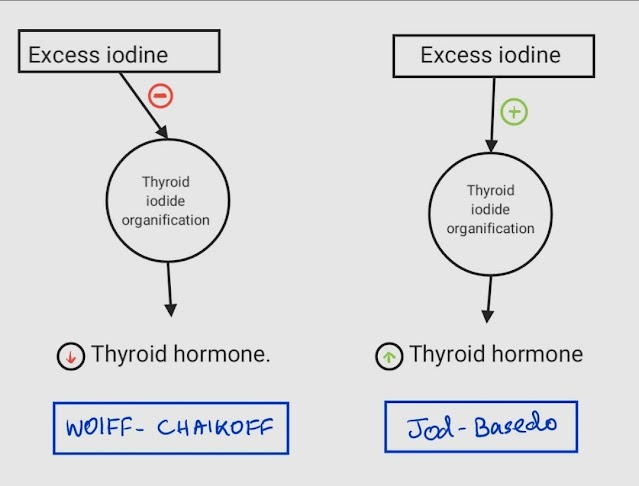
wolff-chaikoff and jod-basedow phenomenon
Wolff–Chaikoff effect And Jod-Basedow effect. (openmed.co.in) [CC BY-NC-SA 4.0]

Mechanism

Thyroid Hormone Function & Synthesis : Mnemonics
Jod-BasedowWolff-Chaikoff
Pre-requisiteAbnormal thyroid gland free from pituitary controlThyroid gland under pituitary control
ConditionsEndemic goitre, Grave’s disease, Toxic multinodular goitre, Thyroid adenomaNormal thyroid (Euthyroid), Hyperthyroid (Grave’s disease)
MechanismExcess iodine stimulates thyroid iodide organificationExcess iodine inhibits thyroid iodide organification
ResultIodine induced hyperthyroidismIodine induced hypothyroidism
a. Normal thyroid (Euthyroid): Escapes after 10 days
b. Autoimmune thyroid: Persists After
  • Facebook
  • Twitter
PGMEE, MRCS, USMLE, MBBS, MD/MS Endocrine systemInternal medicinePathology

Post navigation

Previous post
Next post

Related Posts

PGMEE, MRCS, USMLE, MBBS, MD/MS glycogen stroage diseases

Glycogen Storage Diseases with Mnemonics

Jan 22, 2017Mar 10, 2018

Once again, I’m back with a biochemistry topic that everyone hates. Let’s try to break the topic, simplify it and cover all the important aspects of Glycogen Storage Diseases (GSD). 7 types of Glycogen Storage Diseases Mnemonic:VP CAM HT. This is a pretty lame mnemonic for the order of the…

Read More
PGMEE, MRCS, USMLE, MBBS, MD/MS Advanced glaucomatous changes diagram

Glaucomatous Optic Disc Changes Made Simple

May 3, 2014May 5, 2014

Optic disc changes in Glaucoma is one of the most frequently asked topics in Ophthalmology. However, students are often found to have difficulty in understanding and remembering them. Hence, I came up with an idea to illustrate them with schematic diagrams and mnemonics to simplify the topic. The diagrams are…

Read More

Applied anatomy of Knee Joint

Jan 5, 2014

A. Osteology: 1. Femur: Largest bone in the body Distal femur possess 2 condyles of which the medial one is larger Medial epicondyle is more porminent and supports the adductor tubercle 2. Patella (Knee cap): Largest sesamoid bone Functions: fulcrum for quadriceps protects knee joint enhances lubrication and nutrition of…

Read More

Leave a Reply Cancel reply

Your email address will not be published. Required fields are marked *

This site uses Akismet to reduce spam. Learn how your comment data is processed.

Pre-clinical (Basic Sciences)

Anatomy

Biochemistry

Community medicine (PSM)

Embryology

Microbiology

Pathology

Pharmacology

Physiology

Clinical Sciences

Anesthesia

Dermatology

Emergency medicine

Forensic

Internal medicine

Gynecology & Obstetrics

Oncology

Ophthalmology

Orthopedics

Otorhinolaryngology (ENT)

Pediatrics

Psychiatry

Radiology

Surgery

RSS Ask Epomedicine

  • What to study for Clinical examination in Orthopedics?
  • What is the mechanism of AVNRT?

Epomedicine weekly

  • About Epomedicine
  • Contact Us
  • Author Guidelines
  • Submit Article
  • Editorial Board
  • USMLE
  • MRCS
  • Thesis
©2026 Epomedicine | WordPress Theme by SuperbThemes