Gametogenesis – formation of gametes from primitive germ cells
Spermatogenesis, begins at puberty and occurs in seminiferous tubules (spermiogenesis occurs in sertoli cells). One spermatogenesis takes an average of 74 days to complete.
| Oogenesis | Stages | Spermatogenesis |
| Migrate at 6th week of development | 1. Primordial Germ Cells / PGCs (46, 2n) – epiblast derivative at 2nd weeks (move to yolk sac)
|
Migrate at 6th week of development
|
| Oogonia | 2. Cytogenesis, i.e. -gonia (definitive germ cell) formation (46, 2n) | Spermatogonia type A at puberty (stem cell) –
Some type A spermatogonia differentiate into type B |
Primary oocyte
|
3. Meiosis I – DNA replication (46, 4n) | Primary spermatocyte |
| 1 Secondary oocyte and 1st polar body (during ovarian cycle) | 4. Meiosis I completion –
|
2 Secondary spermatocytes |
| Arrested at metaphase until fertilization | 5. Meiosis II – centromeres split (23, 1n) | 4 spermatids |
| 6. Spermiogenesis (occurs in sertoli cells) | Mature spermatozoa | |
| Completion of meiosis II and formation of mature oocytes (23,1n) and 2nd polar body | 7. Ovulation and fertilization | Capacitation, Acrosomal reaction and penetration of zona pellucida |
| Spermatocytogenesis (arrested PCGs) starts at puberty in males and Meiosis I completion (arrested in prophase) occurs during puberty in females | ||
Ovulation
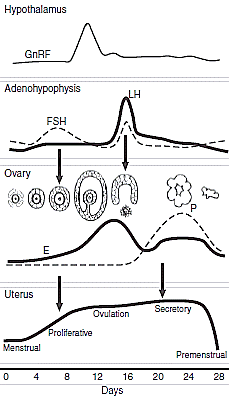
GnRH from hypothalamus stimulates release of LH and FSH from the anterior pituitary. FSH leads to follicular maturation (formation of graafian follicle from secondary follicle). Granulosa cells in secondary and graafian follicles secrete estrogen. FSH also plays role in dominant follicle selection.
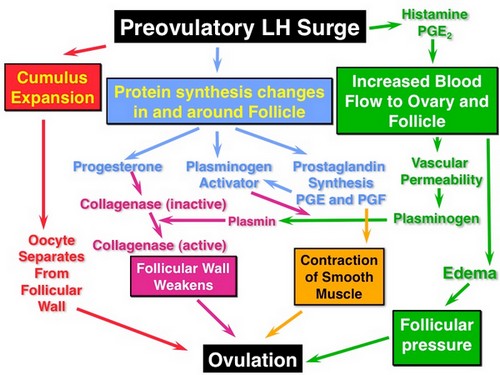
The dominant follicle releases the most estrogen, so that its positive feedback causes LH surge. In the absence of progesterone, estrogen stimulates surge center in the hypothalamus. Ovulation occurs 24-36 hours after LH surge and 12 hours after LH peak. LH surge releases oocytes (secondary oocytes arrested in metaphase of meiosis II) from ovum by several mechanisms:
| Ovarian phase | Dominant hormone | Endometrial phase | |
| Before ovulation | Follicular | Estrogen | Proliferative |
| After ovulation | Luteal | Porgesterone | Secretory |
Note: During ovulation, secondary oocyte is not directly released into the fallopian tube. The occyte is first released into the peritoneal cavity, which then gets sucked into the fallopian tube. If somehow, the oocyte fails to be sucked up into oviduct and remains in the peritoneal cavity – there are chances that that it may be fertilized in the peritoneal cavity. This may give rise to ectopic abdominal pregnancy. The placental separation from such pregnancies result in massive blood loss as there are no muscles to contract and stop bleeding like in uterine cavity.
Fertilization
Site: Ampulla of the fallopian/uterine tube
- Since a secondary oocyte must be fertilized within 12-24 hours after ovulation in order to survive, and it takes about 72 hours to reach the uterus, fertilization must occur in the fallopian tubes.
Spermatozoa:
1. Capacitation: Once ejaculated into the female, vaginal secretions improve the motility and fertilizing ability of sperms. Further exposure to secretions of female genital tract (in uterus and/or fallopian tube) further improbes the mobility and fertilizing ability of the sperms. Capacitation is the process by which the glycoprotein coat and the seminal proteins are removed from the surface of the sperm’s. From the isthmus of fallopian tube, capacitated sperms move rapidly to ampulla, where fertilization takes place.
2. Acrosomal reaction: The sperm binds to the zona pellucida of the secondary oocyte arrested in metaphase of meiosis II and triggers the acrosome reaction, causing the release of acrosomal enzymes (e.g., acrosin).
Both binding and the acrosome reaction are mediated by the ligand ZP3, a zona protein.
3. Penetration of zona pellucida: Aided by the acrosomal enzymes, the sperm penetrates the zona pellucida.

Oocyte:
1. Cortical or Zonal reaction or Polyspermy block: Once, a sperm penetrates the zona pellucida, there is release of lysosomal enzymes from cortical granules near the oocyte cell membrane that changes the oocyte cell membrane potential and inactivates sperm receptors on the zona pellucida.
Interaction between spermatozoa and oocyte:
1. Memrane fusion: Sperm and secondary oocyte membrane fuses.
2. Formation of male pronucleus:
- The nuclear contents and the centriole pair of the sperm enter the cytoplasm of the oocyte. The sperm nuclear contents form the male pronucleus. The tail and mitochondria of the sperm degenerate. Therefore, all mitochondria within the zygote are of maternal origin (i.e., all mitochondrial DNA is of maternal origin).
- The oocyte loses its centriole pair during meiosis so that the establishment of a functional zygote depends on the sperm centriole pair (a cardinal feature of human embryogenesis) to produce a microtubule organizing center (MTOC).
3. Formation of female pronucleus:
- Completion of meiosis II in secondary oocytes leads to formation of a mature ovum, the nucleus of which is known as female pronucleus.
4. Syngamy: fusion of male and female pronucleus (haploid) leads to formation of a 2 celled zygote (diploid).
Dispermy: Two sperm may take part in fertilization during an abnormal process called dispermy resulting in a triploid embryo (69 chromosomes), but it nearly always aborts or dies shortly after birth.
Polygyny: If 2 female pronuclei take part in fertilization, it is called polygyny.