Terminologies
- Monopolar = 1 tip at the end of surgical electrode
- Bipolar = 2 tip at the end of surgical electrode
- Monoterminal = Use of treatment electrode without ground plate (indifferent electrode)
- Biterminal = Both treatment and indifferent electrodes (ground plate) are used
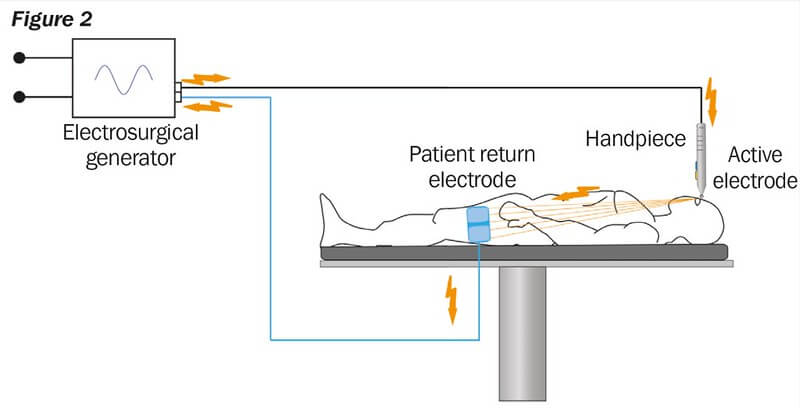
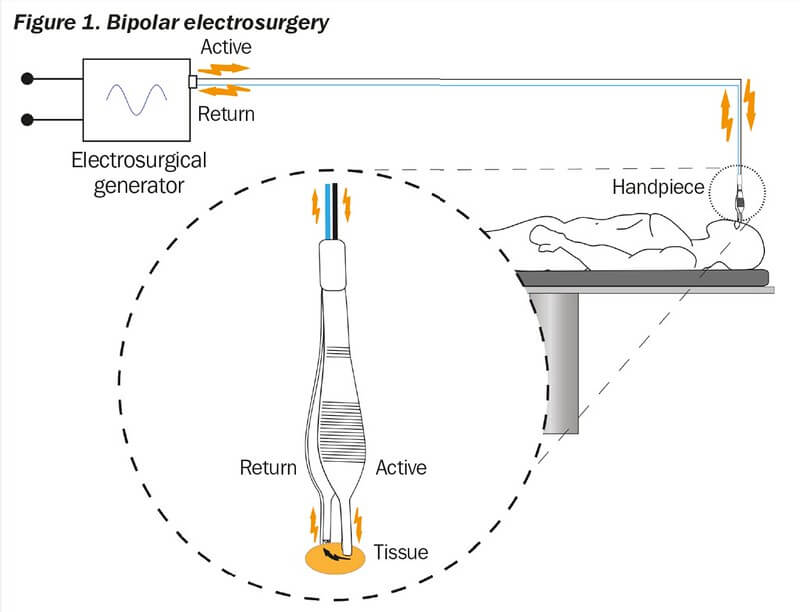
Electrosurgery modalities
| Modality | Electrode configuration | Waveform | Indications | Remarks |
|---|---|---|---|---|
| DC | ||||
| Electrocautery | Patients with ICDs and pacemakers | No current passes through patient (direct heat transference to tissue) | ||
| AC | Unaltered sine wave | |||
| a. High voltage, Low ampere | Can be tolerated in patients with pacemakers at low dosage | |||
| Electrodessication | Monoterminal | Markedly damped | Superficial tissue destruction | Probe directly contacts tissue |
| Electrofulguration | Monoterminal | Markedly damped | Probe held far (spark effect) | |
| b. High ampere, Low voltage | Cannot be tolerated in patients with pacemakers | |||
| Electrocoagulation | Biterminal | Sine wave – 6% on and 94% off | Deep tissue destruction | Higher contact surface area Lower impedance Lower current density |
| Electrosection (pure cut) | Biterminal | Sinewave – 100% on | Cutting | Vaporization Lower contact surface area Higher impedance Higher current density |
| Blend (coagulation + cut) | Biterminal | Sine wave – different proportions of on/off | Hemostasis + Cutting |
Mnemonic: ABC
- Ampere high
- Biterminal
- Coagulation, Cut, Coagulation + Cut (blend)
Mnemonic: VMDeF
- Voltage high
- Monoterminal
- Dessication
- Fulguration
Complications
Mnemonic: ABCDE
1. Active electrode trauma: inappropriate contact or inadvertent activation
2. Blaze (fire): near alcohol source or oxygen
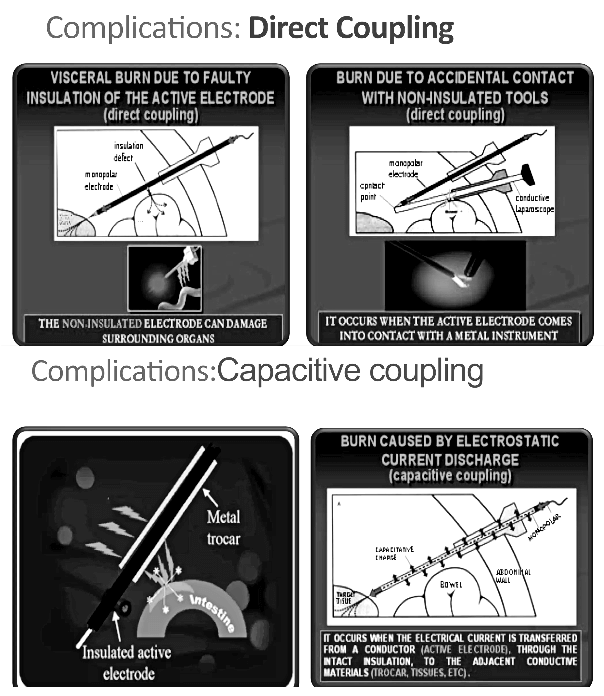
3. Current diversion: ACID
- Alternate ground site burns
- Capacitive coupling: Transfer of current between 2 conductors (electrode tip and metal cannula) separated by insulator through the electrostatic field (reduced by plastic cannula instead of metal cannula); risk increased with –
- High voltage (coagulation mode)
- Open activation (electrodes not in contact with tissue)
- Increased impedance (wrapping of cable around metal clamps like towel clip or activation over previously coagulated tissue)
- Insulation failure: Mainly with high voltage coagulation; smaller the break in insulation, higher the density of current dispersed
- Direct coupling: Transfer of current from one conductive source to another
4. Cardiac pacemaker: Interference from electromagnetic current; reduced by using –
- Bipolar electrode
- Short bursts of monopolar electrode
- Application of dispersive electrode as far as possible from pacemaker
- Immediate deactivation and activation of ICD preoperatively and postoperatively respectively
5. Dispersive electrode burns
- Loss of contact of electrode with patient
- Inappropriate application of electrode on bony prominences or adjacent to ECG leads
6. Explosions: in the vicinity of inflammable gas under pressure
Further reading: Complications, Implications, and Prevention of Electrosurgical Injuries: Corner Stone of Diathermy Use for Junior Surgical Trainees – PMC (nih.gov)

He is the section editor of Orthopedics in Epomedicine. He searches for and share simpler ways to make complicated medical topics simple. He also loves writing poetry, listening and playing music. He is currently pursuing Fellowship in Hip, Pelvi-acetabulum and Arthroplasty at B&B Hospital.