Seven Killer Causes of Fever and Rash
Mnemonic: SMARTTT
- Sepsis
- Meningococcemia
- Acute endocarditis
- Rocky mountain spotted fever
- Toxic erythemas
- Toxic epidermal necrolysis
- Travel-related infections
Onset of Rash with “X” Days of Fever
Mnemonic: Very Sick Person Must Take Double Eggs
- Varicella (Chicken pox): 1st day (rash is often 1st sign in children)
- Scarlet fever: 2nd day
- Pox (Small pox): 3rd day
- Measles (Rubeola or 14 day measles): 4th day (Remember: Koplik spots appear in pre-eruptive phase on 2nd day of fever)
- Typhus: 5th day
- Dengue: 6th day
- Enteric fever: 7th day
Also remember, another similar mnemonic: Really Sick Children Must Take No Exercise
- Rubella (German measles or 3 day measles): 1st day
- Scarlet fever, Small pox: 2nd day
- Chicken pox (Varicella): 3rd day (prodromal symptoms 1-2 days before rash in adults)
- Measles (Rubeola or 14 day measles): 4th day
- Typhus: 5th day
- Nothing
- Enteric fever: 7th day
Remember:
- Roseola infantum (Exanthem subitum, Sixth disease or 3 day fever): rash appears when fever disappears
- Erythema infectiosum (Slapped-cheek disease): no prodromal period and fever
- Drug rash: may appear anytime
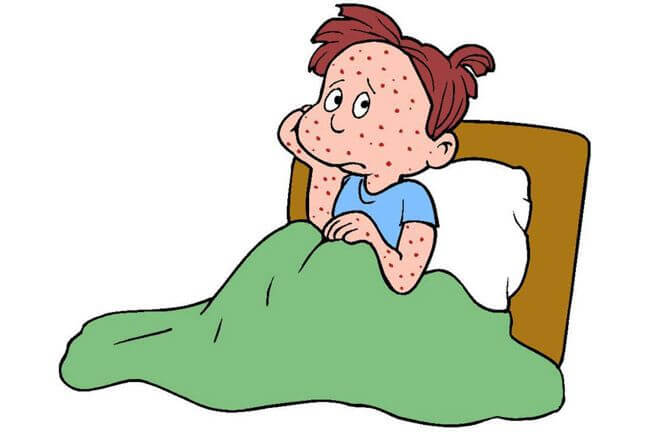
Exanthems – Numbered Diseases of Childhood
Mnemonic: MS (Master in Surgery) and German MD (Doctor of Medicine) in ER (Emergency Room)
- 1st (First) disease: Measles (Rubeola, 14 day measles)
- Measles virus
- 2nd (Second) disease: Scarlet fever
- Streptococcus pyogenes
- 3rd (Third) disease: German measles (Rubella or 3 day measles)
- Rubella virus
- 4th (Fourth) disease: Duke’s disease or Filatov-Duke’s disease (now regarded as a variant of scarlet fever or SSSS)
- 5th (Fifth) disease: Erythema infectiosum or Slapped-cheek disease
- Erythrovirus (Parvovirus) B19
- 6th (Sixth) disease: Roseola infantum (Exanthem subitum, 3 day fever)
- Human Herpes Virus (HHV 6 more than HHV 7)
Diseases Named by Numbered Days
- Three-day fever (3 day fever): Roseola infantum or Exanthem subitum or Sudden fever
- Three-day measles (3 day measles): Rubella or German measles
- Five-day fever (5 day fever): Trench fever or Quintana fever or Shinbone fever
- Seven-day fever (7 day fever): Weil’s disease or Leptospirosis or Canicola fever or Nanukayami fever
- Fourteen-day measles (14 day measles): Measles or Rubeola or Hard measles
Centripetal and Centrifugal Rash Distribution
Centripetal (predominate or start on extremities)
- Hand, foot and mouth disease (caused by enterovirus i.e. coxsackie A16, enterovrius 71)
- Coxsackie A = more common but less severe
- Enterovirus 71 = less common but more severe
- Herpangina = caused by enterovirus; associated with oral enanthem but no exanthems
- Secondary syphilis
- Rocky mountain spotted fever (RMSF)
- Dengue fever
- Small pox
Mnemonic: CARS
1. Coxsackie A
2. RMSF
3. Syphilis
Centrifugal (predominate or start on trunk)
- Viral exanthems: Measles, Rubella, Chicken pox, Scarlet fever
- Epidemic typhus
Involvement of Palms and Soles
Mnemonic: RED HANdS
- Rocky mountain spotted fever (R.rickettsi)
- Endocarditis
- Dengue (Palms and soles are spared by rash but swelling, itching and erythema is often seen)
- Hand-foot-mouth disease (Coxsackie) and Host vs Graft disease (GVHD)
- Autoimmune Kawasaki Disease (KD)
- Neisseria meningococcemia
- Stevens Johnson Syndrome and Syphilis (Secondary and Congenital) and Staphylococcal toxic shock syndrome
Sparing of Face
Mnemonic: SPaRES
- Scarlet fever (Flushing of face occurs but rash doesn’t involve the face)
- Prowazekii caused Epidemic typhus
- Roseola infantum or Exanthem subitum or Sixth disease
Note: The morphology of rashes and detailed approach has not been talked about here. Please refer to standard textbooks for more information.

He is the section editor of Orthopedics in Epomedicine. He searches for and share simpler ways to make complicated medical topics simple. He also loves writing poetry, listening and playing music. He is currently pursuing Fellowship in Hip, Pelvi-acetabulum and Arthroplasty at B&B Hospital.

Am dental dental preparing for pg exam
Pnemonics related to skin and rash is really helpful
Thank u
I had an itchy blister on my right leg and now it has affected my left leg and both palms. I have taken several treatments but now cure. When I incise one inside look spongy. Any diagnosis please
centrifugal and centripetal def are actually reverse
Centrifugal and centripetal are reversed guys.