Skip to content
Epomedicine

Mnemonics, Simplified Concepts & Thoughts

Epomedicine

Mnemonics, Simplified Concepts & Thoughts

pons cross-section

How to Draw Pons Cross-section ?

Dr. Sulabh Kumar Shrestha, MS Orthopedics, Jul 19, 2016Sep 1, 2020

Pons in latin, refers to a “bridge”. Pons varolli is a part of brain-stem, that links thalamus with medulla oblongata. The cross-section of pons is similar to the midbrain as described earlier but few things must be kept in mind:

  1. The orientation of lemnisci in midbrain is more or less vertical, but in pons it is horizontal.
  2. Cranial nerve III and IV arises from midbrain and mainly Cranial nerve V, VI, VIII and VIII arises from pons.
  3. Cerebral aqueduct lies in midbrain and 4th ventricle lies in pons.

Earlier, we imagined transverse section of the midbrain as an inverted striped face of red-eyed demon. Similary, we will use the analogy of an “inverted face of a human” to draw the cross-section of pons.
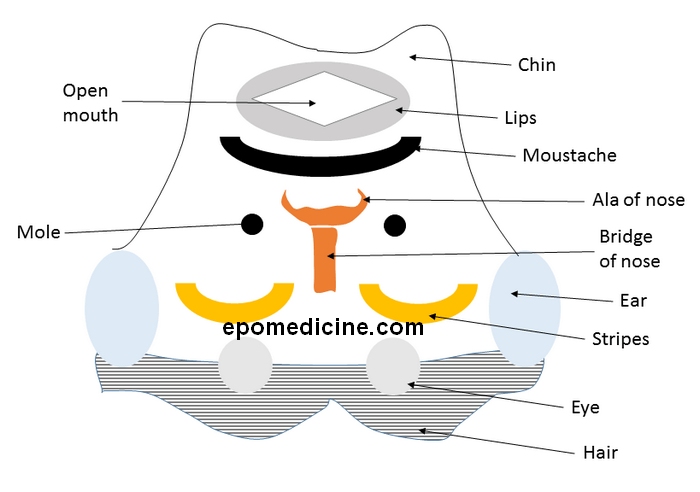
pons mnemonic

Now, let’s label the structures shown above:

  1. Hair = Transverse pontine fibers
  2. Eye = Corticospinal and Corticonuclear tracts
  3. Ear = Middle cerebellar peduncle
  4. Stripes = Lemnisci
    • Medially: Medial lemniscus
    • Middle: Trigeminal lemniscus medially and Spinal lemniscus laterally
    • Lateral: Lateral lemniscus
  5. Bridge of nose = Raphe nucleii
  6. Ala of nose = Medial Longitudinal Fasciculus
  7. Mole = Facial nerve motor nucleus (In caudal pons)
  8. Moustache = Cranial nerve nucleii
    • Medial most = CN VI or Abducens nerve (In caudal pons)
    • Middle = CN V or Trigeminal nerve – motor and sensory (In rostral pons)
    • Lateral most = CN VIII – Superior vestibular nucleus (In caudal pons)
  9. Lips = Periventricular gray
    • Contains locus coeruleus
  10. Open mouth = 4th ventricle
  11. Chin = Superior cerebellar peduncle

Now, let’s look at the real picture:
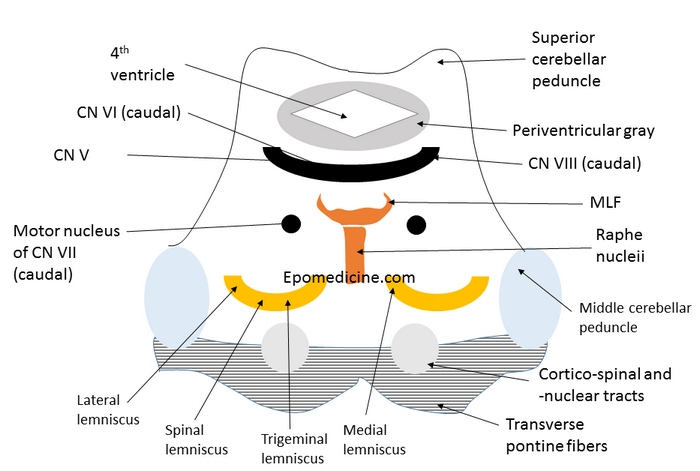
pons cross-section

You can compare with your own face to learn the pons. Wasn’t that easy? Leave comments below 🙂 .

dr. sulabh kumar shrestha
Dr. Sulabh Kumar Shrestha, MS Orthopedics

He is the section editor of Orthopedics in Epomedicine. He searches for and share simpler ways to make complicated medical topics simple. He also loves writing poetry, listening and playing music. He is currently pursuing Fellowship in Hip, Pelvi-acetabulum and Arthroplasty at B&B Hospital.

6 shares
  • Facebook6
  • Twitter
PGMEE, MRCS, USMLE, MBBS, MD/MS AnatomyNervous system

Post navigation

Previous post
Next post

Related Posts

PGMEE, MRCS, USMLE, MBBS, MD/MS hip deformity

Hip and Shoulder Deformities

Jun 7, 2019Jun 7, 2019

HIP Flexion, Abduction, External rotation (FABER) + apparent lengthening: Synovitis Flexion, Abduction, External rotation (FABER) + true lengthening: Anterior dislocation of hip (Obturator) Extension+ Abduction + External rotation (EABER): Anterior dislocation of hip (Superior or Pubic) Flexion, Adduction, Internal rotation (FADIR) + true shortening: Arthritis, Posterior dislocation of hip Flexion,…

Read More
PGMEE, MRCS, USMLE, MBBS, MD/MS

Interpretation of NCCT head: Normal findings

Apr 17, 2024Apr 17, 2024

History: In 1972, Sir Godfrey Hounsfield developed CT scan for which he was awarded Nobel prize in 1979. Through these years CT has come from one rotation in 6 minutes to one in 0.33 seconds. Principle: X rays are produced by CT machine, which are absorbed by different tissues in…

Read More
PGMEE, MRCS, USMLE, MBBS, MD/MS dna replication

DNA Replication Explained With Zipper Model

Jan 25, 2017Jan 26, 2017

Imagine DNA as a zipper Prokaryotic DNA as a zipper with single slider (single origin of replication) and Eukaryotic DNA as a zipper with two sliders (multiple origin of replication). Zipper teeth: Purines and pyrimidine bases Complementary teeth pair: Complementary base pairs attached by hydrogen bonds Top stops: Origin of…

Read More

Comments (6)

  1. Aishwarya says:
    Jun 12, 2018 at 2:11 pm

    Helpful!! Thanks a lot

    Reply
  2. Ana says:
    May 13, 2020 at 7:46 pm

    This is so helpful and creative! I loved the midbrain red-eyed demon too!

    Reply
  3. THARUN TEJ says:
    Sep 1, 2020 at 1:44 am

    hii sir, could u please check whether the location of superior vestibular nucleus is at caudal level or rostral level,
    i confused a lot regarding this , and i think its in causal part of pons , pls verify this sir

    Reply
    1. Dr. Sulabh Kumar Shrestha, MBBS, PGY1 Orthopedics says:
      Sep 1, 2020 at 2:28 am

      Hello Tharun, thank you for the correction. The four vestibular nuclei located in the rostral medulla and caudal pons. Superior and lateral vestibular nuclei are loacted in the caudal pons. Superior vestibular nucleus is located entirely within caudal pons while the lateral vestibular nucleus extends from the caudal pons to rostral medulla.

      Reference: A Textbook of Neuroanatomy By Maria A. Patestas, Leslie P. Gartner

      Reply
  4. Mahmud Musa says:
    Nov 24, 2023 at 6:31 am

    Thank you sir, love from Nigeria!

    Reply
    1. Raphael says:
      May 1, 2024 at 10:14 pm

      This website has been so helpful.
      ♥️ From a fellow Nigerian.

      Reply

Leave a Reply Cancel reply

Your email address will not be published. Required fields are marked *

This site uses Akismet to reduce spam. Learn how your comment data is processed.

Shrestha SK. How to Draw Pons Cross-section ? [Internet]. Epomedicine; 2016 Jul 19 [cited 2026 Jan 27]. Available from: https://epomedicine.com/medical-students/draw-pons-cross-section/.

Pre-clinical (Basic Sciences)

Anatomy

Biochemistry

Community medicine (PSM)

Embryology

Microbiology

Pathology

Pharmacology

Physiology

Clinical Sciences

Anesthesia

Dermatology

Emergency medicine

Forensic

Internal medicine

Gynecology & Obstetrics

Oncology

Ophthalmology

Orthopedics

Otorhinolaryngology (ENT)

Pediatrics

Psychiatry

Radiology

Surgery

RSS Ask Epomedicine

  • What to study for Clinical examination in Orthopedics?
  • What is the mechanism of AVNRT?

Epomedicine weekly

  • About Epomedicine
  • Contact Us
  • Author Guidelines
  • Submit Article
  • Editorial Board
  • USMLE
  • MRCS
  • Thesis
©2026 Epomedicine . All rights reserved.