Principles of development
- Development proceeds from the head downward (cephalocaudal principle).
- Development proceeds from the center of the cody outward (proximodistal development).
- Development depends on maturation and learning.
- Development proceeds from the simple to the more complex.
- Growth and development is a sequential and continuous process.
- Growth and development proceed from the general to specific.
- There are individual rates of growth and development.
Keep in mind, these principles and remember what a child will be able to achieve at the end of a year and fill the missing gaps.
By 1 year
Walk, Scribble, Single words
- 2-3 months: Head holding, Social smile
- 4 months: Rolls over
- 6 months: Sits with support, Stranger anxiety, Smiles at mirror, Palmar grasp
- 9 months: Stands with support, Crawls, Pincer grasp (immature), Says dada/mama (non-specific)
- 12 months: Walks with support, Pincer grasp (mature), Says dada/mama (specific), Separation anxiety, Rapproachment (dependence on parental figure)
Story mnemonic: Imagine and repeat it while reading this story of waking up from bed when you are sleeping in prone position.
2 AM alarm: You lift you heard up, turn towards alarm sound (then turn it off) and smile (you have more time to sleep) but you are lazy to wakeup and sleep again.
4 AM alarm: This time you are more determined and lift you head and chest, yawn (coo) and bring you hand towards yawning mouth (bring hands to midline) and laugh (you have more time to sleep) but you are lazy to wakeup and sleep again.
6 AM alarm: You rollover to supine position (rollover), reach for your cellphone (reach for objects), look at it, transfer it to another hand (transfer objects), sit on bed with hands supporting (sit with support) and respond to your mother calling you (respond to name).
9 AM exercise: Push up (pull to stand) and clap (bang objects) and do some bear crawls to be tired to stand up holding on your bed and then you pinch your fat (pincer grasp). You find that your leg hurts.
12 PM lunch time: You walk to kitchen holding the walls limping on your painful leg (walk with support), pour cereals and milk into bowl (put object into cup).
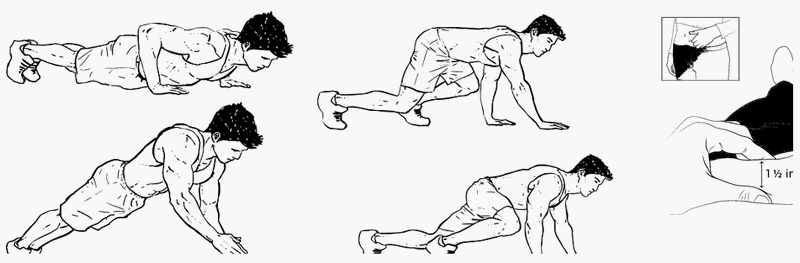
See how the development progresses from head to foot, from proximal to distal and from simple to complex in a sequential manner, i.e. head holding, then rolling over (shoulder and chest), sit (halfway to walk), crawl and then walk for gross motor; palmar grasp to pincer grasp for fine motor; and meaningless cooing/babbling to meaningful 1-2 words for speech.
By 2 years
Mnemonic: Run on 2 feet, Climb 2 steps (one at a time), 2 parallel lines, 2 word sentence, Follow 2 step commands, Turn 2 pages of a book, To-ilet (Pronounce as two-ilet) training
- 15 months: Walks alone, 3-5 meaningful words
- 18 months: Runs, Climb stairs with support, 8-10 meaningul words
- 2 years: Climb stairs without support, 2 word phrases (e.g. love you), Follow 2 step commands, Parallel play (2 children each play alone but confronted by the fact that another child is playing nearby)
By 3 years
They do things that 2 year do but does everything better.
Tricycle, 3 word sentence, Speech 3/4 intelligible, Ready to go to school (alternate feet upstairs, dresses/undressess partially, fixed gender identity, knows full name and gender, copies a circle)
By 4 years
Mnemonic: Remember 5 C (Co-ordination, Color, Cross, Counts to 10, Co-operative play)
Hops/alternate feet downstairs, Copies cross and square, Knows colors, Can use scissors and crayons, Becomes more social (co-operative play with friends, tells stories/poems, dressess/undresses fully without help)
By 5 years
Mnemonic: Person with 5+ parts, 5 word sentences, Hi-5 with friends.
Bicycle, Copies triangle, Draws person with 5+ parts, 5 word sentences, Skips, Shoe laces, Independent dressing/bathing, Has friends
The story in this piece has been inspired from this audio. You can listen to the story here on OTprep.
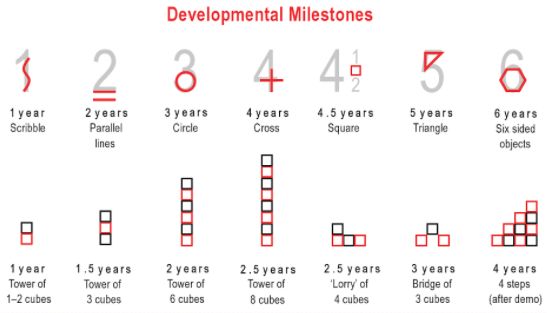
Upto 3 years: Age X 3 = number of cubes a child can stack to make a tower
At 3 years: build gate/bridge of 3 cubes
At 4 years: make 4 step ladder
Red flag signs
In clinical terms, there are a few “absolute indicators,” often referred to as “red flags,” that identify the behavioral or developmental markers suggesting the need for further evaluation.
Typically, there is a 3-6 month range on either side of the development milestone, but this will vary depending upon the behavior.
- By 3 months: Persistent fisting, Failure to alert to environmental stimuli
- By 6 months: Poor head control, Failure to reach for objects, Absent ccoing, Absent smile (Normally achieved by 3 months + 3 months)
- By 10 months: Not sitting without support (Normally achieved by 7 months + 3 months)
- By 12 months: Persistence of primitive reflexes, Development of hand preference (Normally achieved at 18 months – 6 months)
- By 18 months: Not walking without support (Normally achieved by 15 months + 3 months), No single word with meaning (Normally achieved by 12 months + 6 months)
- By 30 months: No 2-3 word sentence (Normally achieved by 24 months + 6 months)
In general, wait for 3 months for milestones acquired in 1st year and 6 months for milestones acquired in 2 year to list it under the “red flag” signs.

He is the section editor of Orthopedics in Epomedicine. He searches for and share simpler ways to make complicated medical topics simple. He also loves writing poetry, listening and playing music. He is currently pursuing Fellowship in Hip, Pelvi-acetabulum and Arthroplasty at B&B Hospital.

Thank you for this! It’s super helpful- I feel like now I’ll actually be able to visualize the milestones.
This is really helpful, but I do have one criticism: At six am you have the baby rolling to supine, but doesn’t that usually happen earlier, like three or four months? And then back to front around six?