Skip to content
Epomedicine

Mnemonics, Simplified Concepts & Thoughts

Epomedicine

Mnemonics, Simplified Concepts & Thoughts

Dengue Classification : Mnemonic

Dr. Sulabh Kumar Shrestha, MS Orthopedics, Aug 22, 2019Oct 23, 2024

Probable Dengue

Mnemonic: FEVeR TLC (Send Total Leukocyte Count in Fever)

a. Fever
b. Endemic area (living or travel)
and 2 of –
c. Vomiting and nausea
d. Rash
e. Tourniquet test positive
f. Leukopenia (EARLIEST sign)
g. Cramps and cries (Aches and pains)

Tourniquet test: Inflate the BP cuff between SBP and DBP and keep it inflated for 5 minutes:
>20 petechiae in 1 inch square indicates capillary fragility.
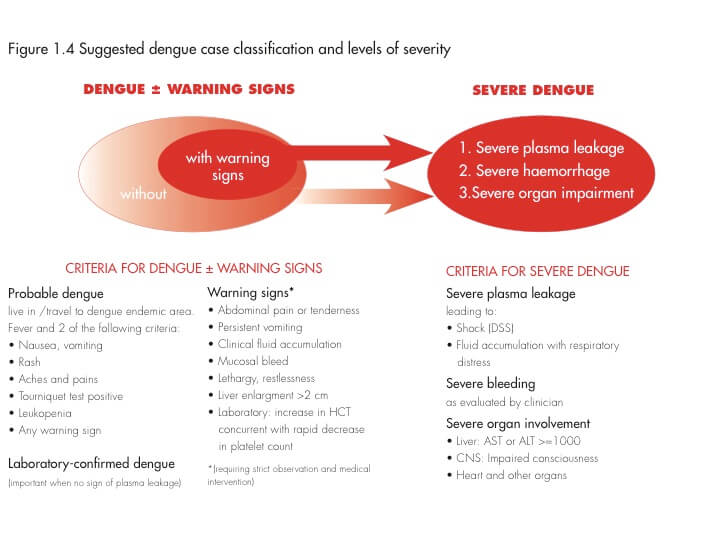
dengue classification

Warning Signs

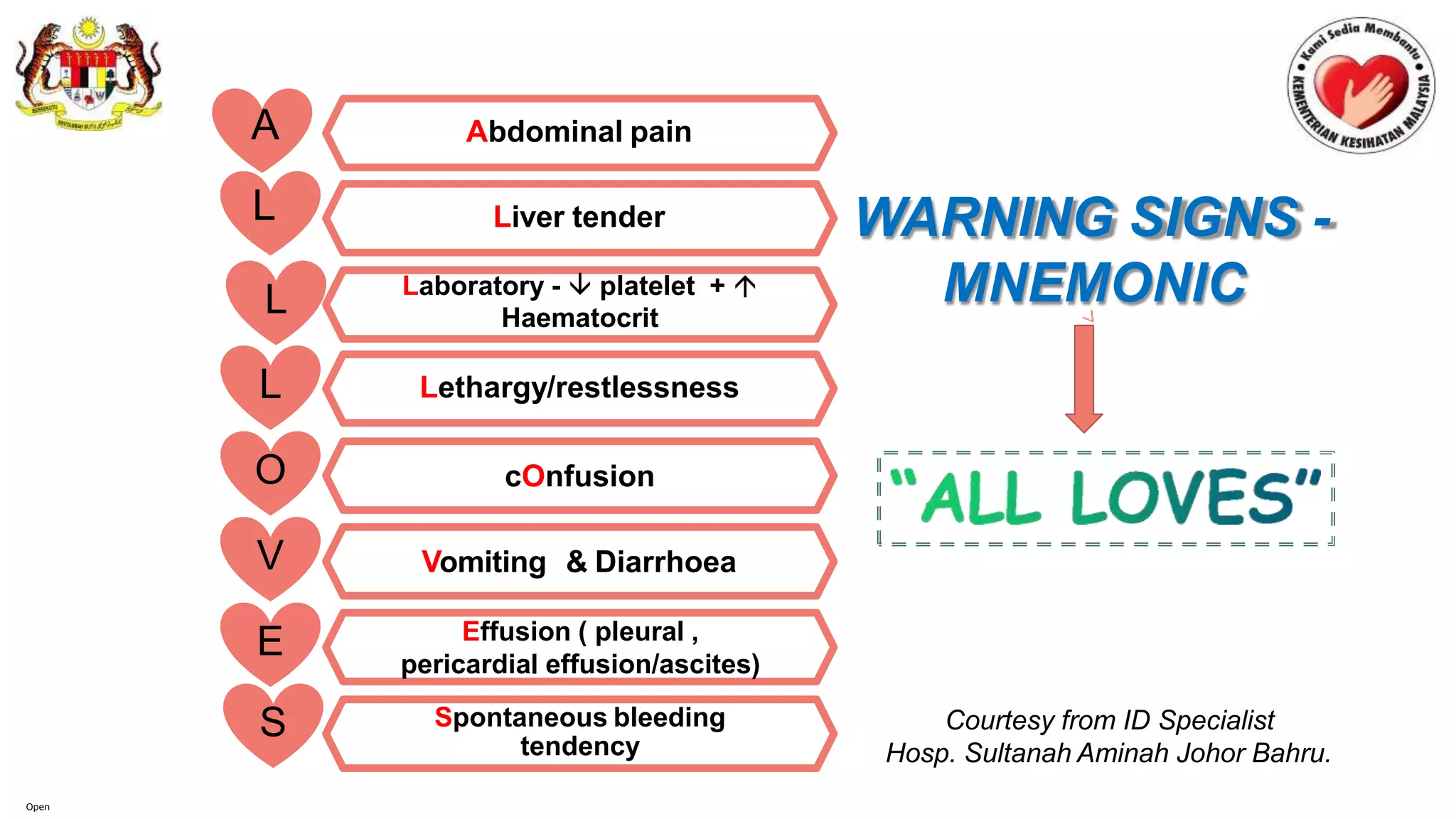
Mnemonic: ALL LoVES

a. Abdominal pain or tenderness

b. Liver enlargement >2 cm

c. Lab – Progressive increase in hematocrit & decrease in platelet count

d. Lethargy, restlessness

e. Vomiting – persistent

f. Effusion (ascites/pleural effusion)

g. Spontaneous bleeding (mucosal bleeds)
Other warning signs: Pregnancy, Infancy, Old age, Diabetes mellitus, Renal failure, Living alone, Living far from home

Severe Dengue

Mnemonic: BCDEF

Any of the following:
a. Severe plasma leakage
b. Severe bleeding
c. Severe organ impairment

a. Bleeding (severe as assessed by Clinician)

b. Cardiac, CNS and other organs involved severely (Impaired consciousness, AST/ALT >/= 1000, etc.)

c. Decompensation of chronic disease

d. Epistaxis (minor bleeding) with thrombocytopenia (platelet <20,000/cu.mm)

e. Fluid leak (Shock or respiratory distress with fluid accumulation)

Confirmatory lab tests

a. Serology IgM
b. RT-PCR
c. NS1 antigen

Reference:

  1. Ajlan BA, Alafif MM, Alawi MM, Akbar NA, Aldigs EK, Madani TA (2019) Assessment of the new World Health Organization’s dengue classification for predicting severity of illness and level of healthcare required. PLoS Negl Trop Dis 13(8): e0007144. https://doi.org/10.1371/journal.pntd.0007144
  2. Dengue | CDC Yellow Book 2024
dr. sulabh kumar shrestha
Dr. Sulabh Kumar Shrestha, MS Orthopedics

He is the section editor of Orthopedics in Epomedicine. He searches for and share simpler ways to make complicated medical topics simple. He also loves writing poetry, listening and playing music. He is currently pursuing Fellowship in Hip, Pelvi-acetabulum and Arthroplasty at B&B Hospital.

1 shares
  • Facebook1
  • Twitter
PGMEE, MRCS, USMLE, MBBS, MD/MS Infectious diseaseInternal medicinePediatrics

Post navigation

Previous post
Next post

Related Posts

PGMEE, MRCS, USMLE, MBBS, MD/MS

Intrinsic thumb muscles : Tricks to Remember

Apr 26, 2020Oct 27, 2022

The muscles of thumb will make 2 compartments – thenar compartment and adductor compartment. Mnemonic: Do it yourself as shown in the image below. Put your left hand with curled in middle/long finger above the palm of right hand. There are 2 muscle layers in this side of the hand….

Read More
PGMEE, MRCS, USMLE, MBBS, MD/MS

Spondylolisthesis : Summary

Aug 31, 2024Aug 31, 2024

Indications for surgery Age group Spondylolisthesis Indications Pediatric Low grade Failure to respond to conservative treatment (9-12 months)Progressive slippageIntractable low back or radicular painNeurological deficit and deterioration High grade Neurological symptomsSevere sagittal plane spinal deformity Adult Low grade Failure of non-operative treatmentProgressive slippageSymptomatic and radiographically unstable isthmic spondylolisthesis High grade…

Read More
PGMEE, MRCS, USMLE, MBBS, MD/MS intercellular junctions

Cell-Cell or Interceullular Junctions

May 22, 2019May 22, 2019

Junction Location Composition Function Remarks Tight junction (Zonula occludens) Epithelial cell-Epithelial cell Claudin and Occludin (attaches to cytoskeleton – actin filament) Prevents paracellular movement of solutes and diffusion Adherens junction (Zonula adherens) Epithelial cell-Epithelial cell E-cadherin (attaches to cytoskeleton – actin filament) Belt desmosome (Anchoring) Cadherins are Ca2+ depndend adhesion…

Read More

Leave a Reply Cancel reply

Your email address will not be published. Required fields are marked *

This site uses Akismet to reduce spam. Learn how your comment data is processed.

Pre-clinical (Basic Sciences)

Anatomy

Biochemistry

Community medicine (PSM)

Embryology

Microbiology

Pathology

Pharmacology

Physiology

Clinical Sciences

Anesthesia

Dermatology

Emergency medicine

Forensic

Internal medicine

Gynecology & Obstetrics

Oncology

Ophthalmology

Orthopedics

Otorhinolaryngology (ENT)

Pediatrics

Psychiatry

Radiology

Surgery

RSS Ask Epomedicine

  • What to study for Clinical examination in Orthopedics?
  • What is the mechanism of AVNRT?

Epomedicine weekly

  • About Epomedicine
  • Contact Us
  • Author Guidelines
  • Submit Article
  • Editorial Board
  • USMLE
  • MRCS
  • Thesis
©2026 Epomedicine | WordPress Theme by SuperbThemes