Skip to content
Epomedicine

Mnemonics, Simplified Concepts & Thoughts

Epomedicine

Mnemonics, Simplified Concepts & Thoughts

gamma loop

Lower Motor Neuron Lesion (LMNL) – Anatomical Basis

Epomedicine, Jul 25, 2016Jul 25, 2016

The anatomical basis of Upper Motor Neuron Lesion (UMNL) has already been discussed earlier. Similarly, we will explain the anatomical basis of clinical syndrome of Lower Motor Neuron Lesion (LMNL).

A. Ipsilateral involvment:

  • Lower motor neuron comprises of motor neurons in the anterior neurons and the fibers originating from them, which innervates the skeletal muscles.
  • These fibers go uncrossed to the same side.

B. Involvement at the level of lesion:

  • Damage of LMN at the level of lesion.

C. Flaccid paralysis, Loss of Deep Tendon Reflexes and Hypotonia:
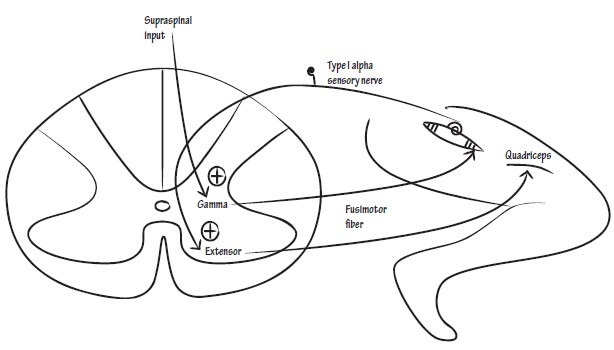
gamma loop

In voluntary muscle contraction: UMN → LMN

In reflex muscle contraction: Muscle sensory neuron → LMN

Tone: γ efferent → Regulates baseline Ia afferent discharge → Regulates baseline α-motor neuron discharge

  • Alpha motor neurons and axons from them activate extrafusal fibers and contract them.
  • So, destruction of this leads to:
    • Loss of efferent limb in monosynaptic stretch or deep tendon reflexes
    • Information from motor cortex doesn’t reach muscles due to defect in Lower motor neuron – leading to flaccid paralysis
    • Loss of gamma and alpha motor neurons lead to decrease in baseline Ia and alpha motor neuron discharge – leading to hypotonicity

D. Muscle atrophy:

  • Denervation (deprived of necessary trophic factors)
  • Disuse

E. Fasciculations and Fibrillations:

  • Damaged α-motor neuron → Spontaneous action potential → Motor unit fires → Visible twitching of muscle fibers group (fasciculations)
  • Increased excitability of muscle fibers due to denervation → Spontaneous contraction of single muscle fiber visible in EMG (fibrillations)
25 shares
  • Facebook25
  • Twitter
PGMEE, MRCS, USMLE, MBBS, MD/MS AnatomyInternal medicineNervous systemPediatrics

Post navigation

Previous post
Next post

Related Posts

PGMEE, MRCS, USMLE, MBBS, MD/MS kawasaki-disease

Kawasaki Disease – Diagnostic Criteria Mnemonic

Oct 7, 2016Oct 7, 2016

The diagnostic criteria of Kawasaki Disease can be remembered using a mnemonic – “FEBRILE“. Fever: >5 days plus ≥4 of the following Enathem: Lips: Erythema, fissuring or crusting Oropharynx: Diffuse injection Tongue: Strawberry tongue Bulbar conjunctivitis: Bilateral, painless and non-exudative Rash: Polymorphous rash Internal organ involvement (not the part of criteria)…

Read More
PGMEE, MRCS, USMLE, MBBS, MD/MS dna replication

DNA Replication Explained With Zipper Model

Jan 25, 2017Jan 26, 2017

Imagine DNA as a zipper Prokaryotic DNA as a zipper with single slider (single origin of replication) and Eukaryotic DNA as a zipper with two sliders (multiple origin of replication). Zipper teeth: Purines and pyrimidine bases Complementary teeth pair: Complementary base pairs attached by hydrogen bonds Top stops: Origin of…

Read More
PGMEE, MRCS, USMLE, MBBS, MD/MS esr

Maximum Normal ESR and CRP for age and gender

Jan 23, 2021Jan 23, 2021

Age and gender plays should be taken into account when interpreting the values of ESR and CRP. The maximum ESR value is limited by the length of the Westergren tube (usually 120 mm), but the CRP has no upper limit. Miller formulae for calculating maximum normal ESR in Adults ESR…

Read More

Leave a Reply Cancel reply

Your email address will not be published. Required fields are marked *

This site uses Akismet to reduce spam. Learn how your comment data is processed.

Epomedicine. Lower Motor Neuron Lesion (LMNL) – Anatomical Basis [Internet]. Epomedicine; 2016 Jul 25 [cited 2026 Jan 17]. Available from: https://epomedicine.com/medical-students/lower-motor-neuron-lesion-lmnl-anatomical-basis/.

Pre-clinical (Basic Sciences)

Anatomy

Biochemistry

Community medicine (PSM)

Embryology

Microbiology

Pathology

Pharmacology

Physiology

Clinical Sciences

Anesthesia

Dermatology

Emergency medicine

Forensic

Internal medicine

Gynecology & Obstetrics

Oncology

Ophthalmology

Orthopedics

Otorhinolaryngology (ENT)

Pediatrics

Psychiatry

Radiology

Surgery

RSS Ask Epomedicine

  • What to study for Clinical examination in Orthopedics?
  • What is the mechanism of AVNRT?

Epomedicine weekly

  • About Epomedicine
  • Contact Us
  • Author Guidelines
  • Submit Article
  • Editorial Board
  • USMLE
  • MRCS
  • Thesis
©2026 Epomedicine . All rights reserved.