Skip to content
Epomedicine

Mnemonics, Simplified Concepts & Thoughts

Epomedicine

Mnemonics, Simplified Concepts & Thoughts

lung segments xray

Silhouette and Cervico-thoracic sign

Epomedicine, Oct 30, 2016May 24, 2019

Synonyms: Obscured margin sign, Loss of outline sign

Silhouette refers to the shadow and derived it’s origin from shadow papercuts done by Etienne de Silhouette.

Principle of Silhouette sign

On a normal Chest X-ray the well-defined borders of the heart and the domes of the diaphragm are visualised because the adjacent normal air containing radiolucent lung.

Silhouette sign is based on the principle that if the two structures have approximately the same radiographic density, an are in intimate contact with each other, then the interface between them is obliterated.

If a lesion effaces one of these interfaces then the sharp margin (heart or diaphragm) is lost. The CXR appearance of a blurred or effacement is referred to as the silhouette sign.

Application of silhouette sign

It is used in localization of intrathoracic opacity like: consolidation, mass, fluid, atelectasis, etc. that are in contact with mediastinum or diaphragm.
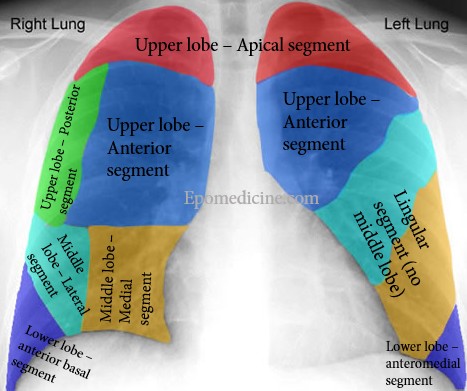
lung segments xray

Silhouette structure Lung segment
Ascending aorta Right upper lobe – Anterior segment
Aortic knob/knuckle Left upper lobe – apicoposterior segment
Right heart border Right middle lobe – medial segment
Left heart border Left upper lobe – lingular segment
Right hemidiaphragm Lower lobe – anterior segment
Left hemidiaphragm
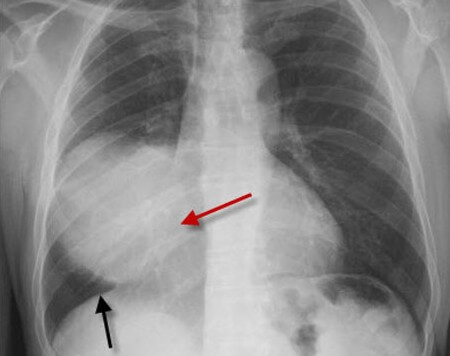
silhouette sign
Where is the intrathoracic pathology localized?
Ans: Right middle lobe

Cervico-thoracic pass sign

Upper most border of the mediastinum:

  1. Anterior mediastinum: Ends at the level of clavicle
  2. Middle and posterior mediastinum: Projects above the clavicle
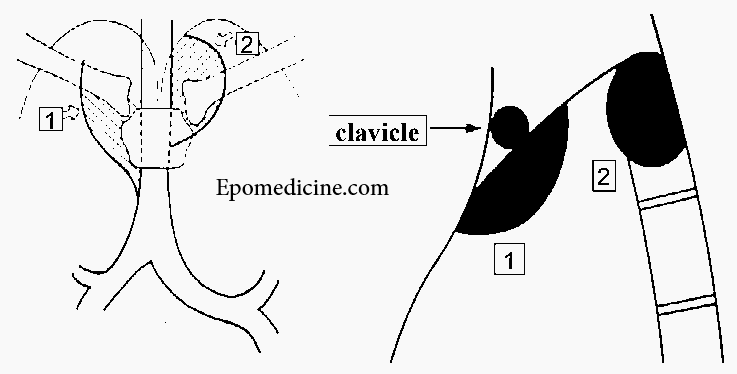
cervicothoracic sign

Interpretation:

  1. The external and superior edges of the mediastinal opacity disappear above the clavicles: opacity is anterior in the superior mediastinum
  2. The superior edge of the opacity is visible in the pulmonary air: the opacity is posterior
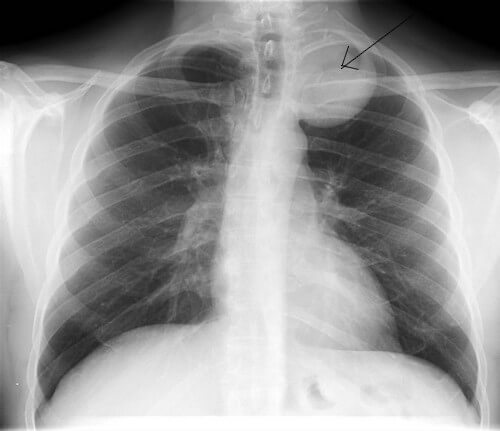
cervicothoracic sign
Where is the pathology located – anterior or posterior?
Ans: Posterior (because the opacity projects above the ipsilateral clavicle)
33 shares
  • Facebook33
  • Twitter
PGMEE, MRCS, USMLE, MBBS, MD/MS RadiologyRespiratory system

Post navigation

Previous post
Next post

Related Posts

PGMEE, MRCS, USMLE, MBBS, MD/MS

Middle Cranial Fossa : Mnemonics

Jun 3, 2023Apr 29, 2024

Boundaries The body of the sphenoid makes up the central portion of the middle fossa and houses the sella turcica, bounded by the anterior and posterior clinoid processes. List of Foramina from Anterior to Posterior Mnemonic: Old Rotund Owls Spin Lazily These foramina are in the Sphenoid bone. Contents of…

Read More
PGMEE, MRCS, USMLE, MBBS, MD/MS

ALI and ARDS : Mnemonics

May 20, 2024May 20, 2024

Diagnosis (Berlin Criteria) Mnemonic A R D S Acute Lung Injury (ALI) Acute onset (<7 days) Ratio PaO2/FiO2 ≤300 mmHg or 40 kPa Diffuse bilateral pulmonary infiltrates on CXR Swan-Ganz pulmonary wedge pressure ≤18 mmHg or No evidence of Left atrial hypertension Acute Respiratory Distress Syndrome (ARDS) Acute onset (<7…

Read More
PGMEE, MRCS, USMLE, MBBS, MD/MS

Rheumatoid Thumb – Nalebuff Classification

Mar 14, 2025Mar 14, 2025

Type Description Treatment 1 Boutonniere (most common) Synovectomy with extensor hood reconstruction; MCP fusion or arthroplasty 2 Boutonniere with CMC subluxation (uncommon; Type 1 + Type 3) Same as type 1 and type 3 3 Swan neck deformity (2nd most common) Splinting vs CMC arthroplasty; MCP fusion 4 Gamekeeper deformity…

Read More

Leave a Reply Cancel reply

Your email address will not be published. Required fields are marked *

This site uses Akismet to reduce spam. Learn how your comment data is processed.

Pre-clinical (Basic Sciences)

Anatomy

Biochemistry

Community medicine (PSM)

Embryology

Microbiology

Pathology

Pharmacology

Physiology

Clinical Sciences

Anesthesia

Dermatology

Emergency medicine

Forensic

Internal medicine

Gynecology & Obstetrics

Oncology

Ophthalmology

Orthopedics

Otorhinolaryngology (ENT)

Pediatrics

Psychiatry

Radiology

Surgery

RSS Ask Epomedicine

  • What to study for Clinical examination in Orthopedics?
  • What is the mechanism of AVNRT?

Epomedicine weekly

  • About Epomedicine
  • Contact Us
  • Author Guidelines
  • Submit Article
  • Editorial Board
  • USMLE
  • MRCS
  • Thesis
©2026 Epomedicine | WordPress Theme by SuperbThemes