Skip to content
Epomedicine

Mnemonics, Simplified Concepts & Thoughts

Epomedicine

Mnemonics, Simplified Concepts & Thoughts

primary dental eruption

Dental eruption : Mnemonic

Epomedicine, Mar 4, 2018

Primary teeth begin eruption at around 6 months and Permanent teeth at around 6 years. In general, lower tooth erupts before it’s upper counterpart with few exceptions (lower before upper rule). Age of 6-12 years is a period of mixed dentition (eruption of permanent 1st molar to eruption of 2nd permanent molar).

Primary (Temporary Teeth)
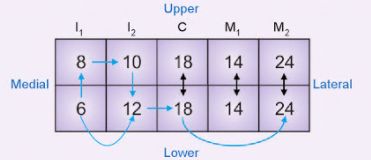
primary dental eruption

Rules and Exceptions:

  1. Eruption progresses from medial to lateral except canines which erupt between 1st and 2nd molar.
  2. Incisors erupt in clockwise fashion at a difference of 2 months starting from lower central incisor.
  3. Lower and upper canines and molar at around similar time.
  4. 2-4-6 rule for canines and molars.

Eruption:

  1. Lower central incisor: 6 months
  2. Upper central incisor: 8 months
  3. Upper lateral incisor: 10 months
  4. Lower lateral incisor: 12 months
  5. 1st molars: 12 months + 2 = 14 months
  6. Canines: 14 months + 4 = 18 months
  7. 2nd molars: 18 months + 6 = 24 months

Secondary (Permanent) Teeth
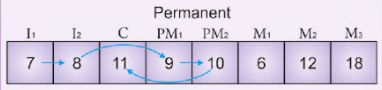
permanent teeth eruption

Rules and Exceptions:

  1. Sequence: Mama Is In Pain, Papa Can Make Medicine, i.e. 1st molar, 1st Incisor, 2nd Incisor, 1st Premolar, 2nd Premolar, Canine, 2nd Molar, 3rd Molar
  2. Eruption occurs sequentially at a difference of 1 year except the 3rd molar which erupts between 18-24 years.
  3. Lower teeth appears few months earlier with exception of the lower canines which erupts almost 2 years earlier, i.e. 9 years.
  4. Premolars appear earlier in upper jaw, i.e. lower 1st premolar would appear at 10 years and lower 2nd premolar would appear at 11 years.
  5. Add 3 years to the age of eruption for the age of completion of calcification.

Eruption:

  1. 1st molar: 6 years
  2. 1st incisor: 7 years
  3. 2nd incisor: 8 years
  4. 1st premolar: 9 years
  5. 2nd premolar: 10 years
  6. canine: 11 years
  7. 2nd molar: 12 years
  8. 3rd molar: 18-24 years
2 shares
  • Facebook
  • Twitter
PGMEE, MRCS, USMLE, MBBS, MD/MS AnatomyDentalPediatrics

Post navigation

Previous post
Next post

Related Posts

PGMEE, MRCS, USMLE, MBBS, MD/MS

Pregabalin : Pharmacology

Dec 5, 2021Dec 5, 2021

Pharmacokinetics After oral ingestion, Pregabalin is rapidly absorbed (Tmax 1.3 hr) Bioavailability is >90% and independent of dose Pregabalin is NOT protein bound Vd is 0.4 L/kg Serum pregabalin concentrations are linearly related to dosage Pregabalin is NOT metabolized Pregabalin is primarily excreted unchanged in urine (98%) with a clearance…

Read More
PGMEE, MRCS, USMLE, MBBS, MD/MS infective endocarditis

Modified Duke’s Criteria for Infective Endocarditis : Mnemonic

Oct 22, 2017

Bacterial Endocarditis FIVE PM, i.e. BE FIVE PM Blood culture positive for IE Endocardial involvement Fever Immunologic phenomena Vascular phenomena Echocardioraphy minor criteria (eliminated) Predisposition Microbiologic evidence Definite Diagnosis from Clinical Criteria: 2 (major) + 0 (minor) or 1 (major) + 3 (minor) or 0 (major) + 5 (minor) Look:…

Read More
PGMEE, MRCS, USMLE, MBBS, MD/MS jones criteria

Revised Jone’s Criteria – Mnemonic

Jun 6, 2019Jun 6, 2019

Remember SPACE LEAF for Revised Jone’s Criteria (2015). Major criteria Mnemonic: SPACE Subcutaneous nodules Pancarditis Arthritis (Polyarthritis; for moderate to high-risk population – monoarthritis also qualifies) Chorea Erythema marginatum Minor criteria Mnemonic: LEAF Long PR interval ESR ≥ 60mm/hr (or ≥ 30mm/hr in moderate to high-risk population) and CRP ≥…

Read More

Comments (3)

  1. Devansh Sharma says:
    Dec 2, 2022 at 4:10 am

    Awesome pneumonic loved it.

    Reply
    1. Meraj Farooque Khan says:
      Jun 25, 2023 at 11:08 am

      Can you tell me from which book has this image been taken from? I used to study from its pdf but can’t remember the name pf the book.

      Reply
      1. Epomedicine says:
        Jun 25, 2023 at 2:53 pm

        Source: APC Textbook of Forensic Medicine and Toxicology By Anil Aggrawal

        Reply

Leave a Reply to Epomedicine Cancel reply

Your email address will not be published. Required fields are marked *

This site uses Akismet to reduce spam. Learn how your comment data is processed.

Pre-clinical (Basic Sciences)

Anatomy

Biochemistry

Community medicine (PSM)

Embryology

Microbiology

Pathology

Pharmacology

Physiology

Clinical Sciences

Anesthesia

Dermatology

Emergency medicine

Forensic

Internal medicine

Gynecology & Obstetrics

Oncology

Ophthalmology

Orthopedics

Otorhinolaryngology (ENT)

Pediatrics

Psychiatry

Radiology

Surgery

RSS Ask Epomedicine

  • What to study for Clinical examination in Orthopedics?
  • What is the mechanism of AVNRT?

Epomedicine weekly

  • About Epomedicine
  • Contact Us
  • Author Guidelines
  • Submit Article
  • Editorial Board
  • USMLE
  • MRCS
  • Thesis
©2026 Epomedicine | WordPress Theme by SuperbThemes