Skip to content
Epomedicine

Mnemonics, Simplified Concepts & Thoughts

Epomedicine

Mnemonics, Simplified Concepts & Thoughts

primary dental eruption

Dental eruption : Mnemonic

Epomedicine, Mar 4, 2018

Primary teeth begin eruption at around 6 months and Permanent teeth at around 6 years. In general, lower tooth erupts before it’s upper counterpart with few exceptions (lower before upper rule). Age of 6-12 years is a period of mixed dentition (eruption of permanent 1st molar to eruption of 2nd permanent molar).

Primary (Temporary Teeth)
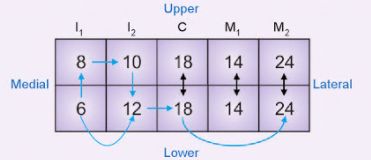
primary dental eruption

Rules and Exceptions:

  1. Eruption progresses from medial to lateral except canines which erupt between 1st and 2nd molar.
  2. Incisors erupt in clockwise fashion at a difference of 2 months starting from lower central incisor.
  3. Lower and upper canines and molar at around similar time.
  4. 2-4-6 rule for canines and molars.

Eruption:

  1. Lower central incisor: 6 months
  2. Upper central incisor: 8 months
  3. Upper lateral incisor: 10 months
  4. Lower lateral incisor: 12 months
  5. 1st molars: 12 months + 2 = 14 months
  6. Canines: 14 months + 4 = 18 months
  7. 2nd molars: 18 months + 6 = 24 months

Secondary (Permanent) Teeth
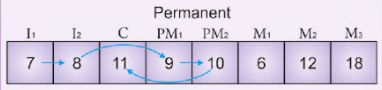
permanent teeth eruption

Rules and Exceptions:

  1. Sequence: Mama Is In Pain, Papa Can Make Medicine, i.e. 1st molar, 1st Incisor, 2nd Incisor, 1st Premolar, 2nd Premolar, Canine, 2nd Molar, 3rd Molar
  2. Eruption occurs sequentially at a difference of 1 year except the 3rd molar which erupts between 18-24 years.
  3. Lower teeth appears few months earlier with exception of the lower canines which erupts almost 2 years earlier, i.e. 9 years.
  4. Premolars appear earlier in upper jaw, i.e. lower 1st premolar would appear at 10 years and lower 2nd premolar would appear at 11 years.
  5. Add 3 years to the age of eruption for the age of completion of calcification.

Eruption:

  1. 1st molar: 6 years
  2. 1st incisor: 7 years
  3. 2nd incisor: 8 years
  4. 1st premolar: 9 years
  5. 2nd premolar: 10 years
  6. canine: 11 years
  7. 2nd molar: 12 years
  8. 3rd molar: 18-24 years
2 shares
  • Facebook
  • Twitter
PGMEE, MRCS, USMLE, MBBS, MD/MS AnatomyDentalPediatrics

Post navigation

Previous post
Next post

Related Posts

PGMEE, MRCS, USMLE, MBBS, MD/MS

Kienbock’s Disease : Mnemonic Approach

Jul 18, 2024Jul 18, 2024

Etiology Mnemonic: RSTUV Lichtman Classification and Management Stage Description Treatment Mnemonic: ABCD Mnemonic: ABCD I Abnormal MRI (decreased T1 intensity; variable T2 intensity) or scintigraphy Analgesics + immobilization II Bone sclerosis ± Bone breaks (fracture lines) Bony procedures:1. Negative or Neutral ulnar variance: Joint levelling procedure (Radius shortening osteotomy; Ulnar…

Read More
PGMEE, MRCS, USMLE, MBBS, MD/MS trinucleotide repeat disorders

Trinucleotide Repeat Disorders and Anticipation Mnemonics

Jan 23, 2017Jan 25, 2017

Anticipation in genetics refers to an increase in severity and decrease in age of onset in successive generations, most likely due to increased size of trinucleotide repeats. Paternal anticipation: Huntington’s disease, Friedreich’s Ataxia Maternal anticipation: Myotonic dystrophy, Fragile X syndrome Diseases Trinucleotide Repeat Affected gene Chromosome Fragile X syndrome CGG…

Read More
PGMEE, MRCS, USMLE, MBBS, MD/MS

Forearm muscles : Tricks to remember

Oct 28, 2015Oct 27, 2022

Anterior Forearm (Compartment) Muscles Total muscles: 8 (4 superficial + 1 intermediate + 3 deep) Mnemonic: Do it yourself as shown in the figure below! Place your thenar/hypothenar eminence over medial epicondyle and fan out 5 fingers with thumb resting below the 4 fingers. The 4 fingers represent superficial flexors…

Read More

Comments (3)

  1. Devansh Sharma says:
    Dec 2, 2022 at 4:10 am

    Awesome pneumonic loved it.

    Reply
    1. Meraj Farooque Khan says:
      Jun 25, 2023 at 11:08 am

      Can you tell me from which book has this image been taken from? I used to study from its pdf but can’t remember the name pf the book.

      Reply
      1. Epomedicine says:
        Jun 25, 2023 at 2:53 pm

        Source: APC Textbook of Forensic Medicine and Toxicology By Anil Aggrawal

        Reply

Leave a Reply to Meraj Farooque Khan Cancel reply

Your email address will not be published. Required fields are marked *

This site uses Akismet to reduce spam. Learn how your comment data is processed.

Pre-clinical (Basic Sciences)

Anatomy

Biochemistry

Community medicine (PSM)

Embryology

Microbiology

Pathology

Pharmacology

Physiology

Clinical Sciences

Anesthesia

Dermatology

Emergency medicine

Forensic

Internal medicine

Gynecology & Obstetrics

Oncology

Ophthalmology

Orthopedics

Otorhinolaryngology (ENT)

Pediatrics

Psychiatry

Radiology

Surgery

RSS Ask Epomedicine

  • What to study for Clinical examination in Orthopedics?
  • What is the mechanism of AVNRT?

Epomedicine weekly

  • About Epomedicine
  • Contact Us
  • Author Guidelines
  • Submit Article
  • Editorial Board
  • USMLE
  • MRCS
  • Thesis
©2026 Epomedicine | WordPress Theme by SuperbThemes