Skip to content
Epomedicine

Mnemonics, Simplified Concepts & Thoughts

Epomedicine

Mnemonics, Simplified Concepts & Thoughts

primary dental eruption

Dental eruption : Mnemonic

Epomedicine, Mar 4, 2018

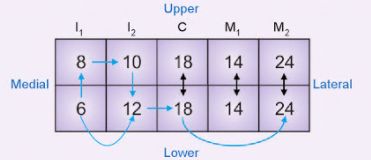
Primary teeth begin eruption at around 6 months and Permanent teeth at around 6 years. In general, lower tooth erupts before it’s upper counterpart with few exceptions (lower before upper rule). Age of 6-12 years is a period of mixed dentition (eruption of permanent 1st molar to eruption of 2nd permanent molar).

Primary (Temporary Teeth)
primary dental eruption

Rules and Exceptions:

  1. Eruption progresses from medial to lateral except canines which erupt between 1st and 2nd molar.
  2. Incisors erupt in clockwise fashion at a difference of 2 months starting from lower central incisor.
  3. Lower and upper canines and molar at around similar time.
  4. 2-4-6 rule for canines and molars.

Eruption:

  1. Lower central incisor: 6 months
  2. Upper central incisor: 8 months
  3. Upper lateral incisor: 10 months
  4. Lower lateral incisor: 12 months
  5. 1st molars: 12 months + 2 = 14 months
  6. Canines: 14 months + 4 = 18 months
  7. 2nd molars: 18 months + 6 = 24 months

Secondary (Permanent) Teeth
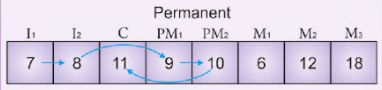
permanent teeth eruption

Rules and Exceptions:

  1. Sequence: Mama Is In Pain, Papa Can Make Medicine, i.e. 1st molar, 1st Incisor, 2nd Incisor, 1st Premolar, 2nd Premolar, Canine, 2nd Molar, 3rd Molar
  2. Eruption occurs sequentially at a difference of 1 year except the 3rd molar which erupts between 18-24 years.
  3. Lower teeth appears few months earlier with exception of the lower canines which erupts almost 2 years earlier, i.e. 9 years.
  4. Premolars appear earlier in upper jaw, i.e. lower 1st premolar would appear at 10 years and lower 2nd premolar would appear at 11 years.
  5. Add 3 years to the age of eruption for the age of completion of calcification.

Eruption:

  1. 1st molar: 6 years
  2. 1st incisor: 7 years
  3. 2nd incisor: 8 years
  4. 1st premolar: 9 years
  5. 2nd premolar: 10 years
  6. canine: 11 years
  7. 2nd molar: 12 years
  8. 3rd molar: 18-24 years
2 shares
  • Facebook
  • Twitter
PGMEE, MRCS, USMLE, MBBS, MD/MS AnatomyDentalPediatrics

Post navigation

Previous post
Next post

Related Posts

PGMEE, MRCS, USMLE, MBBS, MD/MS ECG interval

Basics of ECG- Interpretation of waves and intervals

Nov 9, 2013Jun 12, 2016

A normal ECG is electrical representation of a normal heart beat or sinus rhythm. The cardiac action potential causing deporalization and repolarization of various cardiac tissues gives a pattern of rhythic change is Electrocardiograph which can be used to diagnose different diseases of the CVS.   Normal Rate The beats…

Read More
PGMEE, MRCS, USMLE, MBBS, MD/MS coombs test

Coomb’s test : Mnemonic

May 23, 2019May 23, 2019

Components of Coomb’s test: Mnemonic: ABCD A: Antibody (to be detected) B: Blood antigen (RBC) C: Coomb’s reagent (Anti-antibody) D: Detect agglutination Direct Coomb’s/Antiglobulin test (DAT or DCT): Mnemonic: In DAT/DCT we take A+B from patient and add C [(A+B) + C] Another Mnemonic: DCBA (Direct Coomb’s detect Blood Bound…

Read More
PGMEE, MRCS, USMLE, MBBS, MD/MS

Epiploic foramen of Winslow : Mnemonic

May 13, 2024May 13, 2024

Epiploic foramen is a vertical opening through which lesser sac (omental bursa) communicates with the greater sac (peritoneal cavity proper). It is at the level of T12 vertebra. Boundaries Mnemonic: Epiploic foramen is located between CD and HI. Superior: Caudate process of liver Inferior: Duodenum (1st part) Anterior: Hepatoduodenal ligament…

Read More

Comments (3)

  1. Devansh Sharma says:
    Dec 2, 2022 at 4:10 am

    Awesome pneumonic loved it.

    Reply
    1. Meraj Farooque Khan says:
      Jun 25, 2023 at 11:08 am

      Can you tell me from which book has this image been taken from? I used to study from its pdf but can’t remember the name pf the book.

      Reply
      1. Epomedicine says:
        Jun 25, 2023 at 2:53 pm

        Source: APC Textbook of Forensic Medicine and Toxicology By Anil Aggrawal

        Reply

Leave a Reply to Devansh Sharma Cancel reply

Your email address will not be published. Required fields are marked *

This site uses Akismet to reduce spam. Learn how your comment data is processed.

Pre-clinical (Basic Sciences)

Anatomy

Biochemistry

Community medicine (PSM)

Embryology

Microbiology

Pathology

Pharmacology

Physiology

Clinical Sciences

Anesthesia

Dermatology

Emergency medicine

Forensic

Internal medicine

Gynecology & Obstetrics

Oncology

Ophthalmology

Orthopedics

Otorhinolaryngology (ENT)

Pediatrics

Psychiatry

Radiology

Surgery

RSS Ask Epomedicine

  • What to study for Clinical examination in Orthopedics?
  • What is the mechanism of AVNRT?

Epomedicine weekly

  • About Epomedicine
  • Contact Us
  • Author Guidelines
  • Submit Article
  • Editorial Board
  • USMLE
  • MRCS
  • Thesis
©2026 Epomedicine | WordPress Theme by SuperbThemes