Skip to content
Epomedicine

Mnemonics, Simplified Concepts & Thoughts

Epomedicine

Mnemonics, Simplified Concepts & Thoughts

When Fixing Bones Meets Nerves: A Lesson from the Cubital Tunnel

Dr. Sulabh Kumar Shrestha, MS Orthopedics, Nov 5, 2025Nov 5, 2025

Date of writing: June 17, 2025

Day 3 of my pre-fellowship was unlike the others – not because I scrubbed in for an arthroplasty or a hip case (there weren’t any today), but because I witnessed firsthand how a routine trauma case can spiral into an anatomical and surgical challenge.

Case: A left distal humerus fracture, AO Type C2. The complexity of anatomic fixation of fracture was expected. What wasn’t expected, however, was an iatrogenic transection of ulnar nerve around the cubital tunnel during exposure and handling.

There was a moment of collective pause in the Operation Room – the kind of silence that says, “This just got serious.”

The nerve was immediately explored, ends freshly debrided, and an epineural repair was performed using 6-0 prolene. What I realized today is that trauma surgery is not just about bone alignment. It’s about safeguarding everything around it.

Literature review

The incidence of ulnar neuropathy after surgery for distal humerus fractures varies between 0% and 51%, with an average of 12%.

a. Immediate Direct Repair is Ideal:

For sharp transections of mixed nerves, such as the ulnar nerve, immediate tension-free epineural repair offers the best chance for regeneration. This allows:

  • A single junction for regenerating axons to cross
  • Preserved vascularity on both nerve ends
  • Avoidance of neuroma or glioma formation due to delayed fibrosis
  • Better motor recovery than delayed repair or grafting

b. Outcomes of Immediate Repair vs Grafting:

  • 73% recovery rate with immediate repair
  • 56% with nerve grafting

The sharp nature of the injury and immediate repair in your case favors the better outcome group.

c. Time Sensitivity:

Delay beyond days leads to stump retraction, swelling, and fibrosis, making direct repair without tension increasingly difficult.

d. Prognosis Considerations for Elbow-Level Injuries:

  • Ulnar nerve injuries at the elbow denervate both intrinsic hand muscles and forearm flexors (FDP, FCU).
  • Due to the long distance to intrinsic hand muscles, motor recovery is typically poor even after repair – because of 1% loss of motor end plates per week.

Despite this, early repair is still essential to preserve extrinsic motor function and protective sensation.

e. Sensory vs Motor Recovery:

  • Sensory recovery has better potential (68% meaningful recovery even in proximal injuries)
  • Motor recovery – especially intrinsic hand muscle function remains limited (often <60%), though early repair improves odds.

Further reading: Management of Iatrogenic Ulnar Nerve Transection – PMC
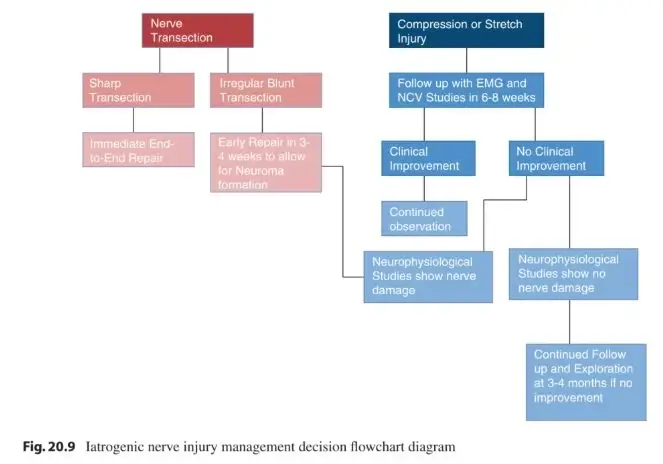
nerve injury management
Source: Arthur A, Foley K, Hamm CW, editors. Perioperative Considerations and Positioning for Neurosurgical Procedures: A Clinical Guide. Springer; 2018 Mar 2.
dr. sulabh kumar shrestha
Dr. Sulabh Kumar Shrestha, MS Orthopedics

He is the section editor of Orthopedics in Epomedicine. He searches for and share simpler ways to make complicated medical topics simple. He also loves writing poetry, listening and playing music. He is currently pursuing Fellowship in Hip, Pelvi-acetabulum and Arthroplasty at B&B Hospital.
  • Facebook
  • Twitter
Fellowship Blog OrthopedicsTrauma

Post navigation

Previous post
Next post

Related Posts

Fellowship Blog

Drill Bit Breakage During Proximal Interlocking Screw Insertion in IMIL Nailing – A Practical Lesson from the OR

Apr 22, 2026

In orthopedic trauma surgery, complications often come unexpectedly which must be dealt critically. even routine procedures can throw a surprise. We came across one such unexpected complication while operating on a case of 23-year-old male with bilateral closed shaft of femur fracture with antegrade intramedullary interlocking (IMIL) nail on left…

Read More
Fellowship Blog

Sacral Dysmorphism

May 11, 2026

Upper sacral segment dysplasia refers to a sacral phenotype in which the size and orientation of the upper sacral segment doesn’t allow safe passage of a trans-iliac, trans-sacral screw and characterized by one or more of the following features/criteria:1 Criteria Projection Frequency Acute alar slope (qualitative criteria without cut-off value)…

Read More
Fellowship Blog

Mathematical Principles in Mechanically Aligned Total Knee Arthroplasty

Mar 21, 2026Mar 21, 2026

Mechanical Axis Concept Natural Knee Target alignment in MA-TKA Tibial cut Distal femoral cut Posterior femoral cut The 3° Compensation Rule Distal femoral and Tibial resection thickness = Implant thickness 2 mm rule in TKA References: Dr. Sulabh Kumar Shrestha, MS Orthopedics He is the section editor of Orthopedics in…

Read More

Leave a Reply Cancel reply

Your email address will not be published. Required fields are marked *

This site uses Akismet to reduce spam. Learn how your comment data is processed.

Shrestha SK. When Fixing Bones Meets Nerves: A Lesson from the Cubital Tunnel [Internet]. Epomedicine; 2025 Nov 5 [cited 2026 Jun 5]. Available from: https://epomedicine.com/fellowship-blog/when-fixing-bones-meets-nerves-a-lesson-from-the-cubital-tunnel/.

Pre-clinical (Basic Sciences)

Anatomy

Biochemistry

Community medicine (PSM)

Embryology

Microbiology

Pathology

Pharmacology

Physiology

Clinical Sciences

Anesthesia

Dermatology

Emergency medicine

Forensic

Internal medicine

Gynecology & Obstetrics

Oncology

Ophthalmology

Orthopedics

Otorhinolaryngology (ENT)

Pediatrics

Psychiatry

Radiology

Surgery

RSS Ask Epomedicine

  • What to study for Clinical examination in Orthopedics?
  • What is the mechanism of AVNRT?

Epomedicine weekly

  • About Epomedicine
  • Contact Us
  • Author Guidelines
  • Submit Article
  • Editorial Board
  • USMLE
  • MRCS
  • Thesis
©2026 Epomedicine | WordPress Theme by SuperbThemes