Skip to content
Epomedicine

Mnemonics, Simplified Concepts & Thoughts

Epomedicine

Mnemonics, Simplified Concepts & Thoughts

Letournel and Judet Classification of Acetabulum Fractures and Simplified Algorithm

Dr. Sulabh Kumar Shrestha, MS Orthopedics, Jul 5, 2026Jul 5, 2026

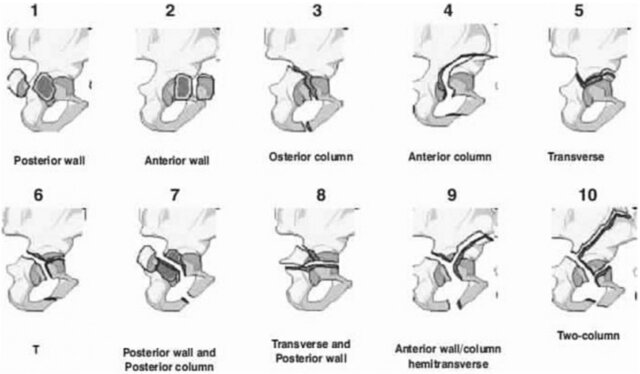
5 Simple or Elementary fracture types: 20% of acetabular fractures

  1. Posterior wall (PW)
  2. Posterior column (PC)
  3. Anterior wall (AW)
  4. Anterior column (AC)
  5. pure Transverse (pT)

5 Combined fracture types: 80% of acetabular fractures

  1. Posterior column and posterior wall (PCPW)
  2. Transverse and posterior wall (TPW)
  3. T-shaped (T)
  4. Anterior column and posterior hemitransverse (ACPHT)
  5. Associated both column (ABC)
letournel judet classification
Mansi, Zieda,*; Aymen, Ben Mahmouda; Abdelkader, Tounsia; Ali, Hagguib; Wajdi, Chermitic; Bacem, Zaidid. Bilateral acetabular fractures (case report). International Journal of Surgery Case Reports 116(C):109424, March 2024. | DOI: 10.1016/j.ijscr.2024.109424 [CC-BY NC-ND 4.0]

Algorithm for acetabular fracture classification

Iliopectineal/Ilioischial line breakageObturator ring (inferior pubic ramus)Posterior wallIliumSpur signFracture classification
Isolated iliopectineal lineIntactAnterior wall (AW)
BrokenAnterior column (AC)
Isolated ilioischial lineIntactPosterior wall (PW)
BrokenIntactPosterior column (PC)
BrokenBrokenPosterior column + Posterior wall (PCPW)
BothIntactIntactpure Transverse (pT)
IntactBrokenTransverse + Posterior wall (TPW)
BrokenIntactT-type (T)
BrokenBrokenAbsentAnterior column + Posterior hemitransverse (ACPHT)
BrokenBrokenPresentAssociated both column (ABC)
dr. sulabh kumar shrestha
Dr. Sulabh Kumar Shrestha, MS Orthopedics

He is the section editor of Orthopedics in Epomedicine. He searches for and share simpler ways to make complicated medical topics simple. He also loves writing poetry, listening and playing music. He is currently pursuing Fellowship in Hip, Pelvi-acetabulum and Arthroplasty at B&B Hospital.
  • Facebook
  • Twitter
Fellowship Blog Pelvi-acetabulum surgery

Post navigation

Previous post

Related Posts

Fellowship Blog

Fixing the Wing: ORIF of an Iliac Wing Fracture Using the Lateral Window of Anterior Approach

Jun 23, 2026Jun 23, 2026

Today’s case involved a 63-year-old female presenting with a right iliac wing fracture (Tile A2) and a left distal radius fracture following trauma. The pelvic injury was managed with open reduction and internal fixation using reconstruction plates and a screw via the lateral window of the anterior approach. The distal…

Read More
Fellowship Blog

Revision Surgery After Failed Open Reduction in Developmental Dysplasia of the Hip

Apr 20, 2026Apr 20, 2026

Re-dislocation rate after primary open reduction: 0-14% [1] Causes and timing of failure of primary surgery: Postoperative period Causes Immediate Approach related, Technical errors Delayed (After 4-6 weeks) Inadequate capsulorrhaphy, Inadequate immobilization Late Abnormal remodeling of acetabulum and femur Across multiple studies, inadequate soft tissue release – specifically the psoas…

Read More
Fellowship Blog

When Locking Screws Refuse to Budge – Techniques for Removing Jammed or Stripped Screws

Dec 6, 2025Dec 6, 2025

Written on August 10, 2025 And once again, today’s case reminded me that removing orthopedic implants can be more challenging than inserting them – especially when faced with a stubborn, stripped or jammed locking screw. We operated on a 25-year-old female with a united distal radius fracture, aiming to remove…

Read More

Leave a Reply Cancel reply

Your email address will not be published. Required fields are marked *

This site uses Akismet to reduce spam. Learn how your comment data is processed.

Shrestha SK. Letournel and Judet Classification of Acetabulum Fractures and Simplified Algorithm [Internet]. Epomedicine; 2026 Jul 5 [cited 2026 Jul 5]. Available from: https://epomedicine.com/fellowship-blog/letournel-and-judet-classification-of-acetabulum-fractures-and-simplified-algorithm/.

Pre-clinical (Basic Sciences)

Anatomy

Biochemistry

Community medicine (PSM)

Embryology

Microbiology

Pathology

Pharmacology

Physiology

Clinical Sciences

Anesthesia

Dermatology

Emergency medicine

Forensic

Internal medicine

Gynecology & Obstetrics

Oncology

Ophthalmology

Orthopedics

Otorhinolaryngology (ENT)

Pediatrics

Psychiatry

Radiology

Surgery

RSS Ask Epomedicine

  • What to study for Clinical examination in Orthopedics?
  • What is the mechanism of AVNRT?

Epomedicine weekly

  • About Epomedicine
  • Contact Us
  • Author Guidelines
  • Submit Article
  • Editorial Board
  • USMLE
  • MRCS
  • Thesis
©2026 Epomedicine | WordPress Theme by SuperbThemes