Skip to content
Epomedicine

Mnemonics, Simplified Concepts & Thoughts

Epomedicine

Mnemonics, Simplified Concepts & Thoughts

Pediatric Pelvic Fracture Classifications

Dr. Sulabh Kumar Shrestha, MS Orthopedics, Apr 29, 2026Apr 29, 2026

Before closure of triradiate cartilage (14 in boys and 12 in girls), pelvic bones are weaker than pelvic ligaments leading to more pubic rami and iliac wing fractures. After closure, they are more likely to sustain fractures of acetabulum, diastasis of pubic symphysis and SI joint separation.

Hence, a pediatric pelvic fracture is an indicator of high energy trauma, and the focus must be shifted for possible coexisting systemic complications, extremity fractures and head trauma. Unlike adult conunterpart, pediatric pelvic ring injuries rarely require surgical management.

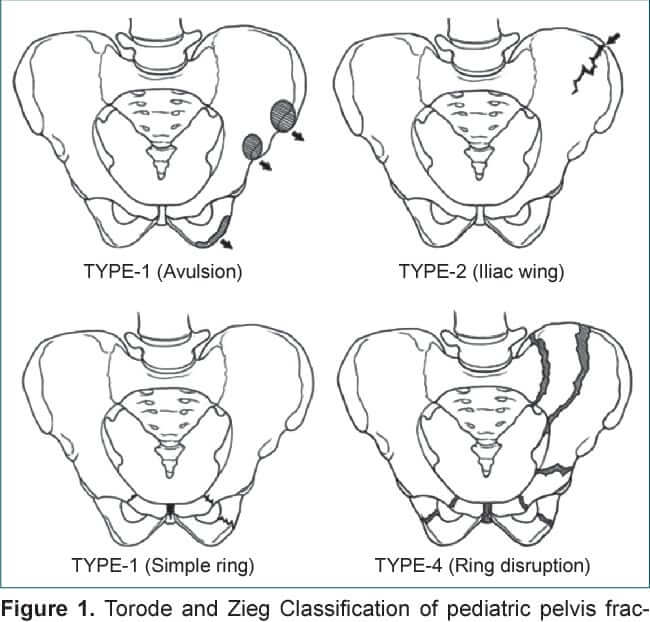
Torode and Zieg Classification

  • Type I: Avulsion fractures
  • Type II: Iliac wing/apophysis fractures
  • Type III (most common; more than 50%): Simple ring fractures without clinical instability
    • Pubic rami fractures
    • Pubic symphysis disruption
  • Type IV: Ring disruption fractures with clinical instability
    • Bilateral pubic rami fractures (straddle fracture)
    • Type III with posterior pelvic ring fracture or sacroiliac joint disruption
    • Type III with acetabular fracture
torode zieg classification

Shore and Torode modification of Torode and Zieg Classification

Type I and II are same as in the original fracture classification.

Type III is further divided into:

  • Type III-A: Stable anterior ring fractures
  • Type III-B: Stable anterior and posterior ring disruptions
    • Increased need for transfusion, increase length of stay, more frequent admission to ICU and more associated injuries

Type IV: Unstable pelvic ring disruptions with gross clinical instability or >2 mm displacement of both anterior and posterior pelvic ring fractures

Ogden Classification

1. Avulsion injuries

2. Stable pelvic ring fracture patterns

  • Infolding of iliac wing
  • Iliac crest apophysis avulsion
  • Isolated ischiopubic ramus fractures

3. Unstable pelvic fractures

  • Unstable rami fractures accompanied with displacement of ischiopubic fragment from symphysis
  • Anterior symphyseal diastasis or pubic rami fractures and posterior sacroiliac joint disruption

Other classifications

For mature pelvis, we use pelvic ring injury classification as for adults:

  • AO/OTA
  • Comprehensive Tile classification
  • Young-Burgess classification

References and further reading:

  1. The Pediatric and Adolescent Hip – Essentials and Evidence (2019)
  2. https://ota.org/sites/files/2021-06/Pediatric4%20Fractures%20of%20the%20Pelvis%20%26%20Acetabulum.pdf

dr. sulabh kumar shrestha
Dr. Sulabh Kumar Shrestha, MS Orthopedics

He is the section editor of Orthopedics in Epomedicine. He searches for and share simpler ways to make complicated medical topics simple. He also loves writing poetry, listening and playing music. He is currently pursuing Fellowship in Hip, Pelvi-acetabulum and Arthroplasty at B&B Hospital.

  • Facebook
  • Twitter
Fellowship Blog Pediatric hipPelvi-acetabulum surgery

Post navigation

Previous post

Related Posts

Fellowship Blog

Normal Hip Development

Dec 23, 2025Feb 2, 2026

4-6 weeks of gestation: By 7 weeks of gestation: By 11 weeks of gestation: Late gestation: Postnatal: The acetabulum is deepened by the natural pressure from the developing femoral head on the acetabulum. Hips in newborns with developmental dysplasia are not just normal hips with capsular laxity; they are structurally…

Read More
Fellowship Blog

A THR After Acetabular ORIF and the 9 Intraoperative Tests That Matter

Dec 19, 2025Dec 19, 2025

Today was one of those surgeries that stays with you not just for the technical challenge, but for what it teaches you as a growing orthopedic surgeon. Our patient was a 30-year-old male with painful AVN of the femoral head, years after an acetabular fracture that had been treated with…

Read More
Fellowship Blog

Drill Bit Breakage During Proximal Interlocking Screw Insertion in IMIL Nailing – A Practical Lesson from the OR

Apr 22, 2026

In orthopedic trauma surgery, complications often come unexpectedly which must be dealt critically. even routine procedures can throw a surprise. We came across one such unexpected complication while operating on a case of 23-year-old male with bilateral closed shaft of femur fracture with antegrade intramedullary interlocking (IMIL) nail on left…

Read More

Leave a Reply Cancel reply

Your email address will not be published. Required fields are marked *

This site uses Akismet to reduce spam. Learn how your comment data is processed.

Pre-clinical (Basic Sciences)

Anatomy

Biochemistry

Community medicine (PSM)

Embryology

Microbiology

Pathology

Pharmacology

Physiology

Clinical Sciences

Anesthesia

Dermatology

Emergency medicine

Forensic

Internal medicine

Gynecology & Obstetrics

Oncology

Ophthalmology

Orthopedics

Otorhinolaryngology (ENT)

Pediatrics

Psychiatry

Radiology

Surgery

RSS Ask Epomedicine

  • What to study for Clinical examination in Orthopedics?
  • What is the mechanism of AVNRT?

Epomedicine weekly

  • About Epomedicine
  • Contact Us
  • Author Guidelines
  • Submit Article
  • Editorial Board
  • USMLE
  • MRCS
  • Thesis
©2026 Epomedicine | WordPress Theme by SuperbThemes