Skip to content
Epomedicine

Mnemonics, Simplified Concepts & Thoughts

Epomedicine

Mnemonics, Simplified Concepts & Thoughts

Sacral Dysmorphism

Dr. Sulabh Kumar Shrestha, MS Orthopedics, May 11, 2026

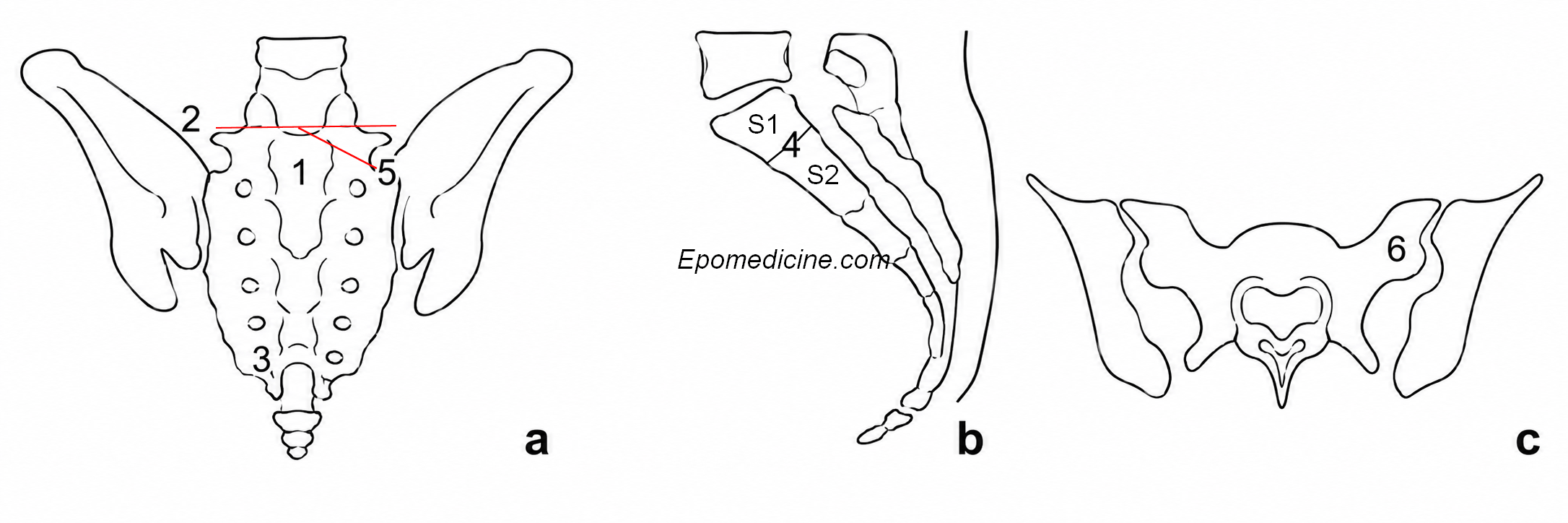
Upper sacral segment dysplasia refers to a sacral phenotype in which the size and orientation of the upper sacral segment doesn’t allow safe passage of a trans-iliac, trans-sacral screw and characterized by one or more of the following features/criteria:1

CriteriaProjectionFrequency
Acute alar slope (qualitative criteria without cut-off value)Outlet97%
Mamillary processOutlet79%
Oval shaped neuroforamenOutlet76%
Collinearity (upper segment of sacrum not recessed in pelvis)Outlet50%
Residual S1/S2 disc spaceTrue lateral47%
Tongue-in-groove morphologyAxial CT29%
Outlet view: (1) Collinearity; (2) Mamillary process; (5) Acute alar slope
Lateral view: (4) S1/S2 residual disc space
Axial CT view: (6) Tongue in groove appearance of iliosacral articulation

Quantitatively, sacral dysmorphism is defined by a sacral dysmorphism score >70.

Sacral dysmorphism score = S1 coronal angle + 2 X S1 axial angle

  • Coronal angle: measured by an angle formed by a line drawn along the axis of the osseous corridor and a line connecting the top of the iliac crests
  • Axial angle: measured as the angle formed by a line drawn on the axis of the osseous corridor and a line connecting the posterior iliac spines
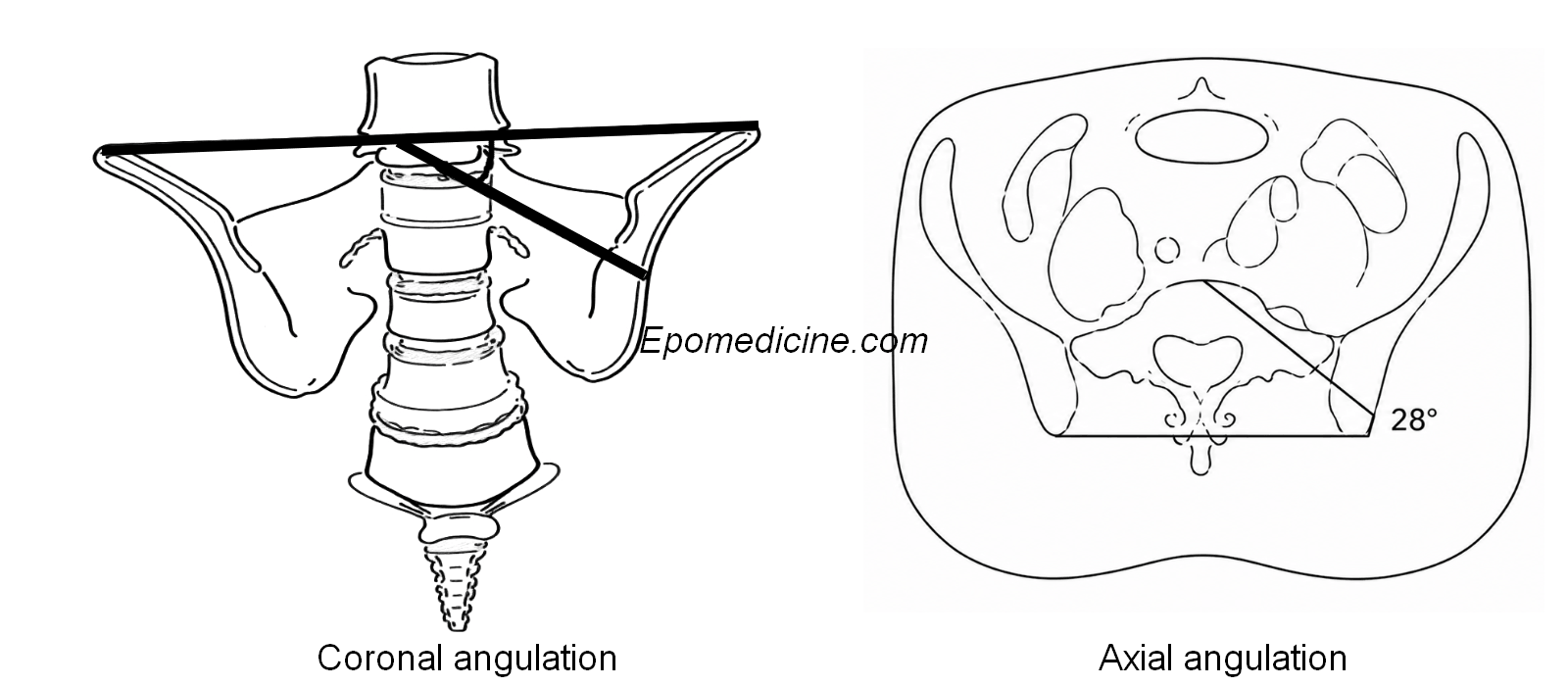
sacral dysmorphism score

In a dysplastic sacrum, the upper sacral safe zone for iliosacral screw insertion is 36% smaller and more oblique. A modified S1 trajectory with 30° caudal to cranial obliquity on the pelvic outlet view and 15° posterior to anterior on the pelvic inlet view or a S2 screw is recommended in these cases.2

References:

  1. Wendt H, Gottschling H, Schröder M, Marintschev I, Hofmann G, Burgkart R, Gras F. Recommendations for iliosacral screw placement in dysmorphic sacrum based on modified in-out-in cor ridors. J Orthop Res. 2018;37(1):689–96. https://doi.org/10.1002/ jor.24199.
  2. Laux, C.J., Weigelt, L., Osterhoff, G. et al. Feasibility of iliosacral screw placement in patients with upper sacral dysplasia. J Orthop Surg Res 14, 418 (2019). https://doi.org/10.1186/s13018-019-1472-7

dr. sulabh kumar shrestha
Dr. Sulabh Kumar Shrestha, MS Orthopedics

He is the section editor of Orthopedics in Epomedicine. He searches for and share simpler ways to make complicated medical topics simple. He also loves writing poetry, listening and playing music. He is currently pursuing Fellowship in Hip, Pelvi-acetabulum and Arthroplasty at B&B Hospital.
  • Facebook
  • Twitter
Fellowship Blog

Post navigation

Previous post
Next post

Related Posts

Fellowship Blog

Classifications of Sequelae of Septic Arthritis of Hip in Children

Nov 20, 2025Apr 21, 2026

Several radiological classifications have been developed to describe the long-term changes in the hip following septic arthritis and to help guide management. Hunka classification Choi classification Forlin and Milani classification Grade 1: Hips with the head or the femoral neck within the acetabulum Grade 2: Hips are dislocated Johari classification…

Read More
Fellowship Blog

Revision Surgery After Failed Open Reduction in Developmental Dysplasia of the Hip

Apr 20, 2026Apr 20, 2026

Re-dislocation rate after primary open reduction: 0-14% [1] Causes and timing of failure of primary surgery: Postoperative period Causes Immediate Approach related, Technical errors Delayed (After 4-6 weeks) Inadequate capsulorrhaphy, Inadequate immobilization Late Abnormal remodeling of acetabulum and femur Across multiple studies, inadequate soft tissue release – specifically the psoas…

Read More
Fellowship Blog

Refracture of the Patella – Early TBW Failure and Re-fixation

Mar 6, 2026Mar 6, 2026

One month following an index TBW procedure (using 4 K‑wires + cerclage), our patient sustained a refracture of the patella after a fall. There was no high-energy direct trauma. This case typifies early failure of a classic TBW construct. Failure Factors Identified in Literature Revision Fixation Alternate Techniques Key Takeaways…

Read More

Leave a Reply Cancel reply

Your email address will not be published. Required fields are marked *

This site uses Akismet to reduce spam. Learn how your comment data is processed.

Shrestha SK. Sacral Dysmorphism [Internet]. Epomedicine; 2026 May 11 [cited 2026 Jun 17]. Available from: https://epomedicine.com/fellowship-blog/sacral-dysmorphism/.

Pre-clinical (Basic Sciences)

Anatomy

Biochemistry

Community medicine (PSM)

Embryology

Microbiology

Pathology

Pharmacology

Physiology

Clinical Sciences

Anesthesia

Dermatology

Emergency medicine

Forensic

Internal medicine

Gynecology & Obstetrics

Oncology

Ophthalmology

Orthopedics

Otorhinolaryngology (ENT)

Pediatrics

Psychiatry

Radiology

Surgery

RSS Ask Epomedicine

  • What to study for Clinical examination in Orthopedics?
  • What is the mechanism of AVNRT?

Epomedicine weekly

  • About Epomedicine
  • Contact Us
  • Author Guidelines
  • Submit Article
  • Editorial Board
  • USMLE
  • MRCS
  • Thesis
©2026 Epomedicine | WordPress Theme by SuperbThemes