Skip to content
Epomedicine

Mnemonics, Simplified Concepts & Thoughts

Epomedicine

Mnemonics, Simplified Concepts & Thoughts

Approach to Neuromuscular Hip Dysplasia in Children with Cerebral Palsy : Principles of management and Long-term Radiographic Outcome

Dr. Sulabh Kumar Shrestha, MS Orthopedics, Feb 25, 2026Feb 25, 2026

Dr. Sulabh Kumar Shrestha1, Dr. Rajendra Aryal2, Dr. Nitesh Raj Pandey2, Dr. Bibek Banskota2
1AKBEF Fellow, 2Unit-1 (Hip, Pelvi-acetabulum & Arthroplasty), B&B Hospital
Poster presentation at Orthocon 2026

Introduction

Progressive hip subluxation is a common orthopedic problem in children with cerebral palsy (CP), with strong correlation to Gross Motor Function Classification System (GMFCS).1Terjesen T. Natural history of acetabular dysplasia and later total hip arthroplasty in late-detected DDH. Acta Orthop. 2023;94:152–157

GMFCS IGMFCS V
Hip dislocation0%90%
Reimer’s migration (MP)0.2%/year9.5%/year

Hip dislocation in CP is caused by 5 factors:

  1. Muscle imbalance (spasticity of hip adductors & flexors & weakness of hip abductors & extensors)
  2. Increased femoral anteversion
  3. Increased femoral neck shaft angle (NSA)
  4. Acetabular dysplasia
  5. Pelvic obliquity

Painful hips in CP are common and proportional to the extent of hip displacement and GMFCS level.2Alshryda S, Sattar S, Howard JJ, Huntley JS, Schoenecker JG. The hip in cerebral
palsy. In: The Pediatric and Adolescent Hip: Essentials and Evidence. 2019:467–530

Management requires early identification, risk stratification, & morphology-based surgical correction.

Objectives

To demonstrate:

  • Principles of management of neuromuscular hip dysplasia in CP
  • Long-term radiographic outcomes following surgical correction

Case Description

A 9-year-old boy with:

  • Spastic Cerebral Palsy
  • GMFCS Level IV
  • Dislocated left hip
  • Associated acetabular dysplasia

The child had progressive displacement with functional limitations in sitting and mobility.
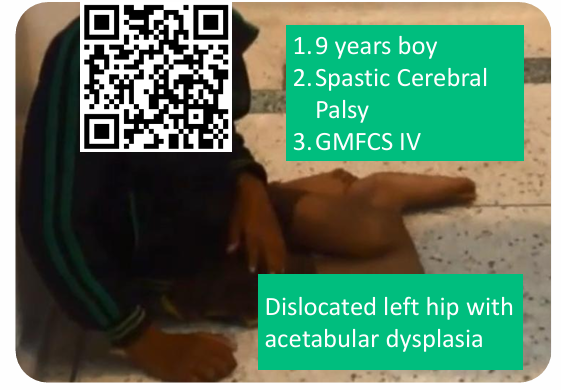
case details
Fig. 1: Representative case showing clinical presentation. QR code:
functional video demonstrating floor mobility.

Why Reduce the Hip?

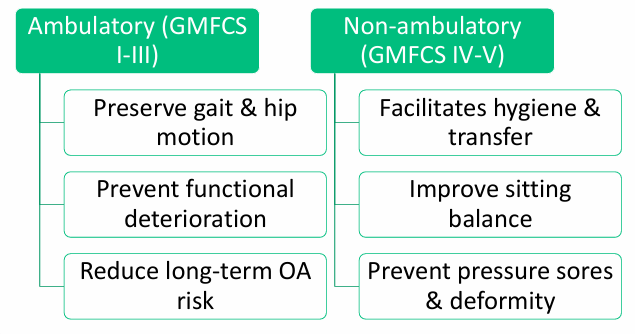
Reduction and reconstruction are necessary to: 3Aroojis A, Mantri N, Johari AN. Hip displacement in cerebral palsy: role of surveillance. Indian J Orthop. 2020.

hip reduction rationale

Hip dysplasia in CP is progressive and GMFCS-dependent. Untreated subluxation may lead to painful fixed dislocation.

How we do it?

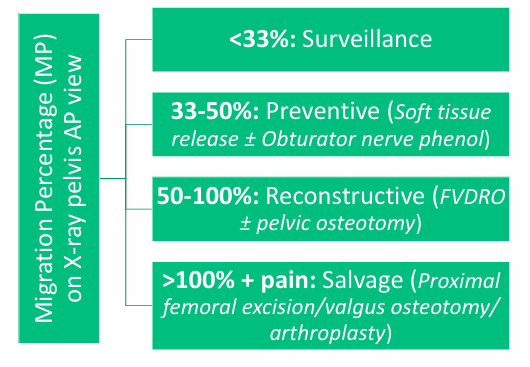
Management is based on Reimer’s MP (RMP): 4Alshryda S, Sattar S, Howard JJ, Huntley JS, Schoenecker JG. The hip in cerebral palsy. In: The Pediatric and Adolescent Hip: Essentials and Evidence. 2019:467–530

neuromuscular hip dysplasia management

What we did?

A single-stage multilevel interventions were done.

Primary pathologyTargeted surgeries
1. Muscular imbalanceAdductor tenotomy + Anterior release
2. Coxa valgaVarus osteotomy + Shortening
3. Increased femoral anteversionDerotation osteotomy
4. Acetabular dysplasiaDega acetabuloplasty
5. Spastic posterior chainHamstring release + Vulpius procedure

Results (Radiographic outcomes)

A. Serial X-rays
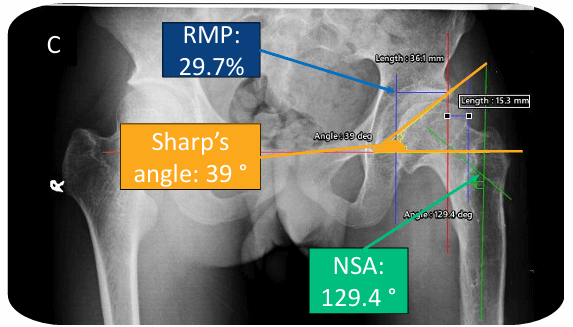
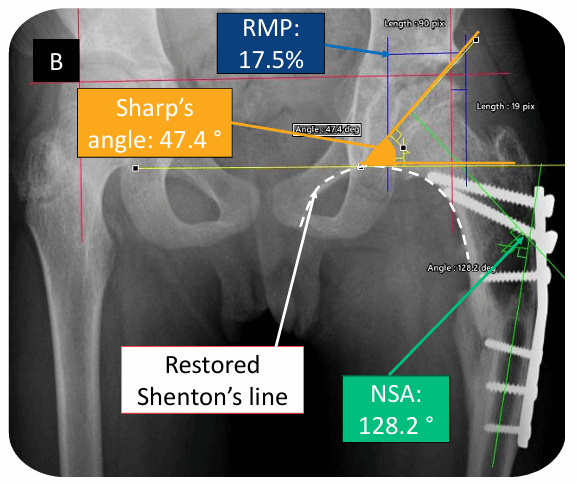
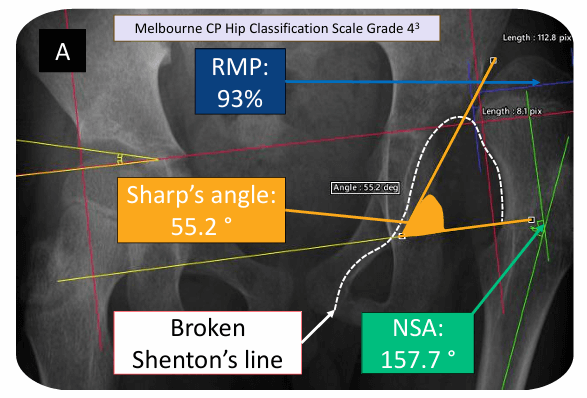
Fig. 2: Radiographic measurements (RMP: Reimer’s Migration Percentage; NSA: Neck Shaft Angle)
A – Preoperative; B – Early postoperative; C – At 11 years followup

B. Quantitative comparisons over time
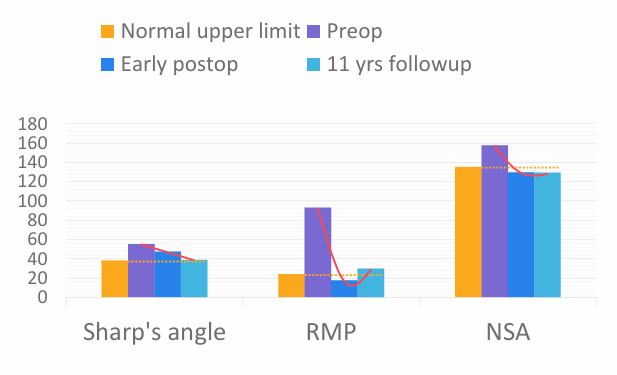
X-ray parameters comparison

Discussion

  1. Radiographic parameters showed early and sustained correction to maturity.
  2. Hip dysplasia in CP is progressive and GMFCS dependent.
  3. Treatment must address femoral and acetabular pathology together.
  4. RMP guides surveillance and intervention timing.

Conclusion

  1. A structured decision-making approach is essential in neuromuscular hip dysplasia.
  2. Early, comprehensive reconstruction can maintain hip stability and long-term function.

dr. sulabh kumar shrestha
Dr. Sulabh Kumar Shrestha, MS Orthopedics

He is the section editor of Orthopedics in Epomedicine. He searches for and share simpler ways to make complicated medical topics simple. He also loves writing poetry, listening and playing music. He is currently pursuing Fellowship in Hip, Pelvi-acetabulum and Arthroplasty at B&B Hospital.
  • Facebook
  • Twitter
Fellowship Blog Pediatric hip

Post navigation

Previous post
Next post

Related Posts

Fellowship Blog

A THR After Acetabular ORIF and the 9 Intraoperative Tests That Matter

Dec 19, 2025Dec 19, 2025

Today was one of those surgeries that stays with you not just for the technical challenge, but for what it teaches you as a growing orthopedic surgeon. Our patient was a 30-year-old male with painful AVN of the femoral head, years after an acetabular fracture that had been treated with…

Read More
Fellowship Blog

When Locking Screws Refuse to Budge – Techniques for Removing Jammed or Stripped Screws

Dec 6, 2025Dec 6, 2025

Written on August 10, 2025 And once again, today’s case reminded me that removing orthopedic implants can be more challenging than inserting them – especially when faced with a stubborn, stripped or jammed locking screw. We operated on a 25-year-old female with a united distal radius fracture, aiming to remove…

Read More
Fellowship Blog

Refracture of the Patella – Early TBW Failure and Re-fixation

Mar 6, 2026Mar 6, 2026

One month following an index TBW procedure (using 4 K‑wires + cerclage), our patient sustained a refracture of the patella after a fall. There was no high-energy direct trauma. This case typifies early failure of a classic TBW construct. Failure Factors Identified in Literature Revision Fixation Alternate Techniques Key Takeaways…

Read More

Leave a Reply Cancel reply

Your email address will not be published. Required fields are marked *

This site uses Akismet to reduce spam. Learn how your comment data is processed.

Pre-clinical (Basic Sciences)

Anatomy

Biochemistry

Community medicine (PSM)

Embryology

Microbiology

Pathology

Pharmacology

Physiology

Clinical Sciences

Anesthesia

Dermatology

Emergency medicine

Forensic

Internal medicine

Gynecology & Obstetrics

Oncology

Ophthalmology

Orthopedics

Otorhinolaryngology (ENT)

Pediatrics

Psychiatry

Radiology

Surgery

RSS Ask Epomedicine

  • What to study for Clinical examination in Orthopedics?
  • What is the mechanism of AVNRT?

Epomedicine weekly

  • About Epomedicine
  • Contact Us
  • Author Guidelines
  • Submit Article
  • Editorial Board
  • USMLE
  • MRCS
  • Thesis
©2026 Epomedicine | WordPress Theme by SuperbThemes