Skip to content
Epomedicine

Mnemonics, Simplified Concepts & Thoughts

Epomedicine

Mnemonics, Simplified Concepts & Thoughts

The 0-3-6-9 rule in Mechanical Alignment Total Knee Arthroplasty (MA-TKA)

Dr. Sulabh Kumar Shrestha, MS Orthopedics, Feb 25, 2026Feb 25, 2026

The goal of MA-TKA is to restore the normal mechanical axis. In contrast to kinematic axis alignment, which attempts to recreate native knee joint line (3° tibial varus and 3° femoral valgus), in MA-TKA, the distal femur and the tibia are cut to be perpendicular (0°) to the mechanical axis.
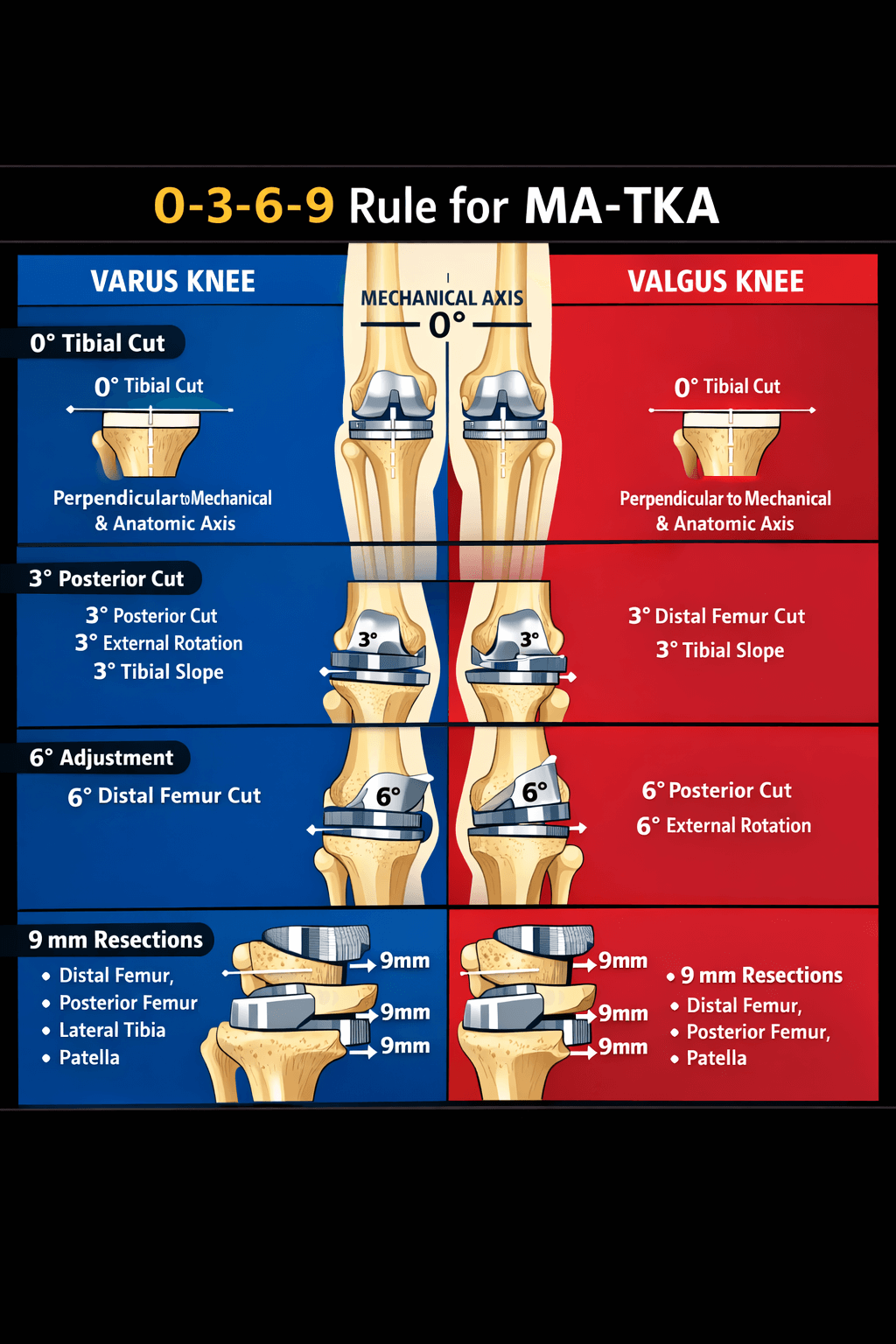
0-3-6-9 rule MA-TKA
AI Generated

Here is a simple 0-3-6-9 rule for MA-TKA. The numbers are arbitrary and may defer according to implant provider and surgical scenario.

RuleVarus KneeValgus Knee
a. 0 degreesTibial cut relative to both the mechanical axis and the anatomic axis (they are parallel)Tibial cut relative to both the mechanical axis and the anatomic axis (they are parallel)
b. 3 degreesPosterior femoral cut made using posterior referencing system – 3 degrees external rotation

3 degrees posterior tibial slope
Distal femoral cut set to 3 degrees valgus relative to intramedullary guide as opposed to 6 degrees in varus knee (to avoid under-correction of deformity)

3 degrees posterior tibial slope
c. 6 degreesDistal femoral cut set to 6 degrees valgus relative to intramedullary guide (difference between anatomical axis & mechanical axis)Posterior femoral cut made using posterior referencing system – 6 degrees external rotation (to compensate for lateral condyle hypoplasia and prevent internal rotation of component)
d. 9 mmSize of:
a. Distal femur cut
b. Posterior femur cut
c. Tibial cut from lateral side
d. Patellar cut
Size of:
a. Distal femur cut
b. Posterior femur cut
c. Patellar cut

dr. sulabh kumar shrestha
Dr. Sulabh Kumar Shrestha, MS Orthopedics

He is the section editor of Orthopedics in Epomedicine. He searches for and share simpler ways to make complicated medical topics simple. He also loves writing poetry, listening and playing music. He is currently pursuing Fellowship in Hip, Pelvi-acetabulum and Arthroplasty at B&B Hospital.

  • Facebook
  • Twitter
Fellowship Blog Arthroplasty

Post navigation

Previous post
Next post

Related Posts

Fellowship Blog

Classifications of Sequelae of Septic Arthritis of Hip in Children

Nov 20, 2025Apr 21, 2026

Several radiological classifications have been developed to describe the long-term changes in the hip following septic arthritis and to help guide management. Hunka classification Choi classification Forlin and Milani classification Grade 1: Hips with the head or the femoral neck within the acetabulum Grade 2: Hips are dislocated Johari classification…

Read More
Fellowship Blog

Normal Hip Development

Dec 23, 2025Feb 2, 2026

4-6 weeks of gestation: By 7 weeks of gestation: By 11 weeks of gestation: Late gestation: Postnatal: The acetabulum is deepened by the natural pressure from the developing femoral head on the acetabulum. Hips in newborns with developmental dysplasia are not just normal hips with capsular laxity; they are structurally…

Read More
Fellowship Blog

Retrograde Percutaneous Screw Fixation of Posterior Column Acetabulum Fracture : C-Arm Views & Technique

Apr 22, 2026Apr 22, 2026

Today in the OR, I observed a retrograde percutaneous screw fixation of a left posterior column acetabular fracture in a 63-year-old male. While I wasn’t scrubbed in, it offered a fantastic opportunity to understand the precision and fluoroscopic guidance required for this minimally invasive approach. It is often said that, “Percutaneous fixation is a surgery performed…

Read More

Leave a Reply Cancel reply

Your email address will not be published. Required fields are marked *

This site uses Akismet to reduce spam. Learn how your comment data is processed.

Pre-clinical (Basic Sciences)

Anatomy

Biochemistry

Community medicine (PSM)

Embryology

Microbiology

Pathology

Pharmacology

Physiology

Clinical Sciences

Anesthesia

Dermatology

Emergency medicine

Forensic

Internal medicine

Gynecology & Obstetrics

Oncology

Ophthalmology

Orthopedics

Otorhinolaryngology (ENT)

Pediatrics

Psychiatry

Radiology

Surgery

RSS Ask Epomedicine

  • What to study for Clinical examination in Orthopedics?
  • What is the mechanism of AVNRT?

Epomedicine weekly

  • About Epomedicine
  • Contact Us
  • Author Guidelines
  • Submit Article
  • Editorial Board
  • USMLE
  • MRCS
  • Thesis
©2026 Epomedicine | WordPress Theme by SuperbThemes