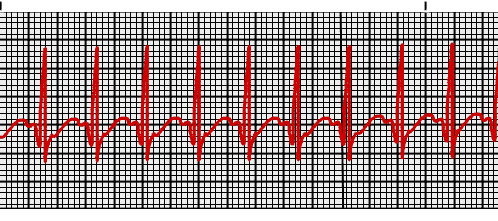
Yesterday, I had encountered a tachycardic patient with heart rate 160/min. Somewhere in medical school, I was taught that the sinus tachycardia with heart rate >160/min must be considered as a Supraventricular tachycardia (SVT). With such misinformation, it was easier for me to overlook the fact that the patient was febrile and anemic and even the P waves were upright and discernible although with difficulty as a “camel hump” or “notched” with T waves. This created a confusion whether the rhythm was sinus tachycardia or supraventricular tachycardia. Fortunately, I decided to go with anti-pyretics first before jumping to the treatment for SVT. On rechecking, the temperature was back to normal and the heart rate had fallen down to 125/min and the P wave preceding QRS was clearer now on ECG. Infact, sinus tachycardia is the commonest type of SVT. However, the SVT here refers to AV nodal re-entrant tachycardia (AVNRT).
Following this event, I sat down and began to search the fact. I have only one thing to say –
The approach to use cut-off value for heart rate to distinguish between Sinus tachycardia and SVT is an act of oversimplification which may lead to unnecessary ineffective treatment depriving patient from the necessary ones.
I decided to unlearn what I had learnt earlier in medical school.
What is the maximum possible heart rate in Sinus tachycardia?
One of the book has mentioned an equation to calculate maximum heart rate during exercise: 1
- HRmax = 220 – age in years OR
- HRmax = 208 – (0.7 X age in years)
Most pediatric textbooks say that sinus tachycardia is usually <220/min in infants and <180/min in adults.
These numbers just show that when the heart rate is more than the calculated, sinus tachycardia is less likely but still possible.
What can be common between Sinus tachycardia and SVT?
- In both the cases, patients may be unstable:
- In sinus tachycardia, due to untreated underlying cause like hypovolemic shock.
- In SVT, due to primary electrical abnormality.
- Both can commonly present with heart rate <150/min or >150/min.
- Narrow QRS complex (<0.12 seconds)
- Non-discernible P waves:
- With very fast heart rates the P waves may be hidden in the preceding T wave, producing a ‘camel hump’ appearance’ in sinus tachycardia.
- In SVT, retrograde P waves may occur before, with or after QRS complex. The ones presenting after QRS complex may occur as pseudo- “R” waves (positive deflection) or “S” wave (negative deflection).

How can you differentiate Sinus tachycardia from SVT?
Whenever possible, history plays and important part in distinguishing the two:
- In sinus tachycardia, there is gradual onset and termination of symptoms like palpitation.
- SVT typically presents with sudden onset and termination of palpitations, light-headedness, chest pain, abnormal pulsations in the neck and dyspnea lasting between seconds to several hours.
- Less commonly, symptoms of SVT may include syncope secondary to vasovagal response or compromised cardiac output, and polyuria secondary to the diuretic effects of atrial natriuretic factor.
- Sinus tachycardia is usually due to physical, emotional, pathological (fever, hypovolemia, anemia, anxiety, infection, malignancy, myocardial infarction, congestive heart failure, pulmonary embolus, thyrotoxicosis) or pharmacological (caffeine, alcohol, nicotine, salbutamol, aminophylline, atropine, cocaine, doxorubicin, daunorubicin) stimulus.
- Majority of the SVT occurs without any underlying cause. A sinus tachycardia without an identifiable underlying cause may be due to “inappropriate sinus tachycardia“.
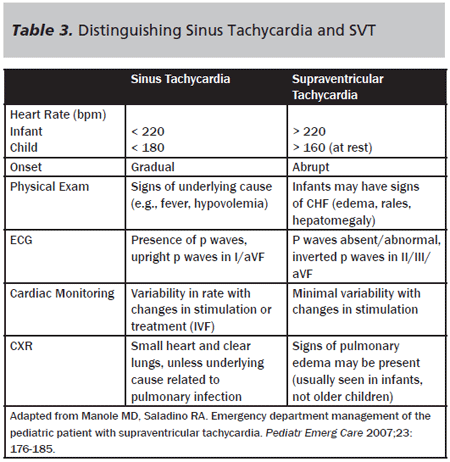
ECG:
1. Rate: Some pediatric books mention that if the rate is faster than 230/min, the rhythm virtually always is SVT. 2 Others advice to think of SVT when heart rate is >160/min.
2. P wave:
- If the P waves are clearly visible and positive (upright) in leads I and aVF (normal P-wave axis), it is likely sinus tachycardia.
- When visible, P waves retrograde and negative in inferior leads – II, III and aVF.
3. Variability:
- In Sinus tachycardia, heart rate varies from beat to beat and often responds to stimuli or treatment of underlying cause.
- In SVT, there is minimal variability with change in stimulation.
4. Response to vagal maneuvers:
- The response may only be seen temporarily in Sinus tachycardia while SVT may be terminated by such maneuvers.
Why is it important to differentiate SVT from sinus tachycardia?
SVT and sinus tachycardia have different mechanisms and different treatment modalities. With misjudgment of the rhythm there is tendency towards unnecessary treatment while ignoring the needed treatment.
Adenosine and DC shock are ineffective and contraindicated in sinus tachycardia.
What do you think is the rhythm in the video below?
Please leave your comments below.

He is the section editor of Orthopedics in Epomedicine. He searches for and share simpler ways to make complicated medical topics simple. He also loves writing poetry, listening and playing music. He is currently pursuing Fellowship in Hip, Pelvi-acetabulum and Arthroplasty at B&B Hospital.