Skip to content
Epomedicine

Mnemonics, Simplified Concepts & Thoughts

Epomedicine

Mnemonics, Simplified Concepts & Thoughts

Bulbocavernosus Reflex (BCR)

Epomedicine, Jun 14, 2020Jun 14, 2020

Synonyms: Bulbospongiosus reflex (BSR), Osinski reflex

Reflex arc:

a. Stimulus: Briskly squeezing glans penis or clitoris or Tugging Foley’s catheter (pulling the balloon of foley’s catheter against the bladder neck)

b. Afferent: Sensory fibers of pudendal nerve

c. Reflex center: S2-S4 spinal segments (Polysynaptic)

d. Efferent: Motor fibers of pudendal nerve

e. Response: Contraction of Perineal muscles (External Anal Sphincer)
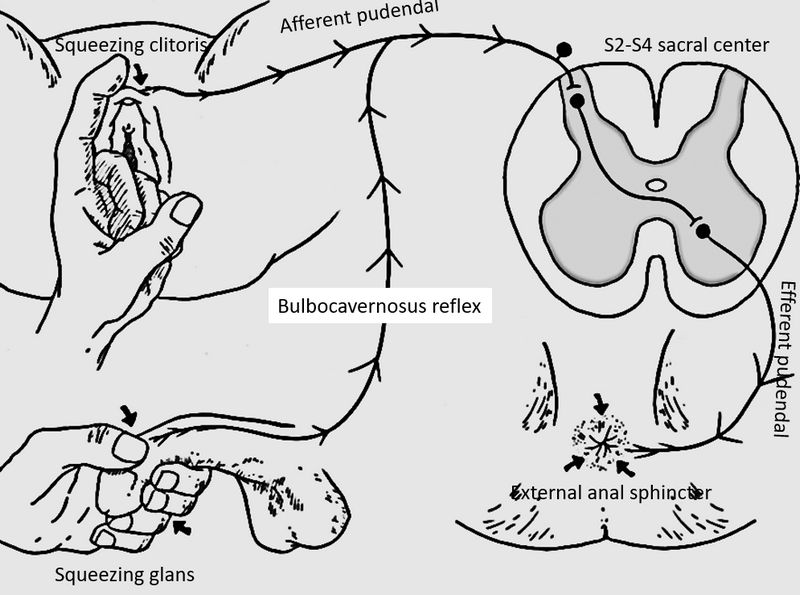
bulbocavernosus reflex

Technique:

  1. Perform per-rectal examination and evaluate anal tone
  2. Apply stimulus for BCR to evaluate for increased anal tone

Importance:

1. Normally present in almost all men and 70% women.

2. In spinal cord injury, return of BCR marks the end of spinal shock.

3. It may be preserved in high conus medullaris lesions but it is lost in cauda equina syndrome.
  • Facebook
  • Twitter
Clinical Skills and Approaches Clinical examinationNervous systemPhysiology

Post navigation

Previous post
Next post

Related Posts

Clinical Skills and Approaches

An approach to Abdominal Trauma

Jan 18, 2024Jan 18, 2024

Abdominal Trauma Abdominal trauma can be broadly classified into: Both of these have different approach of management. In case of any trauma, you need to go serially as per ATLS guidelines, i.e., the primary survey followed by the secondary survey. For quick recap, primary survey includes: Note: according to ATLS,…

Read More
Clinical Skills and Approaches Dermatomyositis skin

Skin signs of Dermatomyositis: Heliotrope rash, Grotton papules and Shawl sign

Jun 19, 2015

Dermatomyositis is a connective tissue disorder characterized by chronic inflammation of voluntary muscles and skin. It is more common in women and the age of onset is 50-70 years. A) Heliotrope Rash: It is a macular, confluent, purple or purple/red rash over both eyelids and periorbital tissue present with or…

Read More
Clinical Skills and Approaches

Orthopedic Examination Made Easy

Jun 4, 2023Jun 23, 2024

Orthopedic examination is a fundamental aspect of assessing musculoskeletal conditions, injuries, and disorders. This comprehensive guide aims to provide healthcare professionals, students, and practitioners with a thorough understanding of the principles, techniques, and best practices involved in conducting orthopedic examinations. By examining the mechanics behind the tests, readers will gain…

Read More

Comment

  1. Ray says:
    May 30, 2025 at 11:54 pm

    Where can I get this test done in Australia on the east coast?

    Reply

Leave a Reply Cancel reply

Your email address will not be published. Required fields are marked *

This site uses Akismet to reduce spam. Learn how your comment data is processed.

Pre-clinical (Basic Sciences)

Anatomy

Biochemistry

Community medicine (PSM)

Embryology

Microbiology

Pathology

Pharmacology

Physiology

Clinical Sciences

Anesthesia

Dermatology

Emergency medicine

Forensic

Internal medicine

Gynecology & Obstetrics

Oncology

Ophthalmology

Orthopedics

Otorhinolaryngology (ENT)

Pediatrics

Psychiatry

Radiology

Surgery

RSS Ask Epomedicine

  • What to study for Clinical examination in Orthopedics?
  • What is the mechanism of AVNRT?

Epomedicine weekly

  • About Epomedicine
  • Contact Us
  • Author Guidelines
  • Submit Article
  • Editorial Board
  • USMLE
  • MRCS
  • Thesis
©2026 Epomedicine | WordPress Theme by SuperbThemes