Skip to content
Epomedicine

Mnemonics, Simplified Concepts & Thoughts

Epomedicine

Mnemonics, Simplified Concepts & Thoughts

Bulbocavernosus Reflex (BCR)

Epomedicine, Jun 14, 2020Jun 14, 2020

Synonyms: Bulbospongiosus reflex (BSR), Osinski reflex

Reflex arc:

a. Stimulus: Briskly squeezing glans penis or clitoris or Tugging Foley’s catheter (pulling the balloon of foley’s catheter against the bladder neck)

b. Afferent: Sensory fibers of pudendal nerve

c. Reflex center: S2-S4 spinal segments (Polysynaptic)

d. Efferent: Motor fibers of pudendal nerve

e. Response: Contraction of Perineal muscles (External Anal Sphincer)
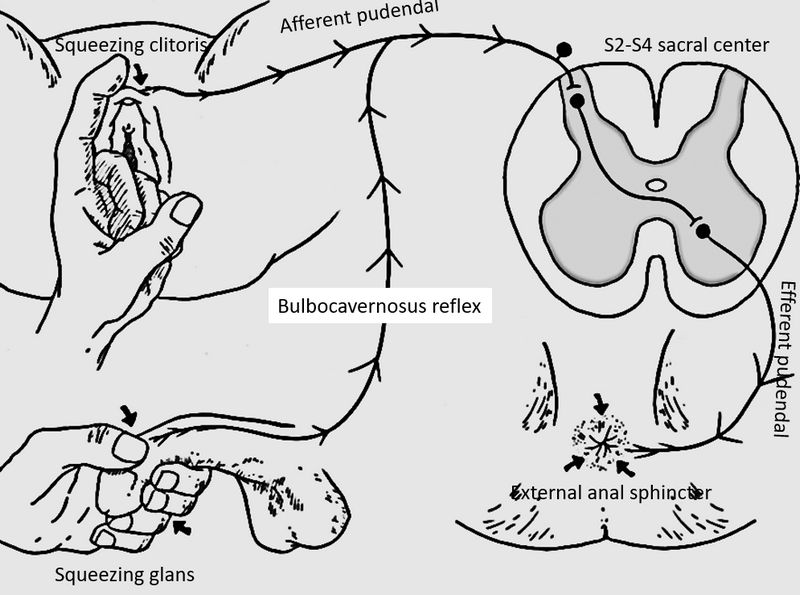
bulbocavernosus reflex

Technique:

  1. Perform per-rectal examination and evaluate anal tone
  2. Apply stimulus for BCR to evaluate for increased anal tone

Importance:

1. Normally present in almost all men and 70% women.

2. In spinal cord injury, return of BCR marks the end of spinal shock.

3. It may be preserved in high conus medullaris lesions but it is lost in cauda equina syndrome.
  • Facebook
  • Twitter
Clinical Skills and Approaches Clinical examinationNervous systemPhysiology

Post navigation

Previous post
Next post

Related Posts

Clinical Skills and Approaches

Management of Diabetes – GLUCOSE BAD mnemonic

Jul 25, 2020Jul 25, 2020

Glycemic control HbA1c 3 monthly or Bianually (if treatment goal acheived and glycemic control considered stable) – Target: Non-pregnant adult patients: <7% Minor cardiovascular disease, minor hypoglycemic episodes, short diagnosis time with diabetes, and long life expectancy: <6.5% Significant co-morbidities, progressive micro- and macrovascular complications, or short life expectancy: <8%…

Read More
Clinical Skills and Approaches ice tool history

Add “ICE” to history – Patient’s perspective

Apr 10, 2020Apr 10, 2020

In medical history taking, “ICE” is an acronym for trilogy of “Ideas”, “Concerns” and “Expectations” which is a doctor’s tool to assess the patient’s perspective of the presenting problem. There has been a shift towards patient centered approach and many patients tend to prefer a shared decision-making model which includes…

Read More
Clinical Skills and Approaches bedbug diseases

Medical Significance of Bedbugs

Sep 1, 2017Oct 26, 2022

Two species of bedbugs bite people: the common bedbug (Cimex lenticularis) and the tropical bedbug (Cimex hemipterous). These bugs are called udus (उडुस) in Nepali and khatmal (खटमल) in Hindi language. The adult bedbug is the approximate size, shape, and color of an apple seed. They are more commonly associated…

Read More

Comment

  1. Ray says:
    May 30, 2025 at 11:54 pm

    Where can I get this test done in Australia on the east coast?

    Reply

Leave a Reply Cancel reply

Your email address will not be published. Required fields are marked *

This site uses Akismet to reduce spam. Learn how your comment data is processed.

Pre-clinical (Basic Sciences)

Anatomy

Biochemistry

Community medicine (PSM)

Embryology

Microbiology

Pathology

Pharmacology

Physiology

Clinical Sciences

Anesthesia

Dermatology

Emergency medicine

Forensic

Internal medicine

Gynecology & Obstetrics

Oncology

Ophthalmology

Orthopedics

Otorhinolaryngology (ENT)

Pediatrics

Psychiatry

Radiology

Surgery

RSS Ask Epomedicine

  • What to study for Clinical examination in Orthopedics?
  • What is the mechanism of AVNRT?

Epomedicine weekly

  • About Epomedicine
  • Contact Us
  • Author Guidelines
  • Submit Article
  • Editorial Board
  • USMLE
  • MRCS
  • Thesis
©2026 Epomedicine | WordPress Theme by SuperbThemes